
How International Events Influence Gold Trading: Economic Trends, Risks, and Opportunities

Gold has always been one of the most reliable and stable assets in the world. Millions of investors, central banks, and several individuals around the world are counting on gold as a means to preserve wealth and insure against financial risks. However, what most individuals fail to understand is that gold trading is deeply influenced by global events, including political tensions, economic shifts, natural disasters, and even technological changes. International events, regardless of whether markets rise or fall, can almost instantly send the gold prices ascending or dipping. 

Being a trusted source of information for precious metals enthusiasts, Eagle Coins Gold & Silver Buying often highlights how understanding global trends can help investors make more informed decisions. 

Why Gold Trading Reacts Strongly to Global Events

Gold is considered a safe-haven asset, unlike many commodities. As uncertainty prevails in the world due to economic meltdowns, political instabilities, or other significant conflicts, gold tends to become more appealing. Investors transfer money out of risky assets to gold, which causes the demand and prices to increase. 

Several factors explain this:

  1. Gold Holds Its Value Over Time: Gold does not depreciate due to inflation or government policies, like paper currency. This ensures that it is a reliable store of wealth during a crisis. 
  2. Limited Supply Creates Stability: The amount of gold is quite limited. When the demand for gold rises suddenly, prices go up quickly. 
  3. Global Demand Remains Strong: A steady demand for gold is contributed to by jewellery, technology, central banks, and even by private investors. 

Due to these attributes, gold trading is especially susceptible to international events that affect investor confidence. 

How Economic Crises Impact Gold Trading

Gold prices often increase when economies weaken or show signs of recession. Investors look for secure, stable assets, and gold consistently proves its value during turbulent periods. 

Examples of Economic Events That Influence Gold Trading:

  • Recessions: During a recession, the stock markets drop while gold tends to rise.
  • Banking Crises: If banks fail or show instability, investors start seeking assets outside the financial system. 
  • High Inflation: Gold becomes a stronger store of value when currencies are weak. 

For example, global inflation rates have been high in recent years, compelling most investors towards gold, as when the value of currency decreases, the price of gold actually goes up. 

Eagle Coins Gold & Silver Buying has observed that when inflation kicks in, there is a tendency for more people to look to either sell or buy precious metals, leading to increased trading activity. 

Political Conflicts and Gold Price Movements

Almost every time there are international conflicts, wars, and even diplomatic disputes, gold trading is affected. Global markets become unpredictable when countries face military tensions or political instability. 

How Political Tensions Affect Gold:

  • The investors fear market uncertainty and shift towards gold. 
  • Mining and distribution may be affected by disruptions in the supply chain
  • Gold is more attractive as a universal store of value because of currency volatility.

For example, geopolitical conflicts in major regions of the world have been known to cause a significant increase in the prices of gold as investors rush to protect their wealth. 

Central Bank Policies and Currency Fluctuations

There are several ways in which central banks influence gold trading. The behaviour of the investors is directly influenced by their interest rates, money supply, and currency valuation decisions. 

Why This Matters for Gold Trading:

  • Lower interest rates usually lead to higher gold prices because gold becomes more desirable than bank savings. 
  • Higher interest rates may reduce the speed of gold trading, although demand tends to remain stable depending on global factors. 
  • Devaluation of currency pushes investors towards gold as a safer alternative. 

When the key economies make monetary policy changes, traders pay close attention to how gold responds. 

Global Trade Relations and Market Regulations

Gold prices may also be affected by international trade policies. Currency and commodity markets are affected by tariffs, sanctions, and trade agreements between countries. 

Potential Impacts on Gold Trading:

  • Tariffs on goods may weaken some currencies, increasing the demand for gold.
  • Economic sanctions can disrupt global liquidity, affecting trading volume. 
  • Trade agreements can stabilize or destabilize markets, influencing gold prices. 

For example, the instability in international trade negotiations often drives investors to gold due to its stability during unpredictable periods. 

Natural Disasters and Their Effect on Gold Trading

Events like earthquakes, tsunamis, or pandemics may affect the gold markets in unexpected ways. 

Why Natural Disasters Affect Gold Prices:

  • Economic damage increases financial uncertainity
  • Mining activities may be interrupted, which will have an impact on global supply
  • The movement of investors to safe assets is associated with unpredictable global events

The recent pandemic demonstrated how quickly investors turned towards gold when global markets became unstable, leading to record levels of gold trading. 

Opportunities in Gold Trading Today

International events create both risks and opportunities. Understanding the market patterns helps traders in making strategic decisions. 

Potential Opportunities:

  • Gold often increases during economic or political instability 
  • Long-term trends indicate that gold maintains a steady value 
  • Gold can be used by traders to diversify portfolios to protect them against inflation

Whether buying, selling, or collecting, working with trusted professionals like Eagle Coins Gold & Silver can help people make confident choices in a fluctuating market. 

Risks to Consider in Gold Trading

While gold is generally stable, traders should be aware of risks:

  • Short-term volatility can affect profits
  • Global events may change over time 
  • Timing is essential when trading gold in international conditions

These risks can be minimized by being informed and evaluating market trends.

FAQs

  1. What are the factors influencing the price of gold?

Gold prices can be influenced by inflation, interest rates, global economic stability, currency strength, and investor demand. 

  1. How can world events impact currency?

World events can impact currency as major events like wars, elections, and economic crises can weaken or strengthen currencies as they affect investor confidence and market stability.

  1. Why does the gold price increase in the international market?

Gold prices rise when economic uncertainty grows, currencies weaken, or global demand for safe-haven assets increases. 

  1. How do global events affect the gold prices?

Global events affect the gold prices as they create market volatility, driving investors towards gold as a safe asset, which leads to the prices of gold going upwards. 

  1. Why does war increase the price of gold?

War leads to economic instability and currency risk, which increases the demand for gold as a secure store of value. 

  1. What is the role of gold in the financial system?

Gold acts as a hedge against inflation, preserves wealth, and supports central bank reserves. 

  1. What are the main factors influencing the price of gold?

Economic uncertainty, interest rates, inflation levels, currency performance, and global demand are the main factors that influence the price of gold. 

  1. Why is gold important to the economy?

Gold is important to the economy because it supports financial stability, strengthens reserves, and provides a reliable asset during economic downturns. 
Costco Gold Bars vs Other Retail Gold Bars?

Gold bars have always been regarded as one of the reliable methods of maintaining wealth, inflation protection, and diversification of an investment portfolio. The interest in retail gold has been on the rise in the last few years, and a significant number of buyers have been comparing Costco gold bars with other retail gold bars found in the market. Despite large retailers taking the gold into the mainstream scene, it is also worth knowing how these options compare before one makes a purchase. 

This guide explains the difference between Costco gold bars and other retail gold bars based on issues like price, purity, availability, resale value, and buyer issues. With these factors in mind, investors and collectors will be able to make the right choices that will meet their financial goals. 


Understanding Retail Gold Bars

Physical gold products that are sold directly to consumers through authorized dealers, financial institutions, or major retailers are known as retail bars. These bars are normally minted in pure high-grade gold, in standard weights of 1 gram, 10 grams, 1 ounce, or in greater sizes.

The gold bars target a broad market, including first-time buyers who are looking to invest at the entry level and sophisticated investors who are building long-term assets. The authenticity, purity, and ease of resale should always be on the mind of the buyers, regardless of their place of purchase. 


What Are Costco Gold Bars?

The attention has been directed to the Costco gold bars due to the fact that they are distributed by a popular retailer with a membership. Their presence has opened up to the end consumer, making gold purchases available to people who may not have delved deeper into the precious metals investment before. These bars are generally available in small quantities and particular weights, and they tend tosell out quickly because they are high in demand. 

Brand recognition is one of the factors that contribute to the attraction of Costco gold bars. Buyers may feel comfortable buying gold through a retailer that they already have confidence in when buying their day-to-day needs. Brand recognition, however, cannot be the sole determinant when investing. 


Purity and Quality Standards

Amongst the factors that are of great importance in the comparison of Costco gold bars and other retail gold bars, there is purity. Most of the well-established retail gold bars, regardless of the seller, are refined to at least 99.99% purity (24 karat gold). It is the purity that is highly accepted in the precious metals that guarantees high resale value. 

Retail gold bars generally come sealed with proper markings that indicate weight, purity, and refiner information. Customers should always verify that the gold meets recognized industry standards, as purity is a very critical factor in determining value.


Pricing and Premiums

One of the most common comparisons between Costco gold bars and other retail gold bars involves pricing. The cost of a gold bar will typically consist of two elements: the price of gold in the spot market and the premium charged by the seller. This premium covers manufacturing, distribution, and operational costs. 

Large retailers may offer competitive pricing because of the high sales volume, but prices can fluctuate when there is a change in availability and market demand. Other retail gold bars sold through specialized precious metals businesses are likely to have different premiums depending on services such as expert guidance, buyback options, and local market support. 

Understanding how premiums work helps buyers to avoid overpaying and ensure transparency in the purchasing process. 


Availability and Convenience

Another important factor is availability. Costco gold bars are often issued in limited quantities and may not always be available. This may make it challenging for buyers who want to purchase gold at a specific time or in certain weights. 

However, other types of retail gold bars are usually available all year round through established precious metals dealers. This consistent access allows buyers to shop according to the market conditions rather than retail stock movements. 

Convenience also extends beyond the initial purchase. Customers should consider how easy it is to ask questions, verify products, or seek guidance before and after purchase.


Resale Value and Liquidity

The value of gold lies not only in ownership but also in being liquid, which can be easily sold when required. The retail gold bars that are of recognized purity and standard weight generally have great resale value. 

When comparing Costco gold bars to other retail gold bars, resale often depends less on where the gold was purchased and more on its condition, authenticity, and market demand. However, the process of reselling can be made easier by collaborating with a knowledgeable precious metals buyer, making sure that there is a fair valuation. 

Businesses such as Eagle Coins Gold and Silver Buying specialize in assessing gold in terms of current market conditions, offering insight into resale expectations and overall market trends. Such knowledge may be valuable when it comes to deciding where and how to buy gold in the first place.


Packaging and Authentication

Retail gold buyers are commonly sold in tamper-evident packaging with certification details. The packaging helps to protect the condition of the bars and reassures buyers of authenticity. 

Although Costco gold bars generally meet these standards, the other retail gold bars offered by retailers through established precious metals businesses also follow strict authentication measures. Buyers should avoid taking gold bars out of their packaging as this can affect the resale value. 


FAQs

  1. Are Costco gold bars pure gold?

Costco gold bars are generally made from 99.9% pure gold (24 karat), which meets standard investment-grade purity levels. Always check the product details and markings to confirm purity.


  1. Which gold bar has the best resale value?

Gold bars with high purity, recognized refiners, and standard weights generally offer the best resale value. Proper packaging and clear certification also help maintain value when selling.


  1. Are there purchase limits on Costco gold bars?

Yes, Costco often places purchase limits on gold bars due to high demand and limited availability. These limits can vary depending on supply and membership policies.


  1. Is Costco gold certified?

Costco gold bars are commonly sold with proper certification and sealed packaging that confirms weight and purity. Certification ensures authenticity and supports resale confidence.


  1. Is Costco Gold high quality?

Yes, Costco gold bars are considered high quality as they meet recognized purity and manufacturing standards. As with any gold purchase, verifying the details and condition is important.

Does Higher Gold Karat Mean Better Quality?

The purchase or sale of gold will make you come across one of the first terms, which is the karat. Most individuals assume that the more the karats, the better the gold, though the reality is different. Understanding what gold karat really represents can help you make smarter decisions in the process of buying jewelry, investing in gold, or even determining the value of objects for resale. 

For buyers and sellers working with trusted precious metal dealers such as Eagle Coins Gold and Silver Buying, it is important to understand how karat affects the quality, durability, and value of gold. 


What Does Gold Karat Actually Mean?

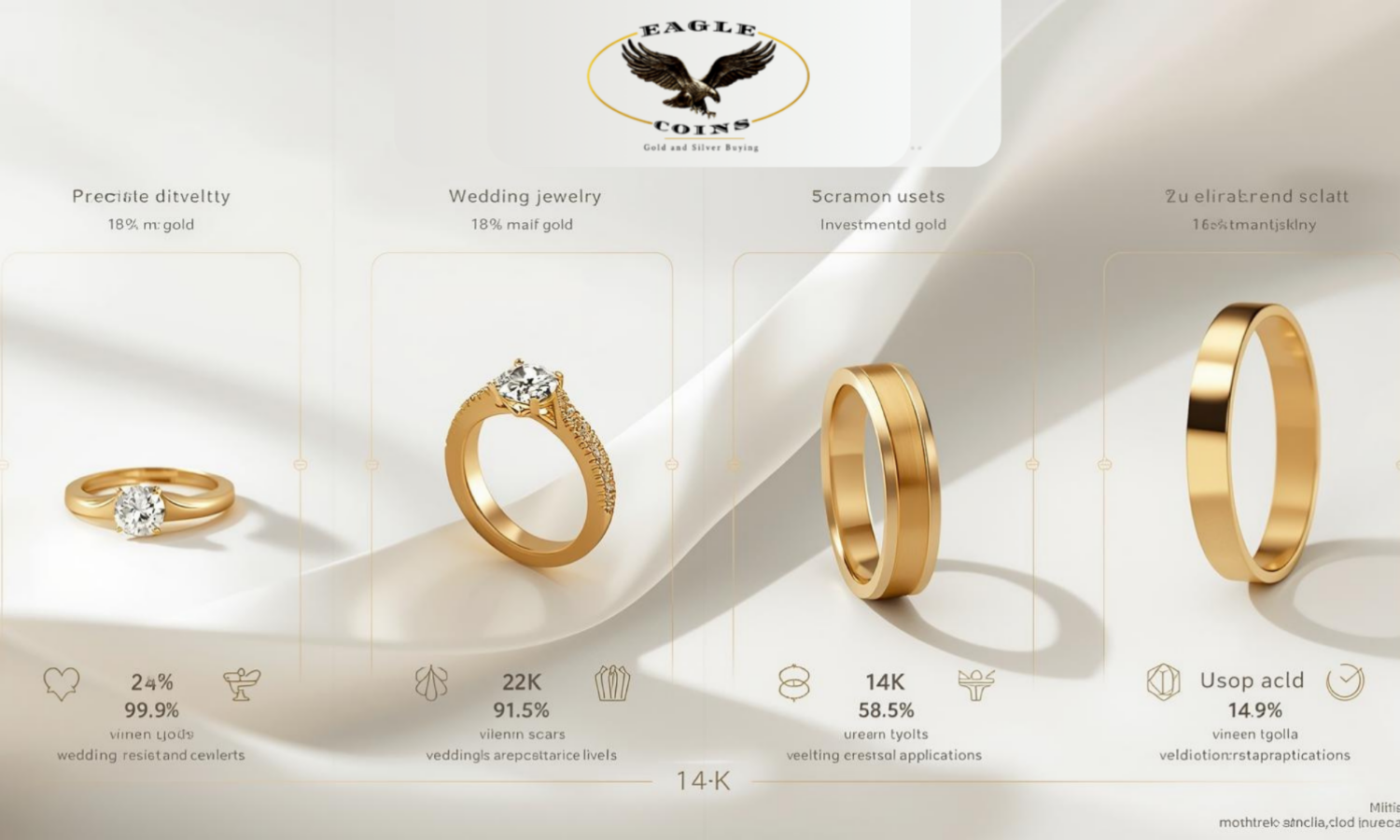
Gold Karat (K) is a unit that is used to determine the purity of gold, indicating how much pure gold is present as compared to other metals. Pure gold is defined as 24 karat, meaning that it contains 99.9% gold with almost no other metals added. 

Here is a simple breakdown: 

  • 24K gold: ~99.9% pure gold
  • 22K gold: ~91.6% pure gold
  • 18K gold: ~75% pure gold
  • 14K gold: ~58.3% pure gold
  • 10K gold: ~41.7% pure gold

The remaining percentage consists of alloy metals like copper, silver, or zinc, which are added to increase the strength, color, and durability. 


Is Higher Gold Karat Always Better?

The brief reply is: it is up to your definition of what is ‘better’. Although karat gold with high content has pure gold, it does not necessarily make it better in every situation.


Purity vs Practicality

From a purity standpoint, 24K gold is regarded as the highest quality gold karat. It has the richest yellow color with the highest amount of intrinsic gold value per gram. However, pure gold is also very soft, and thus, it can easily be scratched, bent, to lose shape through the course of time. 

Gold with a lower karat, while less pure, is more durable and can be used for daily wear. This is why jewelry such as rings, bracelets, and chains is usually made from 18K or 14K gold rather than 24K. 


The Relationship Between Gold Karat and Quality

There are various perspectives on the quality of gold:

  1. Material Value: Gold of a higher karat has more content, which means it will melt and resell at a higher price. This is especially relevant when gold is being sold on a weight basis. Buyers dealing with Eagle Coins Gold and Silver Buying usually consider karat purity carefully when assessing value. 
  2. Durability and Longevity: Lower karat gold is stronger because the alloy metals strengthen the structure. For items that are to be worn regularly, durability can be just as important as purity. 
  3. Aesthetic Appeal: Higher karat gold has a deeper and warmer yellow tone. Some people strongly prefer this traditional look, whereas others feel comfortable with a slightly lighter shade of lower karat gold. 


Understanding the Highest Quality Gold Karat

When people talk about the highest quality gold karat, they are usually referring to 24K gold. It is the purest kind of gold that can be commercially used and is commonly found in: 

  • Gold bars and bullion
  • Investment-grade coins
  • Religious or ceremonial jewelry
  • Products intended primarily for value storage rather than daily wear

Investment-wise, 24K gold is often preferred because its value is directly tied to gold market prices without dilution from other metals. 


Gold Karat and Investment Value

To investors, purity is a significant factor. Higher karat gold is easier to evaluate as its value closely tracks the spot price of gold. This makes 24K and 22K gold a popular choice for bullion or coins. 

That said, resale value is also based on market demand, condition, and authenticity. Dealing with experienced buyers such as Eagle Coins Gold and Silver Buying ensures the correct evaluation of any karat level. 


Jewelry Use: Why Lower Karat Can Be Better

Although higher karat gold is purer, it is not necessarily the best for jewelry that is supposed to be used for everyday wear.

  • 14K and 18K gold are less prone to scratching
  • Alloy metals enhance strength and wearability
  • The jewelry made of lower karat will not lose shape over time

This is why it is believed that 18K gold is a perfect choice due to the balance that it provides with purity, durability, and beauty, making it a practical choice in terms of the quality of gold.


Color Variations and Karat Levels

The karat and composition of alloys also influence the color of gold:

  • Yellow gold: Higher karat levels show deeper yellow tones
  • White gold: Mixed with palladium or nickel and often rhodium-plated
  • Rose gold: It consists of copper to give a pinkish color

Although two pieces may have the same karat, it may look and perform differently depending on the alloy mix.


How Karat Affects Pricing

The purity of gold is closely linked with prices:

  • The greater the content of karat, the greater the amount of gold in the piece, the greater the price per gram.
  • The lesser the karat, the less gold is in it, the less intrinsic value it has

However, craftsmanship, brand, and condition can also influence the final price, especially for jewelry. When selling gold, buyers usually assess based on weight and karat, rather than the retail design value. 


Choosing the Right Gold Karat for Your Needs

Rather than asking whether higher karat gold is “better,” it’s more useful to ask what you need the gold for.

  • For investment or resale: Higher karat gold often makes sense
  • For daily jewelry: Lower karat gold offers better durability
  • For long-term value storage: The highest quality gold karat provides purity and consistency

Understanding these differences helps buyers and sellers to make informed decisions.


FAQs

  1. Is it better to have higher karat gold?

Higher karat gold has greater purity and intrinsic value, but it is softer. It’s better for investment or occasional wear rather than everyday jewelry.


  1. Is it better to buy 18K or 22K gold?

18K gold is more durable and suitable for daily wear, while 22K gold offers higher purity and a richer color. The better option depends on whether you prioritize strength or purity.


  1. Should I buy 22K or 24K gold?

22K gold balances purity and durability, making it perfect for jewelry. 24K gold is the purest form and is best for investment rather than regular wear.


  1. Is it safe to wear high-carat gold daily?

High-carat gold can be worn daily, but it is more prone to scratches and bending. Careful handling is recommended to maintain its shape and finish.


  1. Does 18K gold fade over time?

18K gold does not fade, as it contains real gold. However, minor surface dulling can occur with wear and can be restored with proper cleaning or polishing.

Silver to Gold Ratio Explained: How It Has Changed from 1883 to the Present

Quick answer: The gold-silver ratio measures how many ounces of silver it takes to buy one ounce of gold, calculated by dividing gold’s price by silver’s price. It has ranged from about 15:1 in the bimetallic era to as high as 125:1 during the 2020 market crisis, and has typically traded between 60:1 and 90:1 in recent years. A higher ratio generally suggests silver is cheap relative to gold; a lower ratio suggests the opposite.

PeriodApprox. RatioWhat Was Happening
Pre-1900 (bimetallic era)~15–16:1Ratio fixed by law in many countries; roughly matched natural ore abundance
1920s–1970s25–47:1The ratio became more volatile after the world moved away from strict gold backing
1991~100:1Highest level in decades at the time, signaling silver was historically cheap versus gold
2020 (COVID crisis)~125:1All-time high; gold demand spiked while silver was hit by industrial slowdown fears
Recent years60–90:1Typical modern range; investors watch moves toward either edge as a rotation signal

The relationship between gold and silver has been a topic that has enthralled investors, historians, and economists for centuries. A method that has been used widely to understand this relationship is through the silver to gold ratio, a metric that shows the number of ounces of silver needed to buy one ounce of gold. Through the analysis of silver to gold ratio 1883 to present, we can gain valuable insight into market patterns, economic shifts, and the sentiments of investors across generations. 

This guide explains the historical ratio between gold and silver, why it matters, how it has changed since the late 19th century, and how modern investors can use it for interpretation. 


What Is the Silver to Gold Ratio?

The silver to gold ratio is the rate that is used to compare the price of silver to the price of gold. For example, if the price of gold is $2000 per ounce and the price of silver is $25 per ounce, the ratio is 80:1. This means that it takes 80 ounces of silver to match the value of one ounce of gold. 

In the past, the ratio has fluctuated depending on the economic circumstances, industrial demand, monetary policies, and global events. The ratio is a tool that most precious enthusiasts use to determine the relative value between gold and silver. 


Why the Silver to Gold Ratio Matters

A historical ratio between gold and silver may be used to help investors and collectors to make a wise choice. When the ratio is high, it means that silver can be underestimated in relation to gold, and when it is low, it means that silver can be considered quite expensive. 

Other economic factors, which include inflation, currency stability, industrial growth, and market uncertainty, are also reflected in the ratio. The change of the ratio could reflect the changes in the economic priorities since gold traditionally is regarded as the store of value, and silver has its monetary equivalent and industrial use. 


The Silver to Gold Ratio in the Late 1800s (1883–1900)

Moving to the analysis of silver to gold ratio 1883 to present, the late 19th century provides a great starting point. During the process, bimetallic systems or the gold standard were used in most of the countries. This was more consistently stable, and the common ratio was 15:1 and 20:1. 

The government policies played a significant role in maintaining these levels. Both silver and gold were monetary metals, and their relative worth was affected by the law, minting practices, and fixed exchange rates.


Early 20th Century Shifts

The silver to gold ratio began to fluctuate more prominently when the world approached the first half of the 20th Century. The rise in industrialization led to an increase in the demand for silver, and gold remained the main monetary reserve. 

The ratio rose and fell during World War I, the economic boom, and the fluctuation of monetary systems. These changes caused the precious metals to be more influenced by the Great Depression during the 1930s, where the gold prices became more controlled, and the price of silver became more volatile. 


Mid-20th Century: Monetary Changes and Market Influence

The middle of the 20th century marked a turning point in the historical ratio between gold and silver. The use of silver-backed currencies gradually declined in popularity among governments, and gold started occupying a larger portion in the world financial systems. 

Following World War II, the Bretton Woods system pegged gold to the U.S dollar, with the price of silver beginning to be influenced more by industry needs and not monetary policy. This contributed to increased oscillations in the ratio, which usually oscillated between 40:1 and 50:1. 


Late 20th Century Volatility

From the 1970s, the silver to gold ratio became much more volatile. The end of the gold standard in 1971 enabled gold prices to float freely, and the silver market experienced speculation and a surge in prices. 

Both metals saw increased interest during periods of economic uncertainty, but not always to the same degree. The ratio sometimes dropped drastically when the silver prices went up, and then fell sharply on the other side when markets stabilized. 


The Silver to Gold Ratio in the 21st Century

Conducting an analysis of silver to gold ratio 1883 to present, the 21st century has been characterized by extreme highs and lows. All of these have contributed to economic crises, financial market instability, and global uncertainty. 

At times, the ratio has exceeded 80:1 or even higher, representing strong demand for gold as a safe haven and relatively weaker silver prices. Industrial development and the rise in demand for silver at other times have reduced the gap. 


Factors That Influence the Ratio Today

A number of modern factors influence the historical ratio between gold and silver, such as:

  • Economic uncertainty: Gold usually works better during financial instability
  • Industrial demand: Silver is commonly used in electronics, solar panels, and medical applications.
  • Inflation concerns: Both metals are considered hedges, but gold is often prioritized.
  • Investor sentiment: Market perception can drive rapid shifts in pricing. 

These influences make the ratio a dynamic indicator rather than a fixed benchmark. 


How Investors Interpret the Silver to Gold Ratio

The ratio is used by many investors as a comparative tool rather than a prediction method. An all-time high ratio may encourage some to gather silver, while a low ratio may favor gold. 

However, the ratio must always be viewed in the context of the broader market conditions, personal investment goals, and long-term trends. Learning about silver to gold ratio 1883 to present provides historical context, but it does not guarantee future performance. 


FAQs

What is the silver-to-gold ratio right now?

The ratio changes daily along with gold and silver spot prices. In recent years, it has generally traded between 60:1 and 90:1, though it can move outside that range during periods of market stress. Check the current spot prices for gold and silver, then divide gold’s price by silver’s to get today’s exact figure.

How has the silver-to-gold ratio changed historically?

It was fixed around 15:1 to 16:1 for centuries under bimetallic monetary systems, then became far more volatile after the world moved away from the gold standard in the 20th century, reaching as low as 20:1 in 1980 and as high as 125:1 during the 2020 market crisis.

What does a high or low silver-to-gold ratio mean for investors?

A high ratio (historically above 80) has often signaled that silver is relatively cheap compared to gold, while a low ratio (below 40) has signaled the opposite. Some investors use extreme readings as a signal to consider rotating between the two metals, though past patterns don’t guarantee future performance.


How Big Is a Gram of Gold? Size, Value & Weight Explained

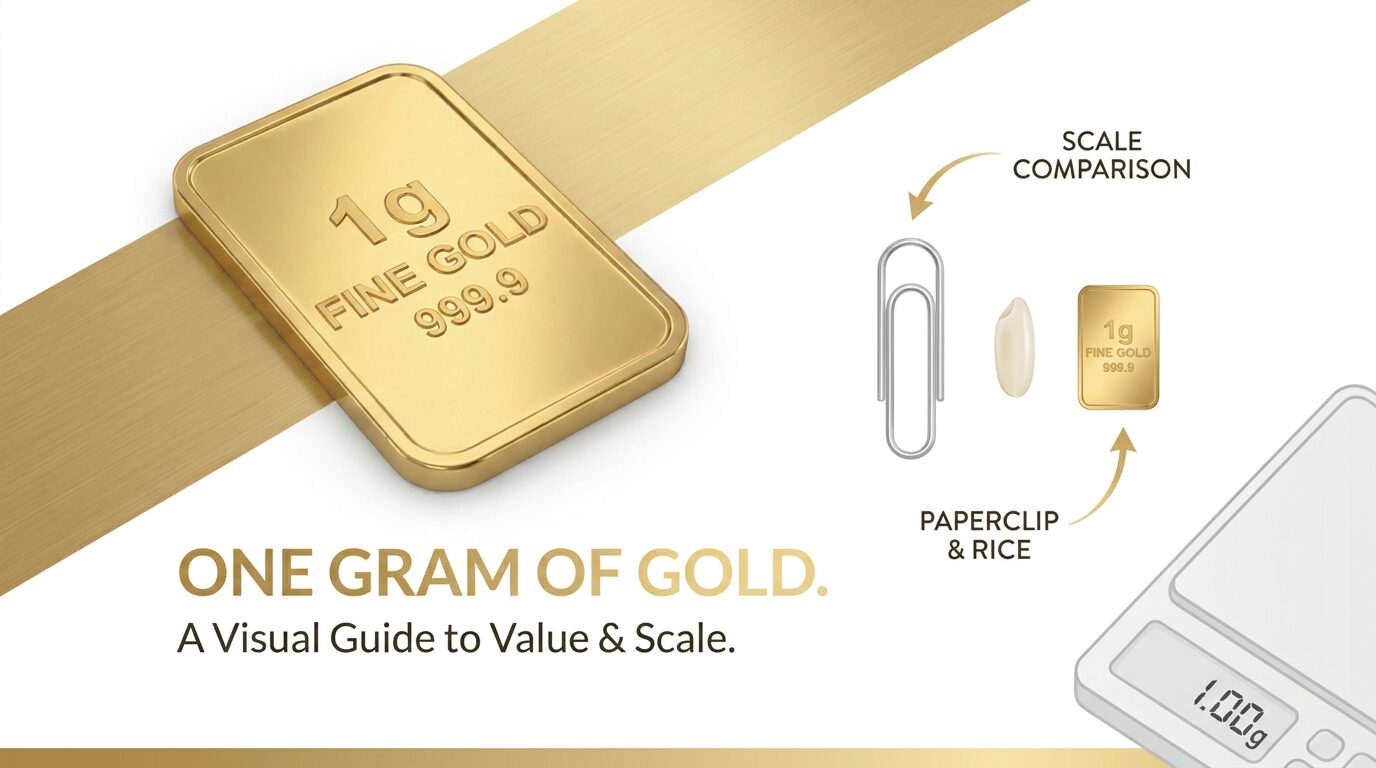
Quick answer: A gram of gold is tiny, about the size of a small paperclip or a shirt button.

As a flat bar, it’s roughly 15–20mm long, 8–10mm wide, and under 1mm thick. It looks small because gold is extremely dense (19.3 g/cm³), so its size never matches its weight or value.

Gold’s been captivating people for thousands of years. Not just because it looks stunning, but because of its tangible value. If you’re just starting out with precious metals, or you’re simply wondering about small denominations, one of the most common questions people ask is: how big is a gram of gold, really?

A single gram sounds minuscule. But once you understand its weight, size, purity, and form, the answer is more surprising than you’d think.

This guide breaks down what one gram of gold looks like across bars, coins, and jewelry, how its size compares across different forms, what it’s actually worth today, and why weight, not appearance, is what really determines its value. If you’re thinking about buying or selling gold in Harwich Port or anywhere along Cape Cod, these details matter more than you might think.

Understanding Gold Weight vs. Size

Here’s the thing most people miss: gold is sold by weight, not by how big it looks. One gram is one-thousandth of a kilogram. Simple enough. But gold is absurdly dense, around 19.3 grams per cubic centimeter. That makes it way heavier than steel, aluminum, or just about any metal you handle day to day.

So when someone hands you a gram of gold, it feels heavier than it looks. That disconnect between size and heft trips up first-time buyers all the time. 

The key takeaway: gold’s compact size is a direct result of how dense it is.

What One Gram Actually Looks Like in Your Hand

Visually, a gram of gold is small. Depending on how it’s formed, it might resemble:

  • A grain-sized bar 
  • A thin, narrow piece of jewelry
  • A small wafer, round or rectangular, that disappears in your palm

In most cases, a gram of gold can rest easily on the tip of your finger. If it’s pressed into a flat bar, you’re typically looking at something under two centimeters long and only a millimeter or so thick. Most first-time buyers do a double take. The value doesn’t match the visual heft, and that’s perfectly normal.

One-Gram Gold Bars: Dimensions and What to Expect

Bars are where most beginners start, and for good reason. A one-gram gold bar is usually rectangular and sold in protective packaging. Typical dimensions run about:

  • Length: 15 to 20 mm
  • Width: 8 to 10 mm
  • Thickness: roughly 1 mm, sometimes less

The packaging itself is often the size of a credit card, which throws people off. The actual bar? The actual gold content is always one gram, no matter of how big the packaging or branding appears.

What Does 1 Gram of Gold Look Like Compared to Everyday Objects?

Coins of one gram exist, though they’re less common than bars.These coins are typically very small in diameter, often comparable to a small button or a shirt snap.

Because coins carry designs, dates, and mint marks, the metal spreads thinner to accommodate the detail. So a one-gram coin can look broader than a one-gram bar even though the scale reads the same. Again, weight determines value. Appearance is just packaging.

Everyday ObjectTypical WeightHow It Compares to 1g of Gold
Standard paperclip~1gNearly identical weight, the closest everyday weight match
US dime2.27g (17.9mm diameter)About double the weight of 1g of gold, but a useful size reference for diameter
Small shirt button~0.5–1gClose in both size and weight to a small 1g gold coin or wafer
Grain of rice~0.02–0.03gMuch lighter by weight, useful only as a visual size reference if the gold were melted into a small droplet, not a weight match

What Is a Gram of Gold Worth Today?

This is what people really want to know when they ask about size. Gold prices shift by the hour based on global trading, so pinning down an exact dollar amount means checking the live spot price on the day you’re reading this.

As a rough guide:

  • 24K (pure) gold is worth close to the full spot price per gram
  • 18K, 14K, and 10K jewelry is worth proportionally less, since it’s mixed with other metals
  • Scrap, broken, or outdated gold jewelry is still valued by its actual gold content and purity, not by how it looks

The only reliable way to know what your gold is worth is to have it professionally weighed and tested. Live spot prices change throughout the day, so an estimate from a chart won’t be as accurate as an in-person appraisal.

Curious what your gold is actually worth? Bring in jewelry, coins, bars, or scrap gold for a free, no-obligation appraisal at Eagle Coins Gold and Silver Buying in Harwich Port. We test purity and weigh on the spot, so you know exactly what you’re being offered and why. Get your free gold appraisal →

How Purity Changes the Size of That Same Gram

Gold purity gets measured in karats or fineness. Pure gold is 24 karat, roughly 99.9% fine. Most one-gram bars and investment-grade coins sit at or near that purity.

But when gold gets mixed with other metals, which is standard for wearable jewelry, the piece needs slightly more volume to hit the same gram weight. Copper and silver simply aren’t as dense. So:

  • One gram of 24K gold: compact, dense, smaller footprint
  • One gram of 18K gold: visibly a bit larger because of the added alloys

This difference is subtle but real. Two items can weigh exactly the same on a scale and look noticeably different in size.

Why One Gram of Gold Is Popular 

There’s a reason a one-gram gold piece is a popular starting point for a few reasons:

  • Affordability: You don’t need deep pockets to get started
  • Flexibility: Small quantities are easy to liquidate when you need cash
  • Gifting: A convenient, meaningful gift without the pressure of a major investment

Understanding the actual size helps set expectations. A gram of gold won’t fill your palm. But what it lacks in bulk, it more than makes up for in concentrated value.

Frequently Asked Questions

How does 1 gram of gold look?

Smaller than most people imagine. It’s typically a thin bar or tiny coin, often no bigger than a fingertip. Gold’s density makes it feel heavier than it appears, which surprises first-time buyers.

How big is 1 gram of gold physically?

In most cases, it is only a few millimeters thick and maybe around 1 to 2 centimeters long, depending on the exact shape. It can easily rest on the tip of a finger.

What is a gram of gold worth today?

The value changes daily based on the live market price and the gold’s purity. For the most accurate number, you really want a professional weighing and testing, like the free appraisals we do in Harwich Port.

What’s the best size of gold to buy?

Depends on your goal. Smaller pieces, including 1 gram, are ideal for beginners and gifting, while larger bars offer better value for long-term investing.

How do you accurately measure 1 gram of gold?

One gram of gold is measured with a precise digital scale made for jewelry or precious metals. Reputable dealers usually double check the weight too, especially when buying or selling, so there’s less guessing.

How pure is a typical 1-gram gold piece?

Most 1-gram gold bars and coins are 24K gold, meaning they’re about 99.9% pure. Always check the purity marking or certification to confirm.

How can I visually estimate a gram of gold without a scale?

Compare it to a standard paperclip (~1 g) or a small shirt button — both are close in weight and roughly the right visual size. A US dime is a useful size reference, too, though it weighs about twice as much. None of these replace an actual scale — they’re just a sanity check before you get something professionally weighed.

Top 10 Countries with the Largest Gold Reserves

Gold has been one of the most trusted stores of value in the world for thousands of years. Its rarity, durability, and universal appeal make it an essential asset for individuals, investors, as well as national governments. While private buyers purchase gold to maintain wealth, countries build strategic reserves to enhance economic stability, support currency value, and protect against uncertainty in the global markets.

Understanding the gold reserves by country gives informative insight into global financial strategies and the way this precious metal is used to create economic resilience. At Eagle Coins Gold & Silver Buying, a company that is known for helping individuals make informed decisions, many collectors often inquire about gold holdings and how gold supports economic health in the long term.


Why Gold Reserves Matter?

It is better to understand the importance of gold reserves before diving into the rankings:

  • Economic Stability: Gold offers a financial buffer when there is inflation, recessions, or currency fluctuations.
  • International Trust: A country’s credibility gets boosted in the international markets once it has large gold reserves.
  • Crisis Protection: When there is uncertainty in the global market, gold is likely to retain or increase its value.
  • Currency Strengthening: Central banks also sometimes buy or hold gold to keep the national currencies strong.

These are the reasons why gold is a critical asset for countries as a symbol of financial security in the long term.

Top 10 Countries with the Largest Gold Reserves

United States

The United States has the largest gold reserves in the world, significantly surpassing any other nation. Its strategic central stockpile is known to be a strong pillar behind the financial system of the country. The U.S. continues to dominate discussions around gold reserves by country, which is due to the fact that its reserves contribute to the global market confidence.

Germany

Germany has built one of the most respected gold reserve policies in the world. Its holdings act as a safeguard for the economy of the nation, and are stored in multiple secure vaults. Germany’s commitment to maintain strong reserves continues to reflect its focus on long-term financial security.

Italy

Italy holds one of the largest gold reserves in Europe, which provides economic reassurance even during periods of political and financial instability. Italy continues to retain gold as a stabilizing asset, despite changes in European markets.

France

France has consistently maintained huge gold holdings over several decades. The strategic value of gold in supporting national financial security makes France a major contributor to the global rankings of gold reserves by country.

Russia

Russia has substantially increased its gold reserves in the past few years, especially to diversify away from foreign currencies. Gold has become a central component of the economic defence strategy of the country and long-term planning.

China

China continues to grow its gold reserves to support economic stability in the long term and increase its financial power globally. Being one of the largest gold producers, its domestic production further enhances its national storage.

Switzerland

Switzerland has an impressive gold reserve, despite its small size, because over the years it has been a significant financial centre in the world. The country values gold as a foundation for economic security.

Japan

Japan uses gold as a protective asset to complement its foreign currency reserves. Gold provides Japan with financial stability and long-term protection in a region that has been heavily impacted by shifting market conditions.

India

The amount of gold reserves in India has grown steadily with the help of national economic policies, as well as the Indian cultural significance of gold in households. It remains a major holder in the international rankings of gold reserves by country.

Netherlands

The Netherlands also holds good gold reserves, as this is one of the measures to protect against economic instability. Regular evaluations ensure that the hold remains one of the core components of national financial planning.

How Gold Reserves Shape Global Economies?

The gold deposits do not merely affect the national wealth; they determine the economic behaviour on a global scale. Here are some of the major ways in which gold affects the global financial environment:

  1. Strengthening Currencies: A country with a huge amount of gold reserves can maintain and stabilise its currency when there are fluctuations in the world economy.
  2. Enhancing Investor Confidence: When there is a high amount of gold reserves in the country, investors view countries as secure and dependable, especially during uncertainty in the market.
  3. Influencing Global Gold Prices: When major nations buy or sell gold, these decisions usually impact the international gold prices.
  4. Supporting Crisis Preparedness: Gold reserves serve as a reliable financial shield during times of geopolitical tension or inflation.

These are some of the trends that many individuals also see gold as a safe long-term investment, something that Eagle Coins Gold & Silver Buying helps their customers understand clearly.

Why Gold Remains a Trusted Global Asset?

The unique qualities of gold continue to make it an irreplaceable element of national and personal wealth holdings:

  • It never corrodes
  • It is universally accepted as valuable
  • It is a form of hedge against inflation
  • It offers long-term stability as compared to volatile markets

Because of these qualities, gold is still a favourite among government and individual collectors. Companies like Eagle Coins Gold & Silver Buying are dedicated to helping individuals determine the benefits of possessing gold while understanding its role in the broader global economy.

FAQs

What are the top 5 countries that produce gold?

The top 5 countries that produce gold are China, Australia, Russia, the United States, and Canada. These nations have rich mineral deposits and advanced mining operations.

Where is gold found on Earth?

Gold is found in underground rock formations, riverbeds, and alluvial deposits. The major gold sources on Earth include mines, mountain ranges, and regions with volcanic or tectonic activity.

Which country has the 2nd largest gold reserve?

Germany has the 2nd largest gold reserve. Its central bank stores these reserves as a key component of the national financial security.

Which country has pure gold?

Pure gold is something that no country exclusively has, but nations like China, Australia, and Russia mine high-quality gold ore. The purity of gold is determined during refining, not by the country.

Who buys the most gold?

India and China are the largest consumers of gold, driven by cultural traditions, jewelry demand, and investment. Their markets provide for a major share of global gold purchases.

Which gold is 100% pure?

24K gold is considered 100% pure. It has no alloy metals, which makes it the softest and most malleable form of gold.

Can I wear 24K gold every day?

While you can wear 24K gold, it is very soft and can get scratches or bend easily. Most people prefer more durable karats like 18K or 22K for daily wear.

What karat gold is best?

For daily jewelry, 18K or 22K gold is considered ideal as it offers a balance of purity and durability. For investment, 24K gold is preferred because of its higher purity.

25 Fascinating Facts About Gold You Never Knew

Gold has captivated all of us for generations, admired for its beauty, worshipped for its rarity, and treasured as a symbol of wealth, authority, and strength. Gold has maintained a special position in history, culture, and economy, whether in jewellery, coins, or reserves.

Here are 25 interesting facts about gold that highlight why this precious metal will always be timeless and valuable.

  1. Gold’s Chemical Nature

Gold is a chemical element, the symbol of which is Au, and the atomic number of which is 79. It weighs approximately 196.97 grams and is one of the densest naturally occurring metals, giving it excellent heft for its size.

  1. Gold Is Extremely Malleable and Ductile

Gold may be beaten into extremely thin sheets or drawn into fine wires. Actually, a single ounce of gold can be beaten into a sheet covering about 9 square metres, or be beaten into a lengthy piece of wire that spans several kilometres.

  1. Melting and Boiling Points

Gold melts at a temperature of 1,064 °C (1,947 °F) and boils at around 2,850 – 2,996 °C (5,171 – 5,371 °C), making it highly stable under conditions that would have melted lesser metals.

  1. Nearly All Mined Gold Still Exists

Although humanity has mined thousands of tonnes of gold over centuries, almost all of it still exists today, due to the fact that gold doesn’t corrode, tarnish, or degrade.

  1. How Much Gold Has Been Mined?

It has been estimated that approximately 216,000 metric tonnes of gold have been mined in the last few years, as far back as 2025.

  1. All That Gold Fits in a Small Cube

If you melted down every bit of gold in the world, it would form a cube roughly 22 metres on each side, which is surprisingly compact, considering gold’s global economic and symbolic impact.

  1. Jewellery Is the Main Use

Jewellery is the largest source of demand for gold in the modern world, consuming almost 45-50% of all gold mined today.

  1. Central Banks and Reserves

Government and central banks hold a large portion of gold in reserve, highlighting gold as a stable and reliable store of value.

  1. Rare Purity: Pure Gold Is Too Soft Alone

Pure gold (24-karat) is of a very soft composition and prone to scratches or damage. This is why it is usually combined with other metals for durability, which commonly results in 18-karat (75% gold) or 14-karat (58.3%) items.

  1. Gold Resists Tarnish and Corrosion

Unlike many metals, gold does not react with oxygen and most chemicals, which means it does not rust or tarnish, which makes the gold objects almost timeless.

  1. Uses Beyond Jewellery: Industry & Technology

The high conductivity and corrosion resistance of gold contribute to its significant role in electronics, both in connectors and in circuit boards, and even in aerospace, medical, and high-precision equipment.

  1. Historical Importance: Gold as Currency

Gold has been the foundation of most monetary systems for centuries. Gold coins are minted by governments and empires, and the majority of national economies were based on the ‘gold standard’ before the development of modern fiat currency.

  1. Gold in the Earth: Scarcity and Distribution

Gold is naturally rare in the Earth’s crust; many of the richest deposits are found in viened rock formation or alluvial deposits, which makes significant discoveries uncommon.

  1. The Metal of Kings, Queens & Civilisation

Since the beginning of history, golf has been a symbol of power and prestige, from the tombs of pharaohs to royal crowns, enduring across cultures and eras. Its legacy as a symbol of wealth remains timeless.

  1. Gold in Science & Medicine

Besides beauty and wealth, gold compounds are used in medicine (in ancient times to treat conditions like arthritis), and modern technology explores the potential of gold in medicine and electronics because of its unique properties.

  1. Gold’s Unmatched Stability

Gold is a noble metal, which is non-reactive and maintains its shine and lustre even after centuries, and is therefore reliable for jewellery, coins, and long-term investment.

  1. Gold Connects Past, Present & Future

Gold has been used in ancient times, in modern electronics, and may someday play a role in advanced technologies, bridging the gap between human history through a single element.

  1. Economically and Emotionally Valuable

Gold is not only a materialistic item, but has an emotional significance as well, passed through generations, used in ceremonies, and often treated as a symbol of love, security, and tradition.

  1. The Symbol Au Comes from Latin

The chemical symbol for gold, ‘Au’, is derived from the Latin word ‘aurum’, which means shining dawn.

  1. Gold’s Density Is Remarkable

Gold is approximately 19.3 times heavier than water and much denser than most common materials, which contributes to its weight feel and substantial value per gram.

  1. Virtually Indestructible Yet Malleable

The unique combination of softness and resistance makes it easy to shape and immune to rust and decay, which is a rare balance among metals.

  1. Limited Global Supply Means Enduring Value

Gold, being finite and much of the easily accessible ore being mined out, its scarcity contributes to its ever-increasing value and demand.

  1. Gold Retains Value Over Time

Even centuries-old gold coins and jewellery can lose value over time, in contrast to many other materials that become worn out or lose their value.

  1. A Global Symbol of Wealth & Security

Whether in the form of jewellery, bullion, or reserve, the universal importance of gold is solidified in its presence across cultures and economies.

  1. Understanding Gold Helps You Invest Wisely

Whether it’s the coins you collect, jewellery you purchase, or the bullion that you hold, having factual knowledge about gold, its rarity, properties, and historical value, helps you make well-informed decisions. Reputation and expertise matter, and trusted dealers like Eagle Coins Gold & Silver Buying help clients in purchases with transparency and trust.

At Eagle Coins Gold & Silver Buying, we believe in educating our clients, not just offering transactions. Buyers should appreciate gold not as a commodity, but as a piece of history, science, and global culture. Knowing these facts about gold will help you recognize the real value and make smart decisions.


FAQs

  1. How special is gold?

Gold is special as it is rare, durable, and does not tarnish, which makes it valuable for jewellery, investment, and technology.

  1. What are three unique qualities of gold?

Gold is very malleable, resistant to corrosion, and also an excellent conductor of electricity.

  1. What are the special powers of gold?

Gold is believed to symbolize wealth, healing, and positive energy, and scientifically, it offers stability and conductivity.

  1. Is gold used in medicine?

Yes, gold can be used in certain medical treatments, diagnostics, and technologies because of its biocompatibility.

  1. What disease was treated with gold?

Gold compounds have historically been used to treat rheumatoid arthritis.

  1. Can gold help with arthritis?

In some cases, gold-based medications have been used to reduce inflammation in rheumatoid arthritis patients.

  1. What is gold used to cure?

Gold doesn’t “cure” disease on its own, but it is used in treatments to manage conditions like rheumatoid arthritis.

  1. Does gold have any medical benefits?

Yes, gold can support medical treatments through its anti-inflammatory properties and its use in diagnostics and medical devices.

How Gold Production Varies by Country?

Quick answer: China has been the world’s largest gold-producing country for over a decade, followed closely by Russia and Australia. Together, a handful of countries, including China, Russia, Australia, Canada, the United States, and South Africa, account for the majority of global gold mining output each year.

Top Gold Producers at a Glance

CountryTypical Share of Global OutputNotes
ChinaHighest single producerWorld’s largest gold-mining nation for over a decade
RussiaAmong the top 3As a major producer, output has grown steadily in recent years
AustraliaAmong the top 3Long-established mining industry, consistently high output
Canada, United States, Ghana, Mexico, Indonesia, South AfricaMid-tier producersEach contributes a meaningful but smaller share of the annual global supply

Gold is a far valuable metal than most think. Apart from the jewelry demand, it is mined globally, as it fuels investments, reserves, and industrial uses. However, there is an uneven distribution of gold mines and mining resources among countries, which means that different countries produce different amounts of gold. While some countries, such as China and Russia, produce the highest amount of gold in the world, countries such as Sweden and New Zealand produce the lowest amount of gold.

Examining this gold production by country is important because it helps one understand the dynamics of supply, mining geography, and the global trends in gold pricing. Read on as we uncover everything in detail.

The Big Picture of Global Gold Mine Production

According to the latest data from the World Gold Council as of 2024, the total amount of gold mined all around the world accounted for about 3661 tonnes. However, this is only a part of the gold manufactured, as it only includes the newly mined gold or the primary gold. The recycled or secondary supply has been completely ignored, which, if added, would give us a much greater number.

These global numbers are important as they tell us about the total availability of gold and help in determining the global pricing of gold, which ultimately influences the local price of gold.

Top Gold Production by Countries in 2024-25

China has been the largest producer of gold all over the world for the past years, producing around 380 tonnes of gold in the year 2024, which is around 10-11% of the total gold produced. China is followed by Russia (≈ 330 tonnes), Australia (≈ 284–290 tonnes), Canada (≈ 200 tonnes), and the United States (roughly 158–190 tonnes).

Roughly, only a handful of countries contribute to the total global gold production. Out of which the above-mentioned countries hold a significant share of the total numbers. This means that they have a major say in determining the price of gold globally.

The Key Determinants of Variation in Production

Gold production by country varies, and this is attributed to a number of factors. Let’s discuss each one by one to get a better understanding:

  • Natural Deposits: While most countries have gold deposits, some countries have a richer gold-bearing geology or easily accessible gold ores. This makes it easier for them to mine larger amounts of gold. The areas include large reserves in Russia’s Siberia, Australia’s Western mining belts, and China’s major mining provinces.
  • Mining Infrastructure & Technology: Technologically advanced and developed countries have access to better resources and systems for mining. This means that countries having advanced mining operations, investment in extraction & refining, and modern mining techniques will have a higher output of gold. This is commonly seen in countries like Australia, Russia, and Canada.
  • Regulatory, Environmental & Geopolitical Factors: Restrictive environmental regulations, government policies, and higher taxation prove to be hindrances for mining. While certain countries have restrictive policies, others may incentivise it. Ultimately, the impact falls on a given country’s ability to scale its production in the subsequent years.
  • Economic Demand: How a country prioritises mining depends on its domestic consumption. If a country has a higher domestic demand, that would mean that the gold they produce would appear as a part of the total global production, but it would still mean lower exports from their end.

Regional Shifts in Gold Production By Country

In the last decade, the production dynamics have changed, and that has also had an effect on the global availability of gold and its pricing. This includes:

  1. Earlier production was led by African countries, but now the dominance has shifted towards Asia, especially China, with major contributions from North America, Australia, and Russia.
  2. Some countries have seen an increase in their output in the last decade, such as Russia, which has seen a significant increase in its output, and Canada, which has doubled its output since 2010.
  3. While Africa, Asia, and America are still contributing to the global gold production, the individual production of each country varies over time due to the factors of exploration success and depletion.

Implications for Global Supply, Prices, Buyers & Sellers

Now that we have gotten a basic understanding of gold production by country, let us understand the implications that major producers can have on the gold market. Now, since the gold manufacturing is dominated by only a few countries, this means that if any geopolitical or regulatory changes take place in these major countries, that would directly affect the global gold supply and price volatility.

From the perspective of buyers and sellers of gold, having an insight into the major countries that supply gold can give them insight into the supply-side risks and long-term pricing trends. Similarly, for recyclers, refiners, and gold buyers (for business), getting to understand the global production distribution would help them anticipate availability, adjust the valuation, and create sourcing strategies.

Final Thoughts

Where most countries in the world are manufacturing and mining gold, the actual volume of gold produced by each country varies according to the geological availability, resources, regulations within the country, and their domestic consumption. All of this amounts to only a handful of countries dominating the total global supply of gold.

Now, the analysis of the share of gold production by country is necessary, as it plays an important role for buyers and sellers to understand the supply dynamics, investment outlook, and global jewellery/ bullion markets. If you are a buyer or a seller of gold, it becomes crucial for you to study this global data that will give you a picture of the availability and pricing of gold. A proper knowledge of this helps one to buy and sell gold responsibly for maximum profit.

Frequently Asked Questions

Which country is the most productive in terms of gold production?

China is the largest producer of gold in the world. In the year 2024, it produced around 380.2 tonnes of gold.

Which country produces the highest quality gold in the world?

Switzerland, Australia, and Canada are known to be the producers of the highest quality and the purest gold in the world.

What is the 20-year return on gold?

By 2024, gold has shown an average growth rate of 9.47% per annum for 20 years. This means that if you had invested $10,000 at the start of this period, you would receive $65,967 by the end of the period, which amounts to an increase of 560% in total.

What is the danger of investing in gold?

Gold has the same risk as other investments; you could lose money. Like all other investments, this can also materialize in different ways.

What happens to gold prices when the market crashes?

The gold prices remain stable even when the market crashes, as the market and gold prices are negatively correlated. This happens because stocks benefit from economic growth and stability, while gold benefits from economic distress and crisis. So, when one goes up, the other goes down.

Who increases the price of gold?

The price of gold is influenced by the market forces of demand and supply. When demand is higher than the supply, prices go up, and when demand is lower than the supply, prices go down. These forces are dependent upon geopolitical events.

In which country is gold the cheapest?

Gold is cheap in the following countries: Switzerland, Hong Kong, Turkey, Indonesia, Colombia, Malawi, and Dubai. These countries have lower taxes, import duties, and a local supply advantage that contributes to lower prices.

How much gold can a US citizen legally own?

There is no limit on the amount of gold a US citizen can legally own. You can buy and own as much gold as you want.

Which countries produce the most gold?

China has led global gold production for more than a decade, with Russia and Australia consistently rounding out the top three. Canada, the United States, Ghana, Mexico, Indonesia, and South Africa are also significant producers.

How does gold production vary by country?

It depends on geology, mining infrastructure, and investment. Countries with large, well-developed mining industries and significant gold deposits, such as China, Russia, and Australia, consistently produce the most, while many other countries contribute smaller but meaningful shares.

24K Gold vs. Other Karat Gold: Differences in Purity, Durability, and Uses

Quick answer: 24k gold is 99.9% pure with no alloy metals, while lower-karat gold mixes in copper, silver, or other metals for added strength. The tradeoff: 24k gold is the softest and most valuable by weight, while 18k and 14k gold are far more durable for everyday jewelry. Lower karat isn’t worse — it’s built for a different job.

24K vs. 22K vs. 18K Gold: Purity and Durability Compared

KaratPurity %DurabilityCommon UsesTypical Resale Value
24K99.9%+Soft, scratches and bends easilyInvestment bars, coins, bullionHighest value per gram; tracks spot price closely
22K~91.6%Soft to moderateOccasional-wear jewelry, coins, some investment piecesHigh value; slightly below 24K per gram
18K75%DurableFine jewelry, engagement rings, daily wearSolid resale; below 22K/24K but above 14K
14K58.3%Very durableEveryday jewelry, rings, chainsModerate resale; most common in US retail jewelry
10K41.7%Most durableBudget jewelry, rings for heavy daily wearLowest resale of common karats; US legal minimum


Your gold jewelry isn’t merely an ornament crafted to be worn. Going above being an adornment, it is a timeless symbol of value, heritage, and security. More than that, the true value of gold jewelry is not in its glittering appearance, but in the amount of pure gold that it holds. So, it becomes more of an investment.

However, have you ever wondered what is hidden beneath? Is 24 karat gold pure gold? How come we have varying shades of gold when raw gold in itself is yellow? Gold’s karatage and color reveal a lot about it, more than the enduring allure and its intrinsic qualities, to its cultural and economic significance. Each color and every karat come with a particular specification that lies behind the value of your gold, and that is what we will be talking about in this blog. So if you are thinking of selling your gold, do read this blog before you sell.

Understanding Gold Purity: Karat and Fineness

The purity of gold is expressed in karats, which is a 24-part scale. This scale measures the parts of gold in a total of 24 parts. In a more precise scale called fineness, the amount of gold is measured in parts per thousand.

Now, if the karat system measures gold in 24 parts, is 24 karat gold pure gold? Yes, it is. 24 karat suggests that all 24 parts consist of gold, meaning it is pure. In the scale of fineness, this corresponds to 999 parts being gold, meaning it is nearly pure. Subsequently, as the karats decrease, so does the purity of the gold. Say, for example, 22k gold, which contains around 91.6% pure gold and 8.4% of other metals, or 22 parts of gold and 2 parts of other metals.

Karat (K)Gold Percentage (%)Gold (Parts per 24)Typical Alloy MetalsCommon Colours Available
24K Gold99.9% – 100%24/24Very minimal traces of other elementsYellow only
22K Gold~91.6%22/24Silver, Copper, ZincYellow
21K Gold~87.5%21/24Copper, Silver, ZincYellow
18K Gold75%18/24Copper, Silver, Zinc, Nickel, PalladiumYellow, White, Rose
14K Gold58.3%14/24Copper, Silver, Nickel, Zinc, PalladiumYellow, White, Rose
10K Gold41.7%10/24Copper, Silver, Nickel, ZincYellow, White, Rose
9K Gold37.5%9/24Copper, Silver, Zinc, NickelYellow, White, Rose

This ratio varies according to the gold karatage and color. The percentage of other metals also changes as the karat increases or decreases, or the color changes.

How is the Color of Gold Important

The color of gold is achieved by the percentage of other metals added. For example, yellow gold contains silver, copper, and zinc (in the case of 22k gold). However, the amount of silver is more than that of copper and zinc to give it its natural yellow hue. On the other hand, rose gold gets its pink color from a higher percentage of copper. Finally, white gold is crafted by alloying pure gold with palladium and silver and is plated with rhodium. As the percentage of other metals changes, so does the appearance of gold.

The following table will help you understand the concept of color and purity metal percentage better:

Gold ColourGold Base (Example: 18K)Alloy Metal Mix (Approx.)Characteristics
Yellow Gold75% gold12.5% Copper + 12.5% SilverClosest appearance to natural gold tone
White Gold75% gold25% Palladium / Nickel / SilverOften rhodium-plated for bright white finish
Rose Gold75% gold22.25% Copper + 2.75% SilverWarm pink tone due to high copper content
Green Gold75% gold25% SilverSubtle greenish tint used in specialty jewellery

Is 24 Karat Gold Pure Gold? Reality Behind the Term

According to the karat system, 24k gold is pure gold. When divided into 24 parts, it contains all 24 parts of gold and so is considered the highest standard of gold. However, in terms of fineness, it contains 999 parts of gold only. So to say, it is almost pure but not 100% pure, which is practically impossible, as even after the mining and processing of gold, some traces of other metals might be left. Which means you can only have 999 parts or as many as 999.9 parts of gold, not a complete 1000.

Considering this, 24k gold is considered pure gold for making bars, coins, and bullion. However, in reality, 24k gold will always have a minute and negligible fraction of other metals and impurities, which are ignored in practice and do not have much effect.

Why Purity Matters — For Investment, Resale, and Jewellery Value

As regards the investment and resale value, 24k is highly acceptable and valuable. This owes to the fact that 24k gold has the highest amount of gold, as per the accepted scale and standard. As the karat number reduces, so does its value, because the value would be calculated on the total percentage of pure gold. So, if you are buying gold for investment or resale purposes, it is better to purchase gold of higher karatage, preferably 24k.

However, if you are purchasing gold for jewelry, 24k wouldn’t be preferable. If it is for daily wear, then even 22k gold jewelry should not be bought. Gold in its purest form is very soft and can easily bend or scratch. In fact, 24k gold is not used for jewelry making. It’s ideal to go for 18k or 14k for jewelry, and choose 22k gold only for occasional wear and investment purposes.

However, be cautious while you are purchasing lower karats of gold, as gold up to a minimum karat is accepted in certain places. In the US, 10k is the minimum legal acceptable gold standard; in France, the UK, Austria, Portugal, and Ireland, it is 9k, and in Denmark and Greece, it is 8k. So, if you go to sell gold of lower karatage in these countries, you wouldn’t be able to sell it.

Which Rolex Models Hold Value Best on Resale?

Steel sports models, the Submariner, GMT-Master II, and Daytona, are well known for holding or exceeding retail value, driven by limited allocation and high demand. Among the more accessible entry-level models covered above, the Datejust and Oyster Perpetual also hold value reasonably well over time, since they’re not tied to the trend-driven price swings that affect rarer sports models.

Which gold karat is best for jewelry vs. investment?

GoalBest KaratWhy
Everyday jewelry (rings, bracelets)14K or 18KAlloy metals add durability for daily wear
Fine or special-occasion jewelry18KBalances purity, color options, and strength
Investment (coins, bars)24K (or 22K for coins like Krugerrand)Value tracks gold spot price directly, with no alloy dilution
Wedding bands (decades of daily wear)14KMost resistant to scratching and bending over time


How This Affects Buyers & Sellers: Final Thoughts

Is 24 karat pure gold? Yes, it is by the accepted standards; however, the value it has depends on its intended use. As a seller, 24k gold has immense value for you; you can earn the maximum possible amount by selling it, based on the given day’s market value for gold and the total quantity of gold you have. However, as a buyer, unless you are not buying it for investment purposes, 24k gold doesn’t hold much value for you. If your intended use is for making jewelry, then it won’t be of much use. It is better to go for 22k, 20k, 18k, or 14k. The lower value of karatage holds the charm of gold and durability, regardless of its color.


If you have 24k gold bullions, old jewelry, coins, or any kind of damaged and broken gold, we will offer you the highest prices for them, based on fair evaluation and market prices. Visit our store and get a free evaluation.

Frequently Asked Questions

Which is best, 24k gold or 22k gold?

For investment purposes, 24k gold is the best; however, for jewelry, 22k is an optimal option. As 24k gold is very soft, it cannot be made into jewelry, but owing to its high gold content, it is suitable for investment.

What is the disadvantage of 24k gold?

24k gold is very soft and gets easily dented or scratched, which makes it poor for making jewelry.

What is malleability in terms of gold?

The characteristic of gold that allows it to be drawn into wires is called malleability.

Is 24k gold equal to 916?

24k gold is the purest form of gold available; it amounts to 999 gold. 916 gold is 22k gold, which has 91.6% pure gold, and the rest is composed of other metals.

How to quickly check if your gold is real or fake at home?

Do a float test or a magnet test. Due to its high density, gold will sink to the bottom of the water. Similarly, gold will also not stick to a magnet.

How can I test gold with vinegar?

Real gold does not change color in contact with vinegar. If you put a few drops of vinegar on your gold and it changes color, this means it is fake.

Will gold be valuable in the next hundred years?

Chances are that it will. This owes to the fact that there is a limited supply of gold. One of the things that affects the price of any commodity is the general rule of demand and supply. Since the supply of gold is less than its demand, gold will still be valuable in the next 100 years.

What reacts badly with gold?

Chlorine can react badly with gold. It breaks the alloy, making your jewelry brittle and breakable.

Can You Sell Gold Anonymously? Legal Ways to Protect Your Privacy When Selling

Quick answer: Not completely, and not legally. Massachusetts law requires a valid government-issued photo ID for precious metal transactions, and federal law requires dealers to report cash transactions over $10,000. What you can get is privacy from the public transaction records, which aren’t publicly accessible, so friends, family, or neighbors won’t know the details unless you tell them.

The guy walked into our shop wearing sunglasses on a cloudy day, paid cash for parking from a roll of bills, and asked if we had cameras. When I said yes, he turned around and left.

That was fifteen years ago, but I still wonder what his story was. Going through a divorce? Hiding assets from creditors? Or just really, really committed to privacy?

The question “can you sell gold anonymously” comes up more than you’d think. And unlike that nervous guy in sunglasses, most people asking have perfectly legitimate reasons for wanting privacy.

The Short Answer That Nobody Wants to Hear

Can you sell gold with complete anonymity? No. Not legally, anyway.

Can you sell gold with reasonable privacy? Absolutely.

The difference between those two statements? That’s where this gets interesting.

Why Complete Anonymity Died in 1984?

Not the Orwell book – the actual year 1984, when Congress passed the Cash Reporting Act. Before then, you could walk into a dealer with a suitcase of gold, walk out with cash, and nobody tracked anything.

Those days are gone. Between the PATRIOT Act, anti-money laundering laws, and state regulations, every legitimate dealer must verify identity for most transactions.

Here’s what killed anonymous gold sales:

  • Money laundering concerns
  • Terrorism financing prevention
  • Tax evasion crackdowns
  • Stolen property tracking
  • Consumer protection laws

The Financial Crimes Enforcement Network (FinCEN) requires dealers to maintain records that include seller identification. No ID, no sale. It’s that simple.

The Privacy You Can Still Protect

While you can’t sell gold like a mysterious stranger in a spy novel, you can minimize your information exposure.

What Dealers Actually Need to Know?

Federal law requires:

  • Your legal name
  • Valid government-issued ID
  • Current address
  • Social Security number (for certain transactions)

What they DON’T need:

  • Your employment information
  • Your reason for selling
  • Your financial situation
  • Your other assets
  • Your mother’s maiden name

I’ve seen dealers ask for everything short of blood type. If they’re asking for more than basic ID verification, they’re overreaching.

Information That Stays Private

When wondering “can you sell gold anonymously,” understand what remains confidential:

  • The sale isn’t publicly recorded
  • No newspaper announcements
  • No online databases showing you sold gold
  • Competitors can’t access your transaction history
  • Your neighbors won’t know

Unless law enforcement has a warrant or the IRS audits you, that transaction stays between you and the dealer.

The Reporting Thresholds That Matter

Different transactions trigger different requirements:

Under $1,000 cash:

  • ID required
  • Basic record keeping
  • No federal reporting

Over $10,000 cash:

  • Form 8300 filed with IRS
  • Detailed transaction records
  • Possible suspicious activity reports

Certain precious metals sales:

  • Form 1099-B for specific quantities
  • Reported to IRS
  • Not all gold triggers this

Here’s what’s interesting: selling $50,000 in American Gold Eagles via bank wire might generate zero reports, while selling $10,001 in gold jewelry for cash triggers immediate federal filing.

The Legal Ways to Maximize Privacy

Strategy 1: Choose Your Payment Method

Wire transfers and checks over $10,000 avoid cash reporting requirements. You’re not anonymous, but you avoid Form 8300.

Strategy 2: Select Privacy-Friendly Gold Types

American Gold Eagles don’t trigger 1099-B reporting regardless of quantity. Pre-1933 gold coins often fall under different rules. Generic gold bars might trigger reporting at 1 kilogram.

Strategy 3: Work With Established Local Dealers

Local dealers who value reputation protect customer information better than fly-by-night operations. We don’t sell customer lists or share information beyond legal requirements.

Strategy 4: Understand State Variations

Some states require photo documentation. Others mandate holding periods. Massachusetts doesn’t photograph sellers, but California might. Research your state’s specific requirements.

The Illegal Methods That Will Ruin Your Life

Since people will wonder, let’s address what NOT to do:

Structuring (Smurfing): Breaking sales into smaller amounts to avoid reporting is a federal felony. The penalties are worse than any taxes you’d avoid.

Fake IDs: Using false identification is identity fraud. That misdemeanor or felony charge isn’t worth privacy.

Unlicensed Dealers: Selling to unlicensed buyers might seem anonymous, but you risk:

  • Getting robbed
  • Receiving counterfeit money
  • Becoming part of criminal investigations
  • Getting terrible prices

Lying on Forms: Providing false information on required forms is perjury. Federal prosecutors love easy cases like this.

Real Stories from Our Shop

The Divorce Situation

A woman asked if she could sell gold without her husband finding out. While we couldn’t make the sale anonymous, we explained that transaction records aren’t public. She sold privately, kept records for her lawyer, and maintained privacy from her spouse.

The Inheritance Concern

A customer inherited gold but didn’t want relatives knowing the amount. Legal sale, private transaction, family never knew the specifics. The estate executor had records, but gossipy cousins didn’t.

The Safety-Conscious Seller

An elderly gentleman worried about becoming a target if people knew he sold valuable gold. We arranged discrete parking, private evaluation room, and payment via wire to avoid carrying cash. Completely legal, reasonably private.

The Technology Factor Nobody Discusses

Modern dealers use more than just ID verification:

  • Security cameras record everything
  • Electronic databases store transaction history
  • Some use facial recognition systems
  • Digital signatures create permanent records
  • Cloud storage means records last forever

If you’re asking “can you sell gold anonymously” in 2025, understand that digital footprints are unavoidable. Even if the dealer wanted to forget you, their systems won’t.

International Options and Their Risks

Some people think selling gold abroad provides anonymity. Reality check:

Switzerland: Famous for banking privacy, but gold dealers still require identification under AMLA regulations.

Dubai: Less restrictive, but traveling with gold triggers customs declarations. Getting money back to the US creates more paper trails than domestic sales.

Caribbean: Some jurisdictions have looser rules, but good luck getting fair prices or avoiding scams.

The OECD’s Common Reporting Standard means most countries share financial information anyway. International sales often create more records, not fewer.

When Privacy Concerns Are Actually Red Flags?

After 40 years, we’ve learned that excessive privacy concerns sometimes indicate:

  • Stolen property
  • Tax evasion attempts
  • Divorce asset hiding
  • Creditor avoidance
  • Money laundering

Legitimate privacy desires are fine. But if you’re trying to hide gold sales from the IRS, creditors, or divorce court, you’re asking dealers to help you break laws. No reputable dealer will risk their license for your privacy.

The Practical Privacy Protection Checklist

For maximum legal privacy when selling gold:

✓ Choose established dealers with privacy policies

✓ Pay attention to store camera placement

✓ Request private evaluation areas

✓ Ask about data retention policies

✓ Avoid unnecessary small talk about assets

✓ Take payment via check or wire, not cash

✓ Don’t post about sales on social media

✓ Shred receipts after tax filing requirements

✓ Choose non-reportable gold types when possible

✓ Understand your state’s specific requirements

The Modern Reality Check

In 2025, asking “can you sell gold anonymously” is like asking if you can fly commercially without showing ID. The infrastructure doesn’t support it anymore.

But here’s what hasn’t changed: reputable dealers respect customer privacy within legal bounds. We’re not posting your sales on Facebook. We’re not gossiping about your transaction at the coffee shop. We’re not selling your information to marketers.

The Bottom Line on Anonymous Gold Sales

The question “can you sell gold anonymously” has a clear answer: not completely, not legally. But you can sell gold privately, securely, and with minimal information disclosure to legitimate dealers who respect customer confidentiality.

At Eagle Coins, we’ve protected customer privacy for over 40 years while maintaining full legal compliance. We understand the difference between privacy and anonymity, and we help customers achieve the former within the law.

Need to sell gold with maximum legal privacy? Contact us at 508-252-8888. We’ll explain exactly what’s required, what’s optional, and how we protect your information.

Frequently Asked Questions

Q: Can coin shows offer more anonymity?

A: No. Legitimate dealers at shows follow the same federal requirements as shops.

Q: What about pawn shops?

A: Pawn shops often have stricter requirements, including photographing sellers and items.

Q: Can I sell gold through a trust or LLC?

A: The entity can sell, but beneficial ownership must still be disclosed under current regulations.

Q: Do private collectors require ID?

A: Private party sales might avoid dealer requirements but create other risks and potential legal issues.

Q: What if I’m selling inherited gold?

A: Same ID requirements apply, plus you’ll need estate documentation.

Q: Can I sell gold without giving my ID?

A: No, not at a licensed dealer. Massachusetts law requires a valid government-issued photo ID for precious metal transactions, and reputable buyers everywhere follow similar identity-verification rules to comply with anti-money-laundering regulations.

Q: Is it legal to sell gold anonymously?

A: Full anonymity isn’t legally possible through a licensed dealer, but the transaction itself stays private from the public. Federal reporting requirements apply only above certain thresholds (e.g., cash transactions over $10,000), and even then, that information goes to regulators, not the public.

Disclaimer: This article discusses legal requirements as of 2025. Laws change frequently. We cannot assist with illegal attempts to avoid reporting requirements or tax obligations.