

Should You Sell Your Jewelry in August? Market Insights & Trends

Last Tuesday, our specialist received a text from a regular customer: “Hey, just saw on the news that jewelry prices are all over the place. Should I wait or sell my mom’s rings now?”

That question perfectly captures what’s happening right now. Everyone’s confused because the signals are mixed. US jewelry demand jumped to $3 billion in Q2, which sounds great. But gold prices have been bouncing around like a pinball. Meanwhile, half the jewelry stores on Route 28 are advertising “We Buy Gold” signs like it’s 2008 again.

So what’s really going on? And why might August actually be the perfect time to sell jewellery if you understand what’s happening behind the scenes?

The answer involves three trends that most people completely miss.

Trend #1: The Generational Handoff Is Accelerating

Walk into any jewelry store and you’ll hear the same story. Younger people aren’t buying traditional jewelry the way their parents did. They want experiences over things. They prefer lab-grown diamonds for ethical reasons. They think spending three months’ salary on an engagement ring is insane.

But here’s what most people miss: this shift is creating a massive liquidation wave that’s just getting started.

Baby boomers are hitting retirement age with jewelry boxes full of pieces they bought when diamonds were forever and gold was the ultimate status symbol. Their kids don’t want most of it. Some pieces have sentimental value, but let’s be honest – how many tennis bracelets does one family need?

This generational handoff creates interesting timing opportunities. August sits right in the middle of summer estate cleanouts when families are going through inherited jewelry and making decisions about what to keep.

Trend #2: The “Instagram Effect” Changed Everything

Social media completely rewrote the rules about what jewelry is worth and why people buy it.

Traditional jewelry marketing was about eternal love and special occasions. You bought a diamond because it would last forever. You chose gold because it showed you’d made it in life.

Now people buy jewelry because it photographs well for Instagram. They want pieces that tell stories or make statements about their values. They’d rather have ten interesting vintage pieces than one expensive traditional set.

This shift creates weird opportunities for sellers. Pieces that jewelry stores might consider “dated” or “out of style” are exactly what younger buyers want. That chunky 1970s gold chain your aunt never wore? It’s probably worth more now than when she bought it, not just because of gold prices but because it’s trendy again.

The key is understanding which trends are driving current demand. Art Deco pieces are hot because they photograph beautifully. Anything with a story behind it gets premium pricing. Simple, classic pieces that can be layered or mixed with other jewelry are selling better than elaborate matched sets.

Trend #3: Regional Markets Stopped Making Sense

Here’s something that would have sounded crazy five years ago: where you sell jewellery now matters more than what you’re selling.

Coastal markets like Boston are paying 20-25% more than inland areas for identical pieces. Summer resort towns have their own pricing dynamics that don’t match anywhere else. Even within Massachusetts, a piece that sells for $500 in Springfield might bring $650 in Wellesley.

Cape Cod sits in a fascinating position because we get both worlds. Our year-round population includes plenty of practical Yankees who view jewelry as either useful or not useful. But our summer population includes people from major metropolitan areas who understand luxury goods markets and aren’t afraid to pay appropriately for quality pieces.

This creates August opportunities that don’t exist other times of year. Summer visitors are here, estate sales haven’t started flooding the market yet, and buyers are actively looking for inventory before fall wedding season picks up.

Why August Timing Actually Makes Perfect Sense?

Most people think about selling jewelry at obvious times. After Christmas when bills arrive. Before major purchases when they need cash. During relationship changes when they want certain pieces gone.

But professional jewelry buyers think differently. They’re always planning ahead, building inventory for busy seasons, looking for pieces their customers want before they need them.

August represents a sweet spot in this cycle. Wedding season is winding down but fall engagements are starting. Holiday jewelry buying is still months away but serious buyers are already thinking about inventory. Estate sale season hasn’t started yet but buyers know it’s coming.

This creates what insiders call “preparation premium.” Buyers are willing to pay competitive prices in August because they need good pieces but aren’t competing with the flood of sellers they’ll see in September and October.

The Cape Cod August Advantage

Selling jewelry on Cape Cod in August combines several advantages that don’t exist other places or other times.

Our summer population creates a unique buyer pool. These aren’t tourists looking for souvenir jewelry. They’re people who own second homes here, which means they have disposable income and understand quality goods. Many of them are from major metropolitan markets where they’re used to paying fair prices for nice things.

The proximity to Boston matters too. For really significant pieces, the drive to the city opens up buyer networks that specialize in high-end jewelry. Boston’s financial district includes people who understand jewelry as investment pieces, not just pretty objects.

What Actually Sells Well Right Now?

Not all jewelry benefits equally from current market conditions. Understanding what buyers want helps optimize your decisions.

Vintage pieces with interesting stories are performing exceptionally well. That includes anything Art Deco, mid-century modern, or with distinctive design elements that photograph well for social media.

Gold jewelry is holding strong values because gold itself remains a solid store of value regardless of style trends. A well-made gold piece can always be melted and reused if the style doesn’t work, which gives buyers confidence.

Designer pieces from recognized names (Tiffany, David Yurman, Cartier) continue commanding premium prices because their brands have established collector markets. These pieces have name recognition that transcends style changes.

Natural diamond jewelry with proper certification is doing better than many people expect. Despite competition from lab-grown stones, quality natural diamonds still appeal to traditional luxury buyers who view them as rare natural resources.

Conversely, fashion jewelry without intrinsic precious metal value faces challenges. Costume pieces that were trendy five years ago have limited resale markets unless they’re from high-end designers or have historical significance.

Making Smart August Decisions

If you’re considering whether to sell jewellery this month, think beyond just current prices and consider your specific situation.

Do you need the money for something specific? Jewelry should never be your emergency fund because you can’t predict exactly what it’ll bring, but if you’ve been planning to sell anyway, August timing works well.

Are the pieces just sitting unused? Beautiful jewelry that lives in a box isn’t serving anyone. Sometimes selling pieces you never wear to buy something you’ll actually enjoy makes perfect sense.

The Practical Reality

Here’s what actually happens when people bring jewelry to us in August.

Most people arrive with mixed expectations. They’ve done some online research, which is good, but online “appraisals” are notoriously unreliable because they can’t account for condition, certification, or current market demand.

The best results come from people who understand that retail prices and resale prices are completely different things. A ring that cost $3,000 new might realistically bring $800-1,200 depending on the stones, setting, and current market conditions. That’s not because buyers are trying to cheat anyone – it’s because retail markups are huge and resale markets are competitive.

Certification makes an enormous difference. GIA papers can double what buyers offer because they eliminate uncertainty about stone quality. Uncertified pieces get discounted heavily because buyers have to assume the worst about potential problems.

Setting quality matters too, but not always in ways people expect. Elaborate custom settings reflect personal taste rather than universal appeal. Simple, classic settings that can be easily modified or reset often bring better prices than ornate pieces that can’t be changed.

The Bottom Line on August Selling

The jewelry market is changing rapidly, and August 2025 represents an interesting moment in that evolution.

Traditional luxury buyers still exist and still pay appropriate prices for quality pieces. But they’re becoming more selective and more knowledgeable about what they’re buying.

Fashion-driven buyers want different things than previous generations valued. They care about sustainability, ethical sourcing, and whether pieces fit their lifestyle rather than just their budget.

Regional variations are becoming more pronounced as wealth concentrates in certain areas and different communities develop different attitudes about luxury spending.

August timing on Cape Cod combines the best of these trends. Summer visitor populations, preparation-season buyer activity, and seasonal market patterns create opportunities that don’t exist other times or places.

Whether you should sell jewellery this month depends on what you own, why you’re selling, and what alternatives you’re considering. But if you’ve been thinking about it anyway, August 2025 offers advantages that might not exist again until next summer.

Ready to Explore Your Options?

At Eagle Coins Gold and Silver Buying, we’ve watched jewelry markets evolve for over 40 years. We understand both traditional luxury values and current market realities.

About Eagle Coins Gold and Silver Buying

Eagle Coins Gold and Silver Buying have served Cape Cod for over 40 years. We’ve helped thousands of families understand jewelry markets during good times and challenging ones. Our goal is helping you make informed decisions based on current reality, not outdated assumptions.

Legal Disclaimer

Information provided is for educational purposes only and should not be considered financial advice. Eagle Coins operates under all applicable Massachusetts laws governing precious metals dealers.
Is Your Dental Gold Worth More Than You Think? Find Out Now

When people think about valuable gold, they tend to picture jewellery, coins, or bars. However, one form of gold that mostly goes unnoticed is dental gold; the gold that is used in crowns, bridges, and fillings. The thing that most people don’t realize is that this type of gold can have great value, particularly when being sold to a professional buyer. If you have ever had dental work replaced, or found old crowns hidden away, it may be the time to ask yourself: ‘Is my dental gold worth more than I think?’


In this detailed guide, let’s explore all you need to know about dental gold, including its composition, sale, and purchase, to get the most value for it. If you’re just curious or looking to sell, this article will help you understand why Eagle Coins Gold and Silver Buying is a reliable brand in converting the unused dental gold into real money. 


What Is Dental Gold?

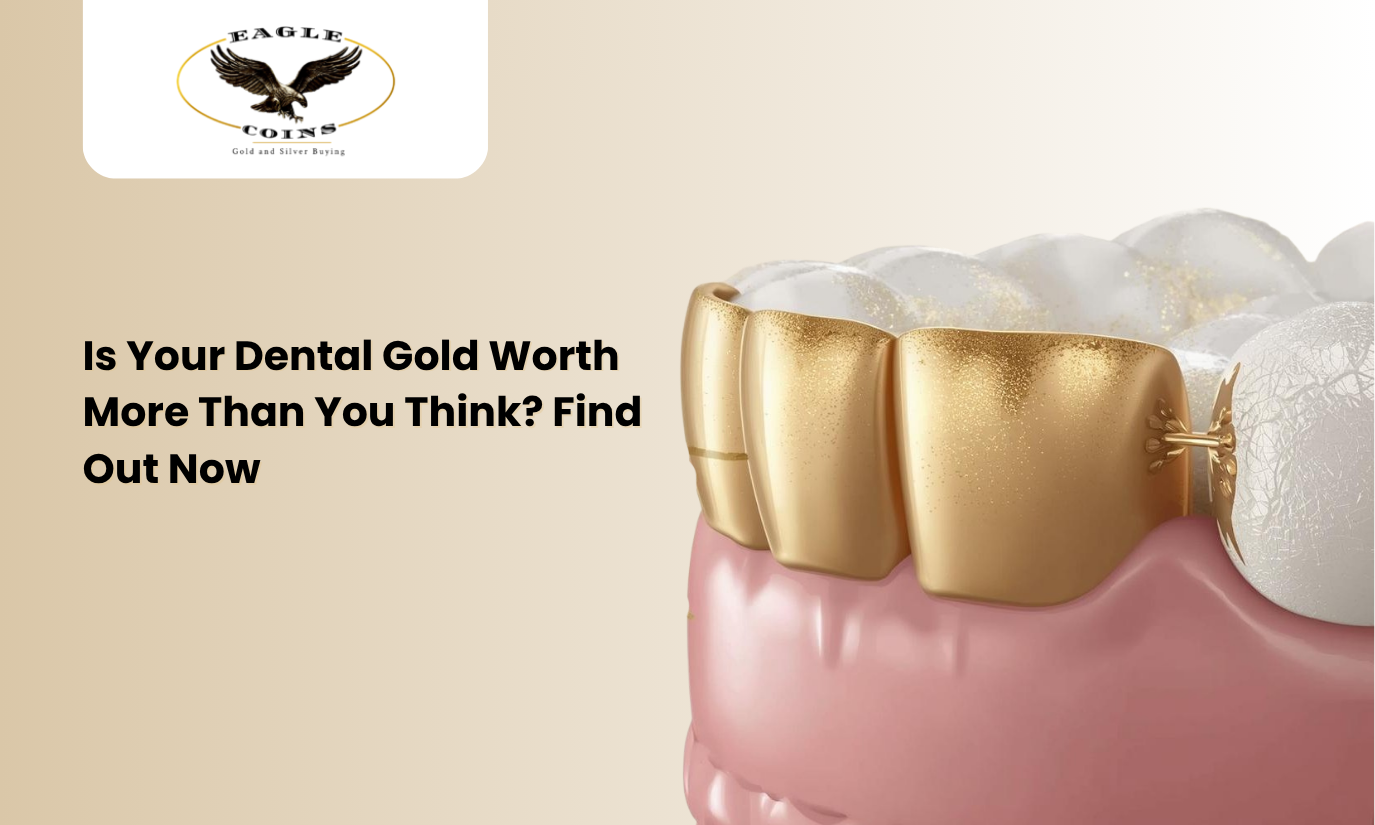
Dental gold refers to the gold alloy used in several types of dental restorations, such as crowns, bridges, inlays, and onlays. It is not made of pure gold, but rather a mix of metals, designed to be durable, resistant to corrosion, and biocompatible with the human body. 

Usually, the dental gold is mixed with other metals such as silver, copper, platinum, or palladium to enhance its strength. Based on its composition, it can range anywhere from 10 karats to 22 karats, which means that it can be anywhere between 40% to 90% pure gold. 

Due to these variations, the value of dental gold may differ greatly from one piece to another. 


Why Is Dental Gold Valuable?


Gold has always been a valuable metal because of its rarity, longevity, and universal demand. Even when it’s used in dentistry, it retains its value. This is the reason why dental gold can be quite valuable. 


  1. High Gold Content: Although dental gold is mixed with other metals, there are several dental crowns that contain a high content of pure gold. 


  1. Current Gold Market Prices: The value of dental gold rises and falls with the market price of gold, which has been strong in recent years. 


  1. Refinable Material: Dental gold is refinable and can be used again as a bar or jewellery, which makes it just as valuable as other types of scrap gold. 


At Eagle Coins Gold and Silver Buying, the professionals evaluate the purity and weight of dental gold to help the sellers get fair and accurate payouts. 


Types of Dental Gold

Not all dental gold is the same. The common types used in dental applications include: 


  • Yellow Dental Gold: It contains the highest percentage of gold, which can be approximately 70-90%.


  • White Dental Gold: They are mixed with metals such as palladium or silver to form a silver-like appearance and additional strength. 


  • Porcelain-Fused Gold Crowns: A layer of porcelain is used on the top of gold for a natural look, though the inner gold is still valuable. 


All types have a unique composition that influences how much they’re worth when sold. 


How Much Is Dental Gold Worth?

The actual price of the dental gold varies depending on several important factors:


  1. Purity (Karat Value): The dental gold with a higher karat will be worth more due to high gold content. 
  2. Weight: The heavier the work, the more the gold it contains, and thus will be of higher value. 
  3. Gold Market Price: The price of gold fluctuates on a daily basis, impacting how much you can acquire. 
  4. Condition and Form: Crowns that have porcelain or any other material attached to them might need refining before being evaluated. 


Professional players like Eagle Coins Gold and Silver Buying use advanced testing processes, such as XRF (X-Ray fluorescence), to determine the exact purity before offering a fair market price. 


How to Tell If You Have Real Dental Gold?

If you’re unsure if your dental work has gold in it or not, here are some clues: 


  • The older dental crowns (before the 2000s) have a higher probability of being made of real gold. 
  • The crowns made of gold usually have a yellow or slightly reddish tint. 
  • They are heavier and more durable in comparison to other materials like ceramic or resin. 


The best way to confirm its authenticity is by visiting a professional buyer or a refiner. Eagle Coins Gold and Silver Buying can test your item within minutes and let you know the actual amount of gold and its value. 


How to Sell Dental Gold Safely?

It is easier to sell dental gold than you might think, but you’ll want to do it the right way and receive a fair price. Here’s how you can do it: 


  1. Collect Your Dental Gold: Remove any leftover crowns, bridges, or fillings that have gold (you can ask your dentist to return them after replacement).


  1. Avoid Cleaning or Modifying: Leave it as it is, don’t clean or alter, as professional buyers have the tools to separate gold from other materials. 


  1. Get a Professional Appraisal: Before selling your dental gold, always get it tested in terms of weight and purity. 


  1. Select a Reliable Buyer: Select an established buyer who has been known for transparency and fair pricing, like Eagle Coins Gold and Silver Buying. 


Their team ensures that sellers receive proper evaluations and competitive offers without any deductions or unclear pricing. 


Tips to Maximize the Value of Your Dental Gold

If you’re planning to sell your dental gold, take the following tips into consideration: 

  1. Know the Market: Follow the prices of gold at present so that you can sell when the prices are high. 


  1. Work with Reputable Buyers: Only select the buyers who have a clear explanation of how they go about testing and pricing. 


  1. Eliminate Middlemen: When you sell your gold, it is best to deal directly with a gold-buying company to ensure that you get the most accurate payout. 


  1. Keep All Pieces: Even the smallest amounts of dental gold can add up in value. 


By taking these few easy measures, you can ensure that you get the best possible prices for your dental gold. 


FAQs

  1. Does dental gold have any value?

Yes, your dental gold has real value because it contains a significant amount of pure gold. The worth of this dental gold depends on the purity, weight, and current market price of the gold. 


  1. How many karat gold is dental gold?

The dental gold usually has about 10 to 22 karats of gold, which depends on the alloy mix used for durability and compatibility in dental work. 


  1. Can I sell my gold dental crown?

Yes, you can sell your gold dental crown to professional gold buyers or refiners who will test the purity of the gold and pay out according to the current gold rates. 


  1. Is dental gold worth any money?

Yes, your dental gold is valuable. Even very small pieces or old crowns can have a good price when they are sold to a trusted buyer. 


  1. What do dentists do with gold crowns they remove?

The dentist returns the gold crown they removed for you on your request, or sends it to recycling or refining facilities for recovery of the metal. 

  1. Who buys old gold tooth crowns?

The old gold tooth crowns are sold to trusted buyers or dealers who deal in precious metals like Eagle Coins Gold and Silver Buying, who test their purity and offer a fair market price. 


  1. How much do 1 gold teeth cost?

A single gold tooth is priced as per the market value of gold, based on the karat, weight and craftsmanship of the gold. 


  1. Is dental gold better than real gold?

Dental gold is real gold, but mixed with other metals for strength and longevity, which makes it more resilient than pure gold for dental use. 

How Much Is White Gold Worth Per Gram? Live Price Guide

Quick answer: White gold is worth the same as yellow gold of the same karat, and weight value comes from gold content, not color. A 10K, 14K, or 18K white gold item is priced by multiplying its weight by its purity percentage and the current gold spot price, using the same formula as any other gold jewelry.

KaratPurityCommon UseValue vs. Yellow Gold
10K White Gold41.7% pure goldBudget jewelry, entry-level ringsSame as 10K yellow gold of equal weight
14K White Gold58.3% pure goldMost common for engagement rings and everyday jewelrySame as 14K yellow gold of equal weight
18K White Gold75% pure goldFine and luxury jewelrySame as 18K yellow gold of equal weight

White gold, a mixture of the ancient beauty of gold and modern silvery shininess, has been a very fashionable and elegant symbol over the years. White gold is a popular precious metal, either in the form of engagement rings, heirloom jewellery, or coins. However, as the gold market passes through its ups and downs, the question that remains on many people’s minds is, ‘What is the price of white gold per gram in 2025?’

2025 Market Overview: White Gold Price Trends

In this detailed guide, let’s explore how white gold is valued, how the market price of this precious metal is influenced, and how you can sell your white gold for its true worth. If you’re looking to sell or learn more about gold valuation, Eagle Coins Gold and Silver Buying can be a reliable centre to conduct correct value estimation and fair market prices. 


What Is White Gold?


White gold is an alloy that is formed through a combination of pure yellow gold with white metals such as nickel, palladium, or silver. The result, a bright, silver-white metal that resembles platinum but comes at a comparatively lower cost. The majority of white gold jewellery is also coated with a thin layer of rhodium that enhances its shine and toughness. 


The white gold usually exists in different purities: 


  • 10K White Gold: Contains 41.7% of pure gold
  • 14K White Gold: Contains 58.3% pure gold (most commonly used for jewellery)
  • 18K White Gold: Contains 75% pure gold (used for luxury pieces) 


The higher the karat rate, the more valuable the white gold product. 


How Is the Price of White Gold per Gram Calculated?


The price of white gold per gram is determined by three main factors: 


  1. Current Gold Market Rate: Gold prices change on a day-to-day basis depending on the market trends all over the world. 


  1. Gold Purity (Karat): The percentage of actual gold that is in your object that determines the intrinsic value. 


  1. Weight and Condition: The heavier pieces or the pieces that are better in condition yield higher payouts. 


To estimate the price of your white gold: 


Multiply the current white gold price per gram by the purity percentage of your gold. For example, if gold in the market is at $70 per gram and you have 14K white gold (58.3%), the approximate value of pure gold content would be $40.81 per gram (70 x 0.583). 


This is just a base figure; of course, there can be additional value attached to it through jewellery craftsmanship, design, and brand. 

What Makes White Gold Valuable?


Although white gold is not as pure as the 24K yellow gold, it has the value that comes from the combination of: 


  • Gold Content: This is the actual percentage of gold in the alloy.
  • Rhodium Finish: This is a high-quality coating that makes the product more durable and lustrous, which increases its market appeal. 
  • Craftsmanship: Complex designs, gemstones, and brand reputation will increase the resale prices. 
  • Market Demand: White gold remains a popular product in wedding and fine jewellery markets, which ensures strong resale potential. 


When selling, it is important to separate the metal value from the design value. The buyers like Eagle Coins Gold and Silver Buying will consider both aspects fairly. 


How to Sell White Gold for the Best Price?


Selling your white gold is a simple and enjoyable process if done through a reliable buyer. Here is the way you can get the most out of it: 


  1. Know the Purity of Your Gold: Check for karat stamps (like 10K, 14K, or 18k) on your jewellery. 


  1. Weigh Your Gold: The heavier your item weighs, the more it’s worth. 


  1. Check Current Market Prices: Stay updated on the gold spot rate so that you can make sure that you are selling at a good time. 


  1. Get a Professional Appraisal: Visit a reputable buyer like Eagle Coins Gold and Silver Buying for a correct evaluation. 


  1. Keep the Middlemen out of it: Selling directly to gold buyers can help you save unnecessary cuts to commissions. 


White Gold vs. Yellow Gold: Is There a Difference in Value?


Although both types of gold share the same base metal, the value of white gold is almost the same as yellow gold of the same karat and weight. The difference lies mainly in the looks and alloy composition. 


However, the jewellery made from white gold might have a slightly higher price if rhodium-plated or crafted by a premium brand. The resale process, however, is mostly focused on gold content, not colour. 


How to Check if Your White Gold Is Real?


Not all the jewellery that looks silvery-white is real white gold. Here’s how you can tell: 


  • Check Hallmarks: A real white gold jewel will have a stamp like 10K, 14K, or 18K. 
  • Magnet Test: Real gold is non-magnetic
  • Professional Testing: The jewellers or gold buyers can either use acid or XRF tests for confirmation. 


At Eagle Coins Gold and Silver Buying, you have to chance to receive the true market value as the professional testers ensure that every item is properly checked before making an offer. 


Tips Before Selling White Gold

Before selling white gold, it is understood that informal tips help to minimize possible losses.


  • Clean your jewellery gently to remove dirt or oils
  • Compare offers from various reputable gold buyers. 
  • The prices of old are subject to change, so keep a watch over trends before selling. 
  • Retain certifications or receipts, if available, as they can increase the resale value. 


The idea behind selling white gold is not simply to sell old jewellery, but to maximize its real worth at the right time. 


FAQs

  1. How is white gold price calculated?

The price of white gold is decided by its purity (karat), the current market value of gold per gram, and the metal alloys mixed in it, like palladium or nickel. 


  1. Does white gold go up in value?

Yes, the value of white gold generally increases as time passes as the prices of gold rise in the market. 


  1. Is white gold a good investment?

White gold can be stated as a good investment, since it holds intrinsic value like yellow gold and retains its resale value. 


  1. Can I sell my white gold?

Yes, you can sell your white gold in the market to reputable buyers like Eagle Coins Gold and Silver Buying for fair market value. 


  1. Is it worth selling white gold?

Yes, it is absolutely worth selling gold, especially when the prices of gold are high or if the item is no longer used. 


  1. What karat of white gold is best?

The most popular options of white gold are the 14K and 18K white gold, which offer a great balance of purity, strength, and shine. 


  1. Is white gold costly than normal gold?

The white gold can sometimes be slightly expensive than normal gold because of the alloy materials and rhodium plating that give it a bright, silvery finish. 


  1. Will white gold turn yellow over time?

Yes, white gold can turn yellow over time as the rhodium plating can wear off, but it can also be easily re-plated to restore its shine.

Cash for Gold Prices: Why They Fluctuate and How to Benefit?

The $200 Per Ounce Swing

On Monday, August 4th, 2025, Citi raised their gold price forecast to $3,500 per ounce over the next three months from their previous $3,300 target, citing deteriorating U.S. economic outlook and weakening labor statistics. This single announcement triggered immediate market reactions that perfectly illustrate why cash for gold prices fluctuate so dramatically.

Within hours of Citi’s announcement, spot gold jumped from $3,356 to over $3,400 per ounce. But what makes this particularly relevant for American sellers: cash for gold prices from local buyers didn’t move in lockstep. Some conservative buyers immediately lowered their offers, fearing volatility. Others raised theirs aggressively, anticipating sustained price appreciation.

This creates the fundamental truth about cash for gold prices: they’re driven by human psychology and local market dynamics as much as global spot prices. Understanding these disconnects is what separates sellers who capture maximum value from those who leave money on the table.

Goldman Sachs Research predicts gold will reach $3,700 by the end of 2025, potentially hitting $3,880 in a recession scenario. But for American sellers, the key isn’t just tracking these forecasts – it’s understanding how local buyers interpret and react to them.

The Federal Reserve’s Hidden Influence on Your Gold Sale

Cash for gold prices in America respond directly to Federal Reserve policy through mechanisms that most sellers never consider but can learn to exploit.

Interest Rate Anticipation Creates Pricing Windows

When the Fed signals potential rate cuts, gold futures markets react instantly. But local cash for gold prices often lag by 2-6 hours as buyers adjust their risk models. This creates temporary arbitrage opportunities where informed sellers can capture better prices during these adjustment periods.

Current market conditions show over 90% probability of Fed rate cuts in September 2025 following weak employment data. Local cash buyers who understand this dynamic often raise their offers in anticipation of Fed dovishness, creating opportunities for sellers who track Federal Reserve communications.

Dollar Weakness Multiplier Effect

Since gold trades globally in U.S. dollars, currency fluctuations create an immediate impact on pricing. A 1% dollar weakening typically translates to 1-2% higher gold prices within the same trading day.

But local cash for gold prices often reflect the previous day’s dollar-gold relationship, not real-time moves. Sellers who monitor currency markets can identify moments when their local cash offers haven’t yet adjusted to favorable dollar movements.

The Central Bank Buying Revolution

The most significant driver of cash for gold prices in 2025 has been unprecedented central bank purchasing that’s reshaping global supply dynamics.

The 900-Tonne Reality

Central banks are forecasted to purchase 900 tonnes of gold in 2025, marking the fourth consecutive year of massive institutional buying. This removes gold from the market faster than mines can replace it, creating structural support for cash for gold prices regardless of short-term volatility.

J.P. Morgan Research estimates gross gold demand has risen over one-third since mid-2022, nearly doubling prices by the second quarter of 2025. This institutional demand directly influences local buyers’ inventory costs and pricing strategies.

Diversification Away from the Dollar

USD reserve holdings have declined to around 57.8% as central banks accelerate diversification into gold. When global institutions compete with local buyers for the same gold supply, it creates upward pressure on cash for gold prices that transcends regional market conditions.

The Technology Revolution Changing Cash for Gold Markets

Cash for gold prices in 2025 operate in a completely transformed technological landscape that creates both opportunities and complexity for American sellers.

Real-Time Price Transparency

Modern sellers arrive knowing spot prices, recent auction results, and market trends. This transparency has forced cash buyers to compete on factors beyond information asymmetry, often resulting in better cash for gold prices for informed sellers who demonstrate market knowledge.

XRF Testing Eliminates Conservative Estimates

X-ray fluorescence testing provides instant, accurate gold content analysis. This technology typically results in 8-15% better cash for gold prices because buyers can offer aggressive rates knowing exact gold content rather than making conservative estimates for protection.

The Seasonal Psychology of American Gold Markets

Cash for gold prices follow seasonal patterns driven by American consumer behavior and market psychology.

The January Resolution Effect

New Year’s financial resolutions drive increased gold purchases in January as investors rebalance portfolios. This demand surge typically translates to 3-5% higher cash for gold prices during the first two weeks of January compared to December levels.

Holiday Liquidation Pattern

November-December see increased gold sales as Americans liquidate assets for holiday expenses. This creates temporary oversupply that can depress local cash for gold prices by 5-8% below spot gold. Smart sellers avoid this period or wait until early January when supply normalizes.

Tax Season Timing

April tax refund spending increases gold purchases, creating demand that supports higher cash for gold prices during spring months. Conversely, tax payment deadlines in April sometimes increase selling pressure as people liquidate assets.

The Geopolitical Premium Factor

Global events create dramatic cash for gold prices fluctuations, but their impact on American buyers follows predictable patterns.

The Crisis Response Timeline

When geopolitical tensions spike, gold prices typically jump 3-8% within hours. American cash buyers’ responses follow a predictable sequence:

  • Hour 1-4: Conservative buyers lower offers to protect against volatility
  • Hour 4-12: Aggressive buyers raise offers to build inventory before further increases
  • Hour 12-48: Market stabilizes as buyers adjust to new price levels

Understanding this timeline helps American sellers identify optimal selling windows during crisis periods.

Why Location Matters for Cash for Gold Prices

American cash for gold prices vary significantly by region due to local economic conditions, demographics, and competition levels.

Urban vs. Rural Disparities

Metropolitan areas typically offer 5-12% higher cash for gold prices due to increased competition and higher overhead costs that buyers can afford. Rural buyers often operate with lower margins but also face less competition.

State Tax Implications

Some states tax precious metals transactions while others don’t. This affects local cash for gold prices as buyers factor tax obligations into their offers. Understanding your state’s tax structure helps identify whether to sell locally or travel to more favorable jurisdictions.

Regional Wealth Concentration

Areas with higher average incomes often support better cash for gold prices because local buyers cater to clientele willing to pay convenience premiums for immediate transactions.

The Psychology of Cash Buyer Decision-Making

Understanding cash for gold prices requires recognizing that local buyers make psychological decisions, not purely algorithmic calculations.

End-of-Month Target Pressure

Cash gold buyers often need to meet monthly volume targets. This creates predictable pricing patterns where cash for gold prices often improve during the last week of each month as buyers compete to hit targets.

Inventory Level Influence

Buyers with low inventory often pay premiums regardless of market conditions, while well-stocked buyers become selective. Building relationships with multiple local buyers helps identify who needs inventory at any given moment.

Maximizing Profits from Price Fluctuation

Successful American sellers understand that cash for gold prices fluctuation creates opportunities beyond simply waiting for high spot prices.

The Multiple Offer Strategy

Different buyers use varying pricing models and risk tolerances. Obtaining quotes from multiple buyers during volatile periods often reveals 15-25% pricing disparities for identical gold.

News Event Timing

Major economic announcements, Fed meetings, and geopolitical developments create temporary pricing inefficiencies. Sellers who understand these patterns can time their sales during optimal windows.

Market Hour Advantages

Cash for gold prices often differ between morning and afternoon as buyers adjust to overnight international market movements. Understanding these daily patterns helps optimize timing.

Ready to Master American Gold Market Timing?

Don’t let the next Citi forecast revision catch you unprepared. At Eagle Coins Gold and Silver Buying, we understand both the technical factors driving cash for gold prices and the local market psychology that creates opportunities for informed American sellers.

Legal Disclaimer

Information provided is for educational purposes only and should not be considered financial advice. Eagle Coins operates under all applicable Massachusetts laws governing precious metals dealers.

How Much Gold Can You Bring on an International Flight Without Paying Duty?

Gold has been traditionally recognised as an investment that is safe and a store of wealth. You must understand the rules of gold on board when flying, whether you are a frequent flyer or planning to move your assets across borders. The question that many investors ask is, ‘How much gold can I carry in international flight?’

Understanding Gold Travel Regulations

The importation and exportation of gold are subject to varying regulations in different countries. These are laws that are aimed at preventing smuggling, money laundering, and tax evasion. While in some countries the gold can be imported duty-free, in others, it is obligatory to declare, and such a declaration requires payment of customs duties. 

Travellers using air transport should be aware of the legal restrictions on the amount of gold they can carry on board to avoid fines, confiscation, or legal difficulties. Knowledge of these regulations ensures smooth transit and protects your precious assets. 

How Much Gold Can I Carry in an International Flight?

The amount of gold that you can bring on an international flight will depend on the home country and the destination country. Travellers are usually permitted to carry some quantity of gold at no customs duty, provided that the quantity of gold is within the duty-free limits. 

For example, in the USA, travellers entering the country are supposed to declare any gold or monetary instrument valued over $10,000. However, there is no specific limit; carrying any amount that exceeds this value must be reported, and if you fail to do so, it can result in fines or confiscation.

Other Countries: In many countries, there are certain limits, often ranging from 50 grams to 1 kg of gold. There are countries where travellers have to report any amount of gold, irrespective of the weight. 

Due to the varied nature of regulation, it is necessary to study the regulations of the country, both on your arrival and departure. 

Types of Gold You Can Travel With

Travellers can also carry gold in different forms, which include:

  1. Jewellery: Most travellers usually carry gold in the form of necklaces, bracelets, rings, and earrings. Jewellery is a type of personal belonging, and generally has higher duty-free limits. 
  2. Coins: Gold coins are accepted extensively, but they have to be declared when they are found to be beyond the weight limit. 
  3. Bars: Bars of gold are more restricted due to their high value. The large bars need to be cleared by customs, and many countries impose severe restrictions and limitations on their importation. 

Purchase receipts or certificates of authenticity should be carried about, particularly with bars and coins, to prove the origin and the value of the gold.

Duty-Free Limits and Customs Declarations

The limits of duty-free travel are very important to understand. The penalty for going beyond these limits usually requires paying customs duty, which can be costly.

  • The amount of duty-free allowance varies depending on your destination. 
  • Gold more than the duty-free limit should be announced at the customs. The non-declaration may lead to seizure or penalties. 
  • Some countries permit the payment of duty to legally transport additional gold, which is a safer option compared to dodging laws. 

With proper planning and honesty with the customs, it is possible to avoid getting into legal trouble and ensure a stress-free journey. 

Safety Tips for Travelling with Gold

Gold is very valuable, and so it should be handled with care when travelling internationally. Here are some practical tips:

  1. Carry a Secure Carry-On: Store gold in your carry-on baggage instead of checked baggage to prevent theft.
  2. Divide Your Gold: When you are carrying large amounts, you should divide them into smaller parts to reduce the risk.
  3. Keep Documentation: Bring receipts, certificates of authenticity and purchase invoices to be checked at customs. 
  4. Avoid Flashy Displays: Do not put on or wear too much jewellery at the airports to ensure that people do not give unnecessary attention to you.
  5. Consider Insurance: Insuring your gold can safeguard you against theft, damage to your gold or loss during transit.

These measures help in securing and complying with the transportation of gold across borders. 

Why Work with Trusted Dealers

If you plan to buy gold in another country and carry it back home, it is easier to deal with reputable dealers. Reputable dealers offer certificates of authenticity, legal advice and regulations on customs paperwork. Eagle Coins Gold and Silver Buying can guide you to understand international travel rules and ensure that the gold investments are transported safely and legally.  

Country-Specific Guidelines

Travellers should research regulations specific to their destination:

  • United States: Gold that is worth more than $10,000 is to be reported and adhered to import regulations by travellers.
  • European Union: Travellers can bring gold for personal use; however, a lot of gold should be declared and might be subject to duty.
  • Middle East: There are several countries that permit lower gold importation duty-free, but which impose strict reporting requirements for higher amounts.

To avoid fines, it is important to ensure one agrees with the official customs websites before travelling.

Planning Ahead

Being aware of how much gold can I carry in international flight is only the first step. This is how to plan good travels:

  • Check the baggage rules of airlines for valuables.
  • Pack gold in a carry-on bag.
  • Prepare customs documentation and receipts for verification 
  • Travel insurance is an option to be considered.

Through these measures, travellers can carry their gold across borders without any problems.

Conclusion

It is essential to be familiar with the relevant laws, weight restrictions, and proper documentation when transporting gold during an international flight. Many travellers often ask, How much gold can I carry in international flight, and the answer is different depending on the country and the type of gold. Jewellery usually has a higher duty-free limit, while coins and bars may be liable for registration and payment of duty. 

By following legal guidelines and securing your gold with the help of reputable dealers such as Eagle Coins Gold and Silver Buying, you can carry your investments safely and with ease. With proper planning, knowledge of the customs laws and adequate handling, you can be sure that your gold is a secure and valuable asset even when you are travelling across borders.

FAQs

  1. How much gold can I carry in an international flight?

The limit of how much gold you can carry depends on the customs rules of your destination country. For example, if you’re going to the USA, you must declare gold or any other valuables over $10,000, while other countries might have different rules. 

  1. What is the limit of duty-free gold?

The limit of duty-free gold is different for every country. In some countries, you can carry up to 50 grams to 1 kilogram of gold without any duty, and in some countries, your valuables have to be below a certain amount. 

  1. What happens if I don’t declare gold?

If you fail to declare the gold above the allowed limit, the customs officer of that country might impose fines, confiscate your gold, or impose legal action against you, depending on their laws. 

  1. How much gold needs to be declared?

If you’ve the gold that exceeds the customs rules, such as duty-free limit of your destination country, it must be declared. Make sure you research the duty-free rules of the country you’re travelling to avoid any problems.

  1. Do I have to declare my personal jewelry at customs?

Personal jewellery, which is often used for everyday life, often does not require any declaration if it falls under the duty-free allowance, but excess or any investment pieces may need to be declared. 

  1. What is the limit of gold without tax?

In many countries, it is allowed for travellers to carry small amounts of jewellery or gold, such as 50 grams to 1 kilogram, tax-free, but this also depends widely on the region. 

  1. Do you get taxed if you buy gold?

Yes, if you buy gold, you might have to bear the taxes, such as sales tax, VAT, or capital gains tax when you sell the gold, which entirely depends on local laws. 

  1. Is gold a good investment?

Yes, gold is usually considered a safe investment that protects your wealth against inflation, fluctuations in currency, or any economic uncertainty.

Gold Bar Weight Categories Explained: Kilobars, Tolas, and More

Quick answer: Gold bars come in standardized weight units that vary by region. Grams and troy ounces are used globally; tolas (~11.66 g) are traditional in South Asia, taels (~37.5 g) in China and Hong Kong, and kilobars (1,000g) are a popular investor size across Asia. The unit doesn’t change the gold’s value; only its total weight and purity do.

UnitGramsTroy OzTypical Origin / Market
Gram bar1g0.032 ozGlobal – low-cost entry point
1 oz bar31.1g1.0 ozGlobal standard investment size
Tola bar (1 tola)~11.66 g0.375 ozIndia, Pakistan, South Asia
10-Tola bar~116.64g3.75 ozIndia, Middle East common trading size
Tael~37.5 g1.2 ozChina, Hong Kong
Kilobar1,000g (1kg)32.15 ozAsia: popular institutional/investor size
Good Delivery bar~12.4 kg~400 ozCentral banks, large institutional trades

Ancient times have seen gold investment as a popular way of keeping wealth. And gold bars are one of the most popular types of investing in this valuable metal. When investing in gold, either as a beginner or an experienced investor, it is important to understand the categories of gold bar weights since they define the pricing, liquidity, and storage. 

Standard Gold Bar Weights

The purpose and market of the gold bars are in multiple weight categories. Knowing the differences can help investors in choosing the bars that match their goals:

1. Kilobar (1,000 grams)

Kilobar is a popular and common bar of gold weight, particularly in Asia. It has a weight of 1,000 grams (1 kilogram or about 32.15 troy ounces), which is a balance between the size of investments that can be undertaken and manageability. Kilobars are ideal where the investors want to hold high values per bar, without dealing with quantities that are very large. They are not very large, and they are standardized, thus they are easy to buy, sell, and stock in a safe location. 

2. Tola Bar (10 Tolas)

Another unit of weight, the tola unit of gold weight, is also a traditional unit, primarily found in India, Pakistan and other areas of South Asia. One tola weighs approximately 11.6638 grams, and a 10-tola bar approximately weighs 116.64 grams. The Tola bars have a cultural value and are widely used in jewellery manufacturing, gifts and during ceremonies. Many investors in the Indian subcontinent are accustomed to tola bars as they are more comfortable with them, culturally relevant, and easy to trade in small denominations. 

3. 400 oz Good Delivery Bar

The standard size of the 400-ounce gold bar, which is also referred to as a Good Delivery bar, is commonly used in the world financial markets, such as the London Bullion Market Association (LBMA). These bars weigh around 12.4 kilograms (approximately 438.0 troy ounces) and are primarily traded by central banks and institutional investors for large-scale transactions. They are not convenient for individual investors because of their size, but they set a standard for gold trading across the world. 

4. 100 oz COMEX Bar

The 100-ounce gold bar is popular among institutional investors and traders, especially in the United States, where it is actively used on the Commodity Exchange (COMEX). These bars weigh approximately 3.11 kilograms, which provides them a balance between large-scale investment and easy handling, compared to 400-oz bars. They are commonly bought and sold either for hedging, speculation, or portfolio diversification. 

5. 1 oz and Smaller Bars

Smaller gold bars that range from 1 gram to 1 ounce are available to everyday investors. These bars offer flexibility, and one can invest gradually or purchase gold as gifts. Smaller bars are more convenient to store, transport, and sell, and are suitable for individuals who are new to the gold market or seeking an incremental investment opportunity. 

Historical Context of Gold Bar Weight

Gold has been a trusted store of value for thousands of years, and weight standards have evolved to allow equity in trade. The tola, which is a traditional unit, has a strong South Asian trading history, and the standardisation of large bars such as the Good Delivery bars in Western financial markets simplified trade across the globe. Understanding these historical and regional standards of weights helps investors appreciate why some sizes of bars tend to be more prevalent in specific markets. 

Regional Preferences

The various regions of the world would prefer different weights of gold bars due to cultural, economic and practical reasons: 

  • Asia: Kilobars are widely marketed in the Asian markets, particularly in India, China and Thailand. They are a good investment option due to their size and worth. 
  • Indian Subcontinent: Tola bars are still well used in jewellery and religious applications, and are of cultural value, so they are highly liquid in these regions. 
  • Western Markets: Bigger bars are used by institutional investors, banks and large-scale traders, such as the 400 oz Good Delivery bar and the 100 oz COMEX bar. 

Choosing the Right Gold Bar Weight

The choice of the correct gold bar weight depends on investment interest, budget, storage, and liquidity requirements. 

  • Investment Size: Large-size bars, such as kilobars or Good Delivery bars, can be used with large investments, but they require secure storage and higher upfront costs. 
  • Flexibility: Smaller bars offer the flexibility to invest in smaller amounts, sell in smaller amounts, and manage risk. 
  • Market Considerations: Not all areas have the same availability and demand; in some markets, bar sizes are easier to buy and sell. 

Buying and Selling Gold Bars

When buying gold bars, it is important to:

  • Buy from reputable dealers such as Eagle Coins Gold and Silver Buying, who offer certified bars and clear pricing. 
  • Understand the market rates for different gold bar weights to avoid overpaying. 
  • Consider liquidity and resale possibilities according to the size of the bar and the demand of the regional market. 

The purchase of kilobars, tolas, or smaller bars, working with reputable dealers, is the only way to be sure of authenticity and smooth transactions.

Conclusion

It is worth knowing the types of gold bar weights to make a wise investment decision. Kilobars to tolas, individual sizes are used depending on the need, e.g. large-scale investment, regional cultural preferences, or in-person small-scale investment. To make sure that your investment is safe, there must be secure storage, certified bars, and to make sure that you pick the right dealer, like Eagle Coins Gold and Silver Buying. 

FAQs

What are the standard weight categories for gold bars?

The most common are gram bars, 1 oz bars, tola bars (South Asia), tael bars (China/Hong Kong), and kilobars — each suited to a different market and investment size. See the table above for exact weights.

What is a tola bar, and how much gold does it contain?

A tola is a traditional South Asian unit of weight equal to about 11.66 grams. Tola bars are most commonly traded as 10-tola bars, weighing approximately 116.64 grams, and are widely used in India, Pakistan, and the Middle East.

How much does a kilobar of gold weigh?

A kilobar weighs exactly 1,000 grams (1 kilogram), equal to about 32.15 troy ounces. It’s a popular size for investors who want significant value in one bar without the size and cost of a Good Delivery bar.

What’s the difference between a kilobar and a tael bar?

A kilobar weighs 1,000 grams, while a tael bar weighs about 37.5 grams, roughly 1/27th the size. Kilobars are common across Asia broadly and with institutional investors; tael bars are specifically tied to Chinese and Hong Kong gold trading traditions.


5 Proven Steps on How to Sell Gold and Get the Best Price

Last week, a customer brought in their grandmother’s ring. The pawn shop said $200. We tested it with XRF instead of acid – turned out to be $340 worth of 18k gold they’d missed completely.

But that’s nothing compared to what happened last September. A customer walked into our Harwich Port location carrying an old jewelry box their grandmother had left them. They’d already been to a pawn shop that morning and weren’t happy with what they heard.

“Eight hundred dollars for all of this,” they said, setting the box on our counter. “That’s what they offered me down the street.”

Inside were pieces that clearly meant something to someone once – a Navy ring with real wear on it, gold chains in different styles from different decades, and some coins wrapped in tissue paper like someone had been saving them for something special.

When our appraiser looked closer, the story changed completely. The ring was 18k gold, much higher quality than the pawn shop realized. One of the chains was a vintage rope style that collectors actually look for. Those wrapped coins? Five American Gold Eagles from the 1980s – worth far more than their weight in gold due to current collector demand.

Final value: $4,000.

“Wait, what?” they said. “I almost walked away with $800?”

After forty-plus years in this business, we see people almost make expensive mistakes like this every week. That’s exactly why knowing how to sell gold the right way matters so much.

At Eagle Coins Gold and Silver Buying, we’ve watched the gold market transform dramatically. Gold hit an unprecedented $3,500/oz in April 2025 due to tariff policies, dropped to $3,200 in July, and JP Morgan now predicts $4,000/oz by Q2 2026. Your timing could literally mean thousands more dollars.

Step 1: Master the Timing Game Most Sellers Miss

How to sell gold successfully starts with understanding something most people never consider: when you sell matters more than ever before.

That bracelet sitting in your drawer? If you’d sold it in March 2025, you’d have gotten about $2,900/oz. Wait until April? Suddenly it’s worth $3,500/oz. That’s a $600 difference per ounce just because of market timing.

The Massachusetts Timing Advantage

Massachusetts has a 5-10 day hold period before buyers can resell your gold. What sellers don’t realize is this creates a unique timing opportunity. If you sell right before a weekend or holiday, you can lock in Friday’s typically higher prices while the hold period runs through usually lower Monday prices.

Track Current Prices Like a Pro

Current gold spot prices fluctuate wildly – we’ve seen $200 swings in single trading days during 2025. Check COMEX futures before you sell. When central banks are buying 900 tonnes annually (the highest in history), they’re literally competing with retail sellers for the same gold supply.

The Trump Tariff Effect Nobody Talks About

Political policies directly impact your gold’s value. The 2025 tariff implementations created unprecedented demand spikes. When the Federal Reserve is buying the same gold you’re selling, you know demand is extraordinary.

Step 2: Use the XRF Testing Advantage to Get 15% More

Most sellers don’t realize different testing methods can mean dramatically different payouts. How to sell gold effectively means insisting on the right testing.

Sarah’s $400 Discovery

Sarah got three quotes in one afternoon: $800, $950, and $1,200 for the exact same gold chain. Same day, same gold, $400 difference because one shop had XRF testing and the others used acid tests.

XRF testing is 99.8% accurate vs 85% for acid tests. Shops using XRF often find higher gold content, meaning 10-15% better prices for the same pieces. When someone tests your 14k ring with acid and gets 13.8k, but XRF shows it’s actually 14.2k, that’s real money.

Demand to Watch the Testing

Professional XRF testing takes 30 seconds and shows exact gold percentages on a digital display. If a buyer won’t let you watch or can’t explain their results, walk away immediately.

Karat Markings Tell Hidden Stories

In our Cape Cod experience, vintage pieces from the 1940s-1960s often test higher than their stamps indicate. European gold frequently exceeds American karat standards. That “14k” wedding band from 1955? Often tests at 14.8k or higher.

Step 3: Master the Silent Negotiation Technique

The psychology of gold selling involves a fascinating technique most people never try: strategic silence.

The 10-Second Rule That Adds Hundreds

A customer recently tried this at three different shops. First shop: $800. At the second shop, when they made their offer, she stayed silent for 15 seconds. The discomfort made them immediately say, “Actually, I can do $950.” Third shop knew they had competition: $1,100.

This technique works because silence creates psychological discomfort. Buyers assume you’re comparing their offer to better ones elsewhere and often improve their initial quote without any negotiation.

The Bulk Pricing Trap

Counterintuitive insight: Sometimes selling pieces individually gets you more money than bulk sales. Large buyers can’t always handle big transactions and may lowball to reduce their risk.

We had a customer with $8,000 worth of gold. As a bulk sale: $6,400. Sold individually over three visits: $7,200. The math favored patience.

Step 4: Leverage the Cape Cod Collector Premium

Understanding how to sell gold in our local market means recognizing Cape Cod’s unique collector base.

The Ethical Gold Premium Phenomenon

Completely new trend: Buyers are paying 15-25% premiums for ethically sourced gold. If your gold has documentation proving ethical sourcing – estate pieces, inherited jewelry with provenance – you could command significantly higher prices.

Military and Naval Heritage Value

Cape Cod’s military history creates premium markets for service-related gold pieces. That Navy ring wasn’t just 18k gold – its 1952 vintage and authentic military provenance added $200 to its collectible value beyond metal content.

Seasonal Demand Patterns

Late fall and early winter see strongest prices here as holiday jewelry demand increases. Summer brings estate sales and inherited pieces, creating temporary oversupply. Time your sale accordingly.

The Three-Shop Minimum Rule

Visit different types of buyers: a pawn shop, a jewelry store, and a precious metals specialist. Each serves different markets with different profit requirements. What one considers scrap gold, another recognizes as collectible.

Step 5: Navigate the Digital Gold Revolution

Digital gold platforms processed $2.1 billion in 2025, but this actually helps physical sellers because it’s created more educated buyers who understand true gold value.

Documentation Creates Value

Professional transactions require detailed receipts showing individual weights, karat content, current spot prices, and exact percentages offered. This documentation helps with tax implications and proves fair market transactions.

Massachusetts Legal Requirements Work For You

State law requires gold buyers to maintain detailed records and hold items before reselling. This protects you from stolen goods accusations and ensures legitimate transactions.

Tax Implications Most People Miss

Gold sales face a maximum 28% capital gains rate for long-term holdings. Short-term sales get taxed as ordinary income. The difference between holding 11 months vs 13 months could save you thousands in taxes.

Why Timing Your Gold Sale Matters More Than Ever

Successfully learning how to sell gold in 2025 requires understanding unprecedented market conditions. Central bank purchases, political uncertainties, and digital platform growth have created opportunities – and risks – that didn’t exist five years ago.

The gold market rewards informed, prepared sellers who understand both traditional techniques and current market dynamics. Take time to research your pieces’ true value, understand testing differences, and choose buyers who demonstrate expertise with current market conditions.

Whether you’re selling a single inherited piece or an entire collection, these five steps help ensure you receive fair market value while avoiding costly mistakes that hurt sellers every day.

Ready to Unlock Your Gold’s True Value?

Don’t make the same $3,200 mistake our customer almost made. At Eagle Coins Gold and Silver Buying, our certified specialists use professional XRF testing equipment to identify the true value of your gold – including premium pieces and collector value that other buyers miss entirely.

Legal Disclaimer

The information provided is for educational purposes only and should not be considered financial, legal, or tax advice. Eagle Coins operates under all applicable Massachusetts laws governing precious metals dealers.

Gold Bullion vs. Gold Coins: Which Sells for More and Why?

Quick answer: Gold bullion (bars) is valued almost purely on weight and purity, with a lower premium over spot price typically 1–3%. Gold coins carry a higher premium (3–8%, more for fractional sizes) but are easier to sell quickly and recognize, and some carry real collector value above their gold content. Bars maximize gold per dollar; coins maximize liquidity and flexibility.
 

Gold Bullion Bars vs. Gold Coins: Key Differences


FactorGold Bullion (bars)Gold Coins
Premium over spotLower – often 1–3%Higher – typically 3–8%, more for fractional sizes
RecognizabilityRequires assay/verification for resaleWidely recognized by weight and design (e.g., Eagles, Krugerrands)
LiquidityGood, especially with reputable refiner marksVery high; easiest to sell quickly at fair value
Collectible upsideNone valued purely on weight and purityPossible rare dates or certified grades can carry a premium above melt value
Best forMaximizing gold per dollarBalancing value with easy resale and flexibility


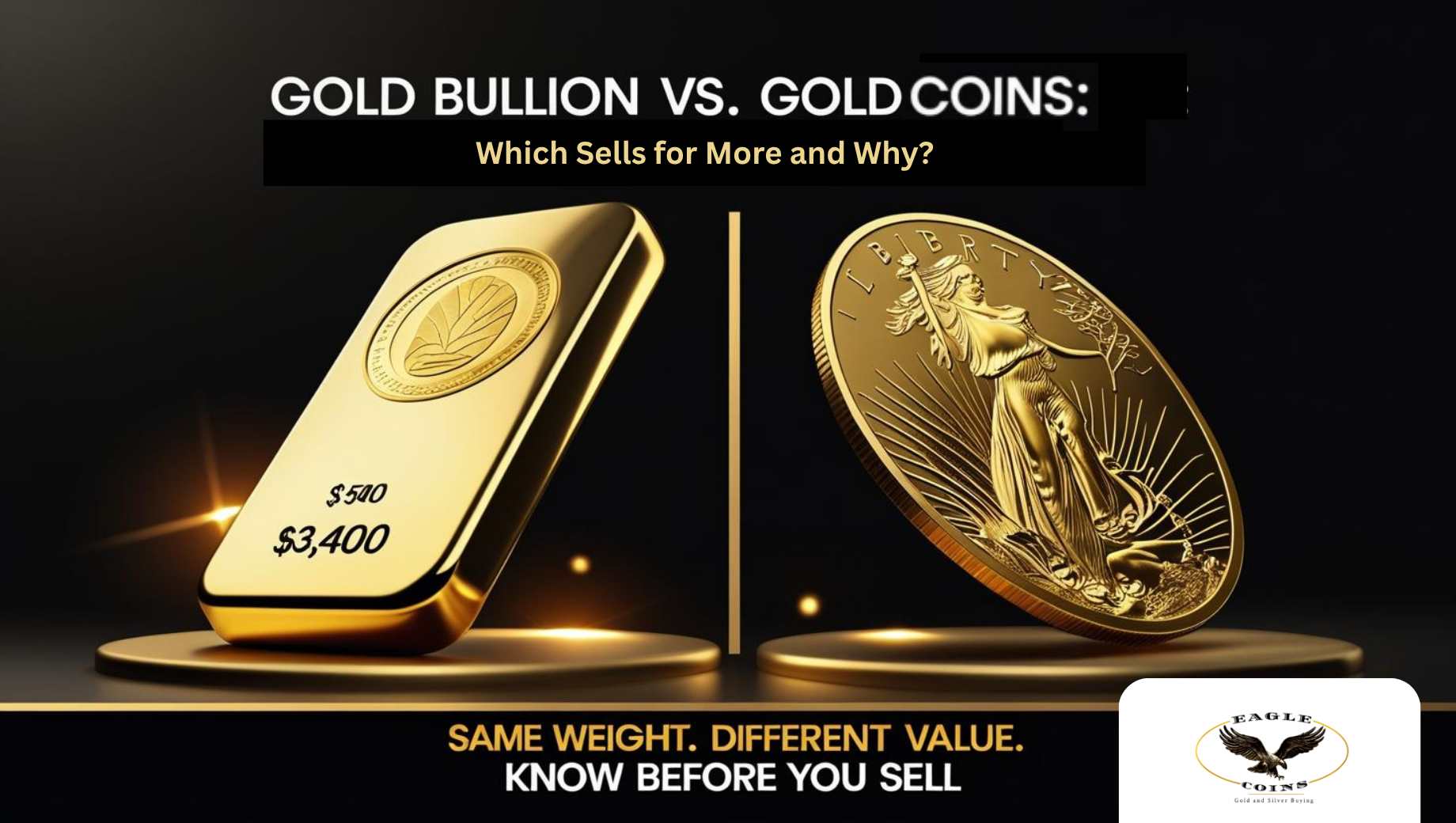
Did you know that two pieces of gold with identical weight can have completely different cash values? We’ve seen someone walk in with a 1-ounce gold bar worth $3,400, while their neighbor sells a 1-ounce American Eagle for $3,550. Same gold but different money.

With gold at $3,371 per ounce right now, understanding these differences is a must. Whether you’re cleaning out an inherited collection or looking to cash in on gold’s current run, knowing which type brings more money can put hundreds of extra dollars in your pocket.

The Numbers Tell the Story

Here’s what identical amounts of gold sell for today:

For a generic 1-ounce gold bar, you’re looking at maybe $30-50 over spot price. But that same ounce in an American Eagle sells at an easy $180-220 premium. Canadian Maple Leafs sit somewhere in between at $150-200 over spot.

Old US gold coins can blow these numbers right out of the water. A $20 Liberty Head coin contains about 0.97 ounces of gold but regularly sells for $200-400 more than its melt value. And for the nice ones, the sky’s the limit.

Source: APMEX, JM Bullion pricing as of July 11, 2025

Why Some Gold Sells for More

Three things drive these price differences, and experienced gold bullion buyers know them cold.

  • First, people trust what they recognize. American Eagles have been around since 1986. Everybody knows them, and they’re backed by the US government. That recognition equals premium pricing.
  • Second, some gold is just easier to sell. Try finding a buyer for a random 10-ounce bar from “Joe’s Precious Metals” versus a Credit Suisse bar. The Credit Suisse moves faster, which means dealers can pay more upfront.
  • Third and most important, supply matters. The US Mint only made 46,000 half-ounce Eagles in 2024, which is the lowest production ever. When supply drops, prices go up.

The American Eagle Premium

American Eagles cost more to buy and sell for more when you turn coins into cash. Here’s why that premium sticks around:

The government backs every Eagle. They test them, weigh them, and stamp them with official markings. Dealers trust them, which means less testing time and better offers.

Eagles also move fast. While a dealer might sit on generic rounds for weeks, Eagles disappear within days. Faster turnover means better prices for sellers.

Plus, Eagles come in multiple sizes. Need to sell just $500 worth of gold? A half-ounce Eagle does the job. Try breaking up a 10-ounce bar – not happening.

Old Gold Coins: The Wild Card

Pre-1933 US gold coins played by different rules entirely. These coins survived the 1933 Gold Reserve Act when the government melted down most American gold coins.

Common dates like 1904 $20 Liberty Heads trade close to their gold content. But anything scarce? The premiums explode. A 1870-CC $20 Liberty Head recently sold for over $50,000. Same basic coin, massively different value.

Condition makes or breaks these coins. A beat-up $20 Saint-Gaudens might bring $2,200. The same coin in mint condition? $6,000 or more. That’s why serious collectors pay for professional grading.

The Grading Game

Professional grading costs money but often pays for itself. NGC charges $20-40 per coin depending on service level. PCGS runs at similar rates with occasional specials.

The math usually works on coins worth $150 or more. Below that threshold, grading costs eat up the premium. Above it, you often get back 5-10 times the grading fee.

I’ve seen raw coins sell for $2,400 while the same coin graded MS-64 brings $3,200. That $40 grading fee just earned someone $760.

Gold Bars: The Efficiency Play

If you want maximum gold for minimum premium, bars are your answer. Generic 1-ounce bars carry $30-50 premiums. Ten-ounce bars drop to $15-25 per ounce. Big bars from major mints trade almost at spot price.

The downside? Liquidity. Everyone wants to buy a 1-ounce Eagle. Finding someone who wants a 100-ounce bar takes longer. But if you’re buying purely for gold content, bars give more metal per dollar. Smart gold bullion buyers understand this trade-off.

Major names matter here too. Credit Suisse, PAMP Suisse, and Perth Mint bars command respect. Random refiners? Not so much.

What’s Driving 2025 Prices?

Several factors are pushing gold prices higher and creating opportunities for sellers.

Trump’s 35% tariffs on Canadian goods spooked markets. Trade wars historically drive gold buying as people seek safe havens.

Central banks bought 244 metric tons in the first quarter alone. When governments are stockpiling gold, private demand usually follows.

The Federal Reserve held rates at 4.25-4.50%, but everyone expects cuts later this year. Lower rates typically boost gold prices since it reduces the opportunity cost of holding non-yielding assets.

The Authentication Factor

Fake gold is everywhere. The Secret Service estimates $1.2 billion worth circulates annually. This reality affects pricing because dealers spend time and money verifying authenticity.

Government coins like Eagles and Maple Leafs are harder to fake convincingly. That reduced authentication risk translates to better offers.

Certified coins eliminate the guesswork. When a coin comes in an NGC or PCGS holder, dealers know it’s real. That confidence shows up in pricing.

Market Timing and Liquidity

Gold markets move fast. Premiums can shift based on supply shortages, geopolitical events, or Federal Reserve announcements.

Right now, physical gold carries higher premiums than usual. Supply chain disruptions and strong retail demand are pushing prices up across all categories.

Speed matters when you need cash. Eagles sell within hours. Maple Leafs take days. Generic bars might sit for weeks. This liquidity difference affects pricing, and dealers pay more for items they can flip quickly, which is why it’s easier to turn coins into cash than bar.s

Making the Right Choice

Your best option depends on your goals and timeline.

Need maximum gold per dollar? Buy bars. Want easy resale? Choose Eagles. Looking for potential collector upside? Research pre-1933 coins.

For most people, Eagles offer the best balance of recognition, liquidity, and resale value. The premium you pay upfront usually returns when you sell.

The Bottom Line

Gold bullion buyers understand these market dynamics and match their purchases to their selling strategy. If you’re holding gold bought years ago, current conditions favor selling – premiums are elevated, demand is strong, and dealers are competing for inventory. 

The key is knowing what you own. That Eagle might be worth $200 more than you think, while that old $20 gold piece could be a collector’s dream. Most gold bullion buyers spot these differences immediately. When you’re ready to turn coins into cash, this knowledge turns into profit. Finding the right place to turn coins into cash makes all the difference.

*Disclaimer: Gold prices fluctuate constantly. All pricing examples are based on market conditions as of July 2025 and are for educational purposes only. Actual offers may vary based on current spot prices, item condition, and market demand.*

FAQs

What’s the difference between gold bullion and gold coins?

Bullion (bars) is valued almost entirely by weight and purity, with only a small premium over the spot price. Coins carry a higher premium but are easier to recognize and resell quickly, and some particularly rare dates or graded pieces carry real collector value beyond their gold content.

Should I buy gold bullion or gold coins?

If maximizing the amount of gold per dollar is the priority, bullion bars typically offer the lower premium. If ease of resale and flexibility matter more, widely recognized coins like American Gold Eagles or Canadian Maple Leafs tend to sell faster and more predictably.

Selling Gold for Cash? Avoid These 5 Costly Mistakes!


Last week, a woman from Dennis brought us a gold bracelet, which she had already tried to sell elsewhere. The first dealer offered her $180, but we paid her $420 for the same piece. The only difference was she’d made one of the classic mistakes that cost sellers hundreds of dollars every day.

With gold trading around $3,371 per ounce in July 2025, learning how to sell gold properly has never been more important. These five mistakes can slash your payout in half, but they’re completely avoidable once you know what to watch for.

Mistake #1: Accepting the First Offer Without Shopping Around

The biggest mistake people make when they need gold for cash is taking the first offer they get. It’s like buying a car without checking other dealerships.

Gold buyers vary wildly in what they pay. Mail-in companies typically offer 60-80% of spot price, while local dealers often pay 70-90%. Local dealers like us can offer more because we have lower overhead and can sometimes resell pieces at retail prices.

Always get at least three quotes before you sell. It takes maybe two hours but can easily put an extra $200-500 in your pocket. When you’re learning how to sell gold effectively, this step alone makes the biggest difference.

Mistake #2: Not Knowing What You Own

People constantly underestimate what they’re selling, and when they see a “cheap” 10k gold chain, they automatically assume it’s worthless. Meanwhile, that chain weighs 28 grams and contains over half an ounce of gold, which is worth over $1,400 at current prices. So remember to:

  • Check the markings. Look for 10k, 14k, 18k, or 24k stamps, or sometimes you’ll also see 417, 585, or 750.
  • Weigh your pieces. A simple kitchen scale gives you a ballpark since gold is heavy.
  • Research designer names. Tiffany, Cartier, or other luxury brands sometimes bring premiums above gold content.

Understanding these basics puts you ahead of 90% of sellers who walk in blind.

Mistake #3: Falling for “Instant Cash” Pressure Tactics

With gold prices at historic highs, pressure tactics are more common than ever. Legitimate gold buyers don’t pressure you, and if someone is pushing you to sell immediately, walk away.

The FTC has warned about increased gold buying scams in 2024-2025, including government impersonation scams. These scammers pressure victims to buy gold quickly to “protect” their money, then steal both the cash and gold.

Real professionals explain their testing process, show you current gold prices, and give you time to think.

Take your time. If someone tells you “this offer expires in 20 minutes,” that’s your cue to leave. Understanding how to sell gold properly means knowing you control the timeline.

Mistake #4: Choosing Mail-In Services Over Local Dealers

Mail-in gold buying services spend millions on advertising because they’re profitable, but for them, not you. Industry data shows they consistently pay 60-80% of spot price.

Local dealers like us typically offer 70-90% of spot price, and sometimes higher during strong markets. We don’t have the shipping and insurance costs that mail-in services do.

Plus, once you mail your gold, you lose all negotiating power. You’re stuck with whatever they offer.

At our location, you can watch the entire testing process. You see exactly what we’re doing, and you’re free to ask questions.

The convenience of mailing your gold isn’t worth the $200-400 you’ll typically lose compared to selling locally. When you need gold for cash, a few extra hours of your time pays off handsomely.

Mistake #5: Not Understanding the Testing Process

Gold buyers use several testing methods, and understanding them helps you spot fair dealers versus those trying to lowball you. With counterfeit gold circulation estimated at over $1 billion annually, proper testing is crucial.

  • XRF Testing is the current gold standard. These analyzers are non-destructive, fast, and highly accurate. We use professional XRF equipment that gives instant, precise readings.
  • Electronic testing provides quick digital readouts of gold content. Honest dealers will show you the display.
  • Acid testing involves tiny scratches and chemical drops. It’s reliable but requires skill to interpret correctly.

Red flags: dealers who won’t explain their testing, refuse to let you watch, or give dramatically different results than other buyers. When you’re figuring out how to sell gold safely, transparency in testing is crucial.

Current Market Reality

Gold has more than doubled since 2020, reaching new highs in 2025. Central banks added 244 tons of gold reserves in Q1 2025 alone, while Trump’s tariffs and geopolitical tensions continue driving safe-haven demand.

This strong market benefits sellers who know how to sell gold at current rates. That old wedding ring might be worth $400-900 depending on weight and purity.

Red Flags to Avoid

Watch out for these warning signs when getting gold for cash:

  • Buyers who won’t show you current gold prices
  • Dealers who refuse to explain their testing process
  • Anyone pressuring you to sell immediately
  • Buyers who won’t let you watch the testing
  • Dealers who give verbal offers without showing calculations

Getting the Best Deal

Here’s how to maximize your payout:

  • Do your homework. Know roughly what your gold should be worth.
  • Get multiple quotes. Three different buyers, minimum, shows you the market range.
  • Ask questions. How do they test? What’s the current gold price?
  • Don’t rush. Take time to evaluate offers. Good dealers won’t pressure you.

The Bottom Line

Learning how to sell gold properly in 2025’s strong market can put hundreds of extra dollars in your pocket. The key is avoiding these five costly mistakes that trip up most sellers.

When you’re ready to get gold for cash, these guidelines help ensure you get maximum value for your items. A little knowledge goes a long way in this business.

For honest evaluation and competitive pricing on your gold items, visit Eagle Coins Gold & Silver Buying at 537 Main Street, Harwich Port. We explain our process, show you current market prices, and never pressure you to sell. With over 40 years of experience, we understand what your gold is really worth.

*Disclaimer: Prices subject to market fluctuation. Examples for educational purposes only. Actual offers may vary based on current market conditions and item specifics. Not investment advice.*

FAQs

What’s the biggest mistake people make when selling gold for cash?

The most common mistake is accepting the first offer without shopping around. Gold buyers offer different rates, and comparing 2–3 quotes can increase your payout by hundreds of dollars.

How can I tell what my gold is really worth before selling?

Check the karat markings (like 10k, 14k, or 18k), weigh your item, and research if it’s from a designer brand. These steps help you estimate its value before meeting buyers.

Are mail-in gold buying services trustworthy?

Mail-in services are convenient but often pay less—typically 60–80% of the gold’s value. Local gold buyers like us usually pay 70–90% and let you watch the full testing process.

What should I look for in a trustworthy gold buyer?

Look for dealers who explain the testing process, show you real-time gold prices, and don’t pressure you. Transparency is key to getting a fair and accurate payout.

How is gold tested, and can I watch the process?

Reputable dealers use methods like XRF analyzers, electronic testers, and acid tests. At Eagle Coins Gold and Silver Buying, you’re welcome to observe the entire process for full transparency.

Where to Sell Gold Bars Safely and Get the Best Price in 2025?


Last month, a guy walked into our Harwich Port shop with a 10-ounce PAMP Suisse bar he’d been holding for eight years. He’d gotten three different quotes online, and they were all over the place – from $2,850 to $3,200 for the same bar. That $350 spread? That’s exactly why selling gold bars isn’t as straightforward as people think. If you’re asking “where can I sell my gold safely,” you’re dealing with a more specialized market than most people realize.

With gold trading around $3,355 per ounce in July 2025, driven by geopolitical tensions and Federal Reserve policies, knowing where to sell gold bars without getting ripped off has never been more important. Unlike gold coins that every dealer knows, bars come from dozens of different refiners, and not all buyers treat them equally.

Why Your Gold Bar Might Be Harder to Sell Than You Think?

Here’s something most people don’t know: that shiny gold bar in your safe deposit box might be tougher to sell than a beat-up American Eagle coin. Sounds crazy, right?

The problem is recognition. Every coin dealer knows an American Eagle. But your 5-ounce bar from XYZ Refinery? That might require extra testing, research, or just make the dealer nervous.

The bars that sell easily in 2025:

  • PAMP Suisse (the gold standard, literally – Lady Fortuna design)
  • Credit Suisse (now produced by Valcambi SA)
  • Perth Mint (Australia’s official mint, LBMA accredited)
  • Johnson Matthey (now under Royal Canadian Mint branding)

Got something else? You’re not out of luck, but you’ll need to find dealers who know their stuff and have proper testing equipment.

The “Where Can I Sell My Gold” Reality Check

When people ask us, “Where can I sell my gold quickly?” they usually want two things that don’t always go together: speed and maximum profit. The truth is, getting the best price takes a little legwork.

We’ve seen people make expensive mistakes by rushing. Like the woman who sold her 1-kilo bar to the first buyer she found because she needed cash fast. She got $1,800 less than she could have by waiting two weeks and shopping around. Ouch.

The better approach? Get quotes from three different types of buyers:

  • Local coin shops (like us)
  • Precious metals dealers
  • Online buyers (for comparison)

Just don’t mail anything until you’re sure about the buyer. Too many horror stories there.

What Affects Your Gold Bar’s Price

Forget the fancy packaging – here’s what matters when you’re trying to figure out where to sell gold bars:

  • Brand recognition beats everything. A PAMP Suisse bar sells faster and for more money than a no-name bar with identical gold content.
  • Size matters, but not how you think. Smaller bars (1 oz, 2.5 oz) are easier to sell because more people can afford them.
  • Documentation is money. That little certificate that came with your bar? Keep it. Assay cards, serial numbers, original packaging – they all add value because they prove authenticity.
  • Condition matters less than you’d expect. A slightly dinged PAMP bar still sells for nearly the same as a pristine one. Gold is gold.

Red Flags That Should Send You Running

When you’re wondering, Where can I sell my gold?’ here are the warning signs that should send you running:

  • Pressure tactics. “This offer expires in one hour.” Real dealers don’t work that way. The FTC warns against high-pressure gold buying tactics – legitimate businesses give you time to think.
  • No testing. Any legitimate buyer will test your bars. If they make an offer without testing, run.
  • Vague pricing. “We pay top dollar!” means nothing. Get specific percentages of spot price.
  • Too-good-to-be-true offers. If someone offers 98% of spot when everyone else is at 90%, there’s a catch.

Market Timing: Does It Matter?

People always ask if they should wait for higher gold prices. Honestly? Unless you’re a professional trader, you’re probably better off selling when you need to sell.

Gold hit new highs in 2024 and continues strong in 2025 at around $3,355/oz thanks to inflation worries, Federal Reserve rate cut expectations, and ongoing geopolitical tensions, including U.S. trade policies. But trying to time the perfect moment? That’s a game most people lose.

What matters more is getting the best price from the right buyer on the day you decide to sell.

Why We’re Different (And Why It Matters)

If you’re asking, Where can I sell my gold locally? ‘Here’s why dealers like Eagle Coins make sense for gold bar sellers:

  • You watch the whole process. We test your bars in front of you using professional XRF testing equipment that provides instant, accurate results. We explain our pricing and answer questions. No black box.
  • Immediate payment. Walk in with bars, walk out with cash. No waiting and no “processing time.”
  • No shipping risks. Mail a $5,000 gold bar? Not for us, thanks.
  • Expertise counts. We know the difference between a Credit Suisse bar and a knockoff. Some buyers don’t.

Common Mistakes That Cost Money

After handling thousands of gold bar transactions, we see the same mistakes repeatedly:

  • Selling to the first buyer. Always shop around. That extra hour of research often pays for itself.
  • Not knowing spot price. Check current gold prices before you sell. With gold at $3,355/oz in July 2025, don’t let anyone lowball you.
  • Selling everything at once. Sometimes breaking up large holdings gets better prices.

The Bottom Line on Where to Sell Gold Bars?

Selling gold bars safely comes down to three things: research, patience, and choosing the right buyer. Don’t rush, don’t fall for high-pressure tactics, and don’t mail your gold to strangers without doing serious homework.

When people ask us, “Where can I sell my gold for the best deal?”, our honest answer is: start local, get multiple quotes, and verify everything. With central banks continuing to stockpile gold and physical gold demand exceeding 1,180 metric tons in 2024, your gold is valuable – treat it that way.

For those interested in learning more about different types of gold investments, we’ve helped Cape Cod families with everything from inherited collections to modern bullion. For Cape Cod residents wondering where to sell gold bars without the headaches, we’re at 537 Main Street in Harwich Port. Free evaluations, fair pricing, and no pressure. Because your gold deserves better than a mail-in envelope.

Gold prices change daily. Current pricing based on July 2025 market conditions. This is educational information, not investment advice. For fraud reporting or consumer protection, visit reportfraud.

FAQs

Where can I sell my gold bars safely in 2025?

You can safely sell your gold bars at trusted local coin shops like Eagle Coins in Harwich Port, MA. Avoid mail-in services unless you’ve verified their legitimacy. In-person evaluations with XRF testing offer transparency and immediate payment.

How do I get the best price when selling gold bars?

To get the best price, compare offers from at least three types of buyers: local coin dealers, precious metals experts, and reputable online platforms. Also, ensure your bars have proper documentation and are from recognized brands like PAMP Suisse or Perth Mint.

Do all gold buyers accept every type of gold bar?

No. Many buyers prefer well-known brands like PAMP Suisse, Credit Suisse, and Perth Mint. Unrecognized or generic bars may require extra testing and often sell for less. Stick to reputable dealers who have the expertise to evaluate all types.

Should I wait for higher gold prices before selling?

While gold prices may rise, trying to time the market is risky. In 2025, gold is already trading near all-time highs. It’s smarter to focus on getting the best deal from a reliable buyer when you need to sell.

What documents should I bring when selling gold bars?

Bring any original packaging, assay cards, and serial-numbered certificates that came with your gold bars. These help prove authenticity and can increase your payout.