
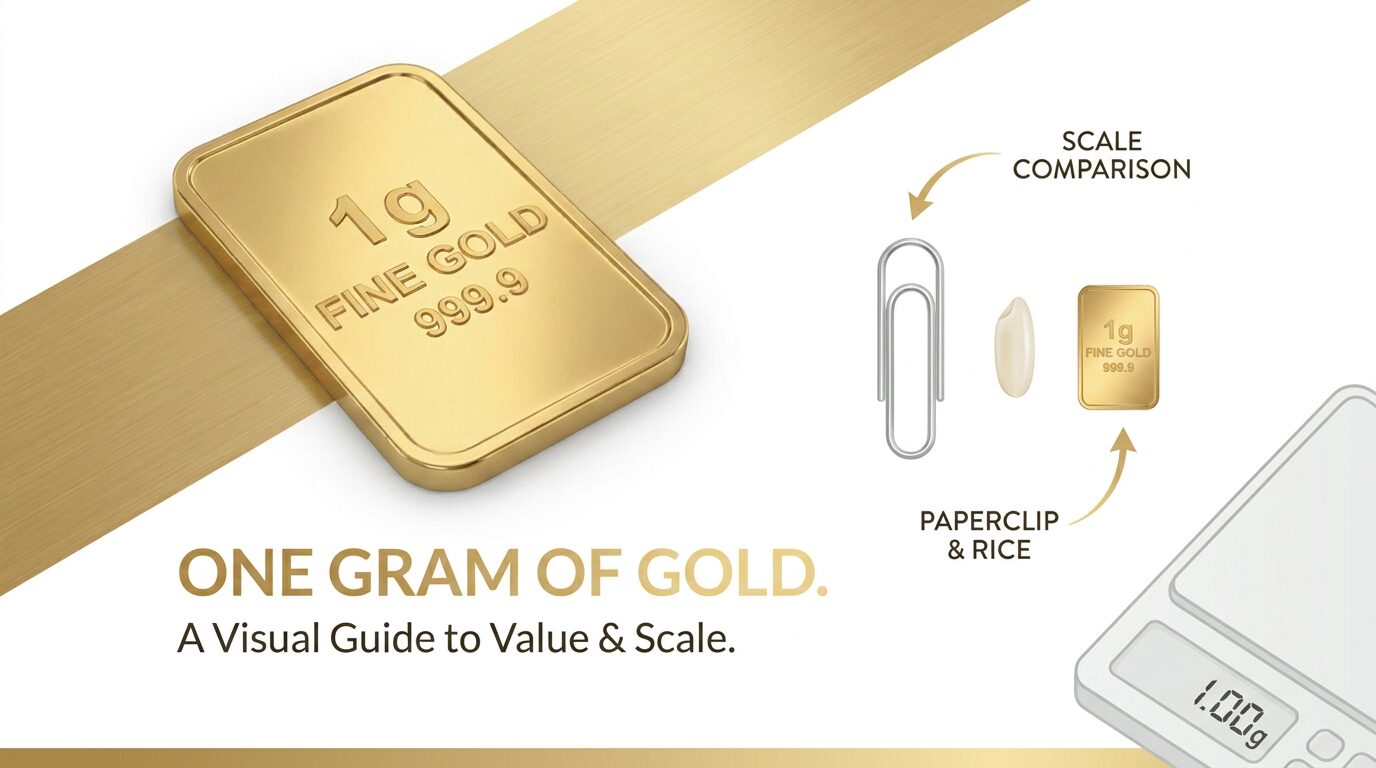
Quick answer: A gram of gold is tiny, about the size of a small paperclip or a shirt button.
As a flat bar, it’s roughly 15–20mm long, 8–10mm wide, and under 1mm thick. It looks small because gold is extremely dense (19.3 g/cm³), so its size never matches its weight or value.
Gold’s been captivating people for thousands of years. Not just because it looks stunning, but because of its tangible value. If you’re just starting out with precious metals, or you’re simply wondering about small denominations, one of the most common questions people ask is: how big is a gram of gold, really?
A single gram sounds minuscule. But once you understand its weight, size, purity, and form, the answer is more surprising than you’d think.
This guide breaks down what one gram of gold looks like across bars, coins, and jewelry, how its size compares across different forms, what it’s actually worth today, and why weight, not appearance, is what really determines its value. If you’re thinking about buying or selling gold in Harwich Port or anywhere along Cape Cod, these details matter more than you might think.
Understanding Gold Weight vs. Size
Here’s the thing most people miss: gold is sold by weight, not by how big it looks. One gram is one-thousandth of a kilogram. Simple enough. But gold is absurdly dense, around 19.3 grams per cubic centimeter. That makes it way heavier than steel, aluminum, or just about any metal you handle day to day.
So when someone hands you a gram of gold, it feels heavier than it looks. That disconnect between size and heft trips up first-time buyers all the time.
The key takeaway: gold’s compact size is a direct result of how dense it is.
What One Gram Actually Looks Like in Your Hand
Visually, a gram of gold is small. Depending on how it’s formed, it might resemble:
- A grain-sized bar
- A thin, narrow piece of jewelry
- A small wafer, round or rectangular, that disappears in your palm
In most cases, a gram of gold can rest easily on the tip of your finger. If it’s pressed into a flat bar, you’re typically looking at something under two centimeters long and only a millimeter or so thick. Most first-time buyers do a double take. The value doesn’t match the visual heft, and that’s perfectly normal.
One-Gram Gold Bars: Dimensions and What to Expect
Bars are where most beginners start, and for good reason. A one-gram gold bar is usually rectangular and sold in protective packaging. Typical dimensions run about:
- Length: 15 to 20 mm
- Width: 8 to 10 mm
- Thickness: roughly 1 mm, sometimes less
The packaging itself is often the size of a credit card, which throws people off. The actual bar? The actual gold content is always one gram, no matter of how big the packaging or branding appears.
What Does 1 Gram of Gold Look Like Compared to Everyday Objects?
Coins of one gram exist, though they’re less common than bars.These coins are typically very small in diameter, often comparable to a small button or a shirt snap.
Because coins carry designs, dates, and mint marks, the metal spreads thinner to accommodate the detail. So a one-gram coin can look broader than a one-gram bar even though the scale reads the same. Again, weight determines value. Appearance is just packaging.
| Everyday Object | Typical Weight | How It Compares to 1g of Gold |
|---|---|---|
| Standard paperclip | ~1g | Nearly identical weight, the closest everyday weight match |
| US dime | 2.27g (17.9mm diameter) | About double the weight of 1g of gold, but a useful size reference for diameter |
| Small shirt button | ~0.5–1g | Close in both size and weight to a small 1g gold coin or wafer |
| Grain of rice | ~0.02–0.03g | Much lighter by weight, useful only as a visual size reference if the gold were melted into a small droplet, not a weight match |
What Is a Gram of Gold Worth Today?
This is what people really want to know when they ask about size. Gold prices shift by the hour based on global trading, so pinning down an exact dollar amount means checking the live spot price on the day you’re reading this.
As a rough guide:
- 24K (pure) gold is worth close to the full spot price per gram
- 18K, 14K, and 10K jewelry is worth proportionally less, since it’s mixed with other metals
- Scrap, broken, or outdated gold jewelry is still valued by its actual gold content and purity, not by how it looks
The only reliable way to know what your gold is worth is to have it professionally weighed and tested. Live spot prices change throughout the day, so an estimate from a chart won’t be as accurate as an in-person appraisal.
Curious what your gold is actually worth? Bring in jewelry, coins, bars, or scrap gold for a free, no-obligation appraisal at Eagle Coins Gold and Silver Buying in Harwich Port. We test purity and weigh on the spot, so you know exactly what you’re being offered and why. Get your free gold appraisal →
How Purity Changes the Size of That Same Gram
Gold purity gets measured in karats or fineness. Pure gold is 24 karat, roughly 99.9% fine. Most one-gram bars and investment-grade coins sit at or near that purity.
But when gold gets mixed with other metals, which is standard for wearable jewelry, the piece needs slightly more volume to hit the same gram weight. Copper and silver simply aren’t as dense. So:
- One gram of 24K gold: compact, dense, smaller footprint
- One gram of 18K gold: visibly a bit larger because of the added alloys
This difference is subtle but real. Two items can weigh exactly the same on a scale and look noticeably different in size.
Why One Gram of Gold Is Popular
There’s a reason a one-gram gold piece is a popular starting point for a few reasons:
- Affordability: You don’t need deep pockets to get started
- Flexibility: Small quantities are easy to liquidate when you need cash
- Gifting: A convenient, meaningful gift without the pressure of a major investment
Understanding the actual size helps set expectations. A gram of gold won’t fill your palm. But what it lacks in bulk, it more than makes up for in concentrated value.
Frequently Asked Questions
How does 1 gram of gold look?
Smaller than most people imagine. It’s typically a thin bar or tiny coin, often no bigger than a fingertip. Gold’s density makes it feel heavier than it appears, which surprises first-time buyers.
How big is 1 gram of gold physically?
In most cases, it is only a few millimeters thick and maybe around 1 to 2 centimeters long, depending on the exact shape. It can easily rest on the tip of a finger.
What is a gram of gold worth today?
The value changes daily based on the live market price and the gold’s purity. For the most accurate number, you really want a professional weighing and testing, like the free appraisals we do in Harwich Port.
What’s the best size of gold to buy?
Depends on your goal. Smaller pieces, including 1 gram, are ideal for beginners and gifting, while larger bars offer better value for long-term investing.
How do you accurately measure 1 gram of gold?
One gram of gold is measured with a precise digital scale made for jewelry or precious metals. Reputable dealers usually double check the weight too, especially when buying or selling, so there’s less guessing.
How pure is a typical 1-gram gold piece?
Most 1-gram gold bars and coins are 24K gold, meaning they’re about 99.9% pure. Always check the purity marking or certification to confirm.
How can I visually estimate a gram of gold without a scale?
Compare it to a standard paperclip (~1 g) or a small shirt button — both are close in weight and roughly the right visual size. A US dime is a useful size reference, too, though it weighs about twice as much. None of these replace an actual scale — they’re just a sanity check before you get something professionally weighed.

 +1 508-252-8888