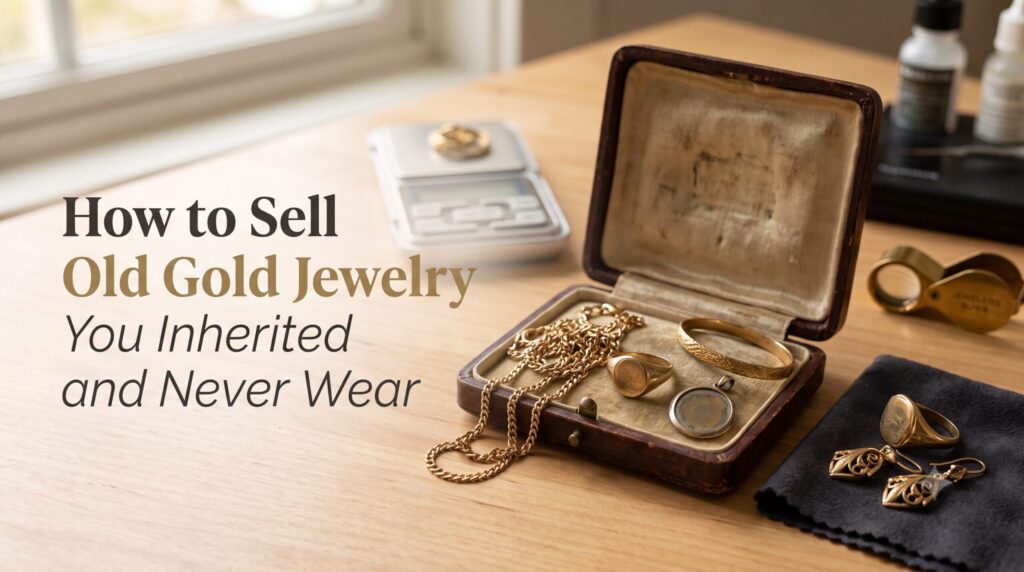
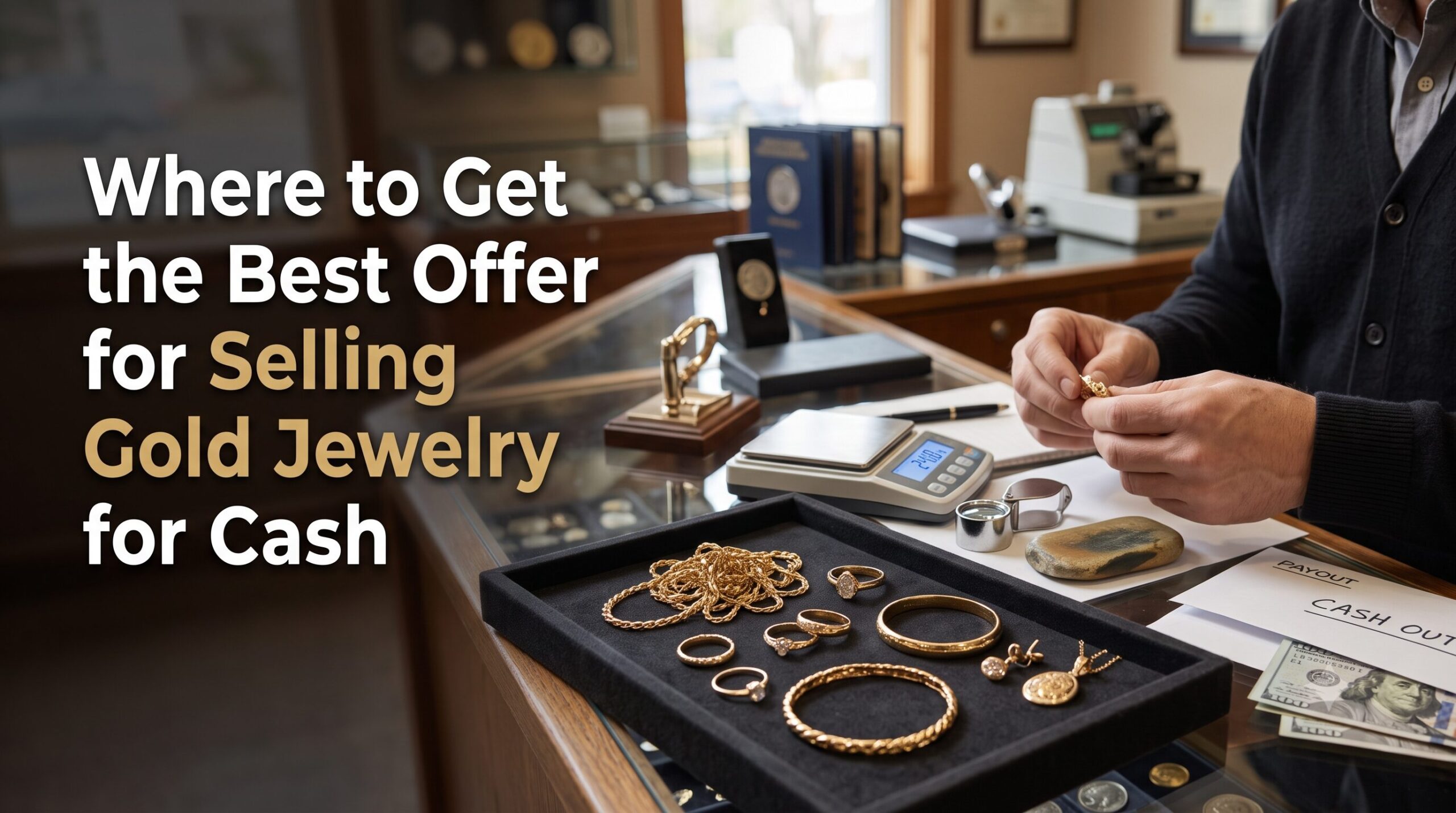
Selling gold jewelry for cash comes down to karat, weight, and the live market rate on the day you sell. A proper evaluation tests purity scientifically, cleans the piece, weighs it to three decimal points per gram, and prices it against current rates. Watching that happen in person beats mailing your jewelry to a stranger.
Most people who walk in here holding a gold ring are not thinking about grams. They are thinking about the person who gave it to them.
That is the part no pricing guide accounts for, and it is why selling gold jewelry is different from selling anything else you own. There is a number, and it is a real number, but it has nothing to do with what the piece meant or what it cost when it was new.
What follows is how that number actually gets calculated: what karat means in practice, what happens during a proper evaluation, what moves an offer up or down, and why the difference between a scientific test and a glance at a stamp can be several hundred dollars on a single ring.
Whether you sell at the end of it is entirely your business. Plenty of people hear the number and take the ring home.
Table of Contents
- Why Jewelry Is Harder to Sell Than Scrap
- What Gold Jewelry We Actually Buy
- What is Karat
- What Happens During the Evaluation
- Four Things That Move Your Offer
- Local Buyer vs. Mail-In vs. Pawn Shop
- Why Face-to-Face Matters More With Jewelry
- Bring It In, Even If You’re Undecided
- Frequently Asked Questions
Why Jewelry Is Harder to Sell Than Scrap
Selling a gold bar is arithmetic. Selling your mother’s bracelet is not.
That difference is real, and it’s worth naming before anything else. People bring in wedding bands after a divorce, chains after a funeral, rings they haven’t worn in fifteen years but couldn’t throw away. The metal has a market price. The piece has a history, and the two numbers have nothing to do with each other.
We’re not going to tell you the sentimental part doesn’t matter. What we will do is give you an honest number for the metal, explain how we got there, and let you decide what to do with that information. Plenty of people come in, hear the number, and take the ring home again. That’s a perfectly good outcome.
The hesitation most first-time sellers feel is usually about being taken advantage of. Watching your piece get tested and weighed on the counter in front of you, rather than sealed into an envelope, tends to settle that quickly.
What Gold Jewelry We Actually Buy
Almost anything in gold, in almost any condition.
- Rings, chains, bracelets, earrings, and pendants in 10k, 14k, 18k, 22k, and 24k
- Broken chains, snapped clasps, and bent pieces
- Single earrings with no match
- Dental gold, including crowns and bridges
- Estate and inherited pieces, including full collections
- Gold watches, including vintage and luxury brands such as Rolex and TAG Heuer
You don’t need the original box, the receipt, or a matching set. If it’s gold, it has value, and we’ll weigh it — the same goes for scrap gold and karat gold in every grade.
The single most common thing people leave at home is the broken stuff. A snapped chain is worth exactly the same per gram as an intact one. So is one earring. If you’re cleaning out a drawer, bring the tangle at the bottom too. We sort it here.
What is Karat
Karat is a purity measurement, and it’s the biggest single factor in what your piece is worth.
Pure gold is 24k. Everything below that is gold mixed with other metals for strength, because pure gold is soft enough to bend with your hands. The number tells you how much of the piece is actually gold:
- 10k is 41.7 percent gold
- 14k is 58.3 percent gold
- 18k is 75 percent gold
- 22k is 91.7 percent gold
- 24k is 99.9 percent gold
So two rings that look identical and weigh the same can be worth very different amounts. A heavy 10k ring can be worth less than a lighter 18k one. This constantly surprises people, and it’s why guessing from appearance doesn’t work.
Stamps help, but they’re not the final word. Marks wear down, and occasionally a stamp is simply wrong. That’s why we test rather than read.
What Happens During the Evaluation
Four steps, all of them in front of you, none of them costing you anything.
- Multilevel scientific testing.
We establish the actual gold content rather than relying on a stamp. - Ultrasonic cleaning.
Residue, polish, skin oil, and years of grime all add weight that isn’t gold. Cleaning first means you’re paid for metal, not dirt. - Weighing to three decimal points per gram.
Not a rounded figure. The third decimal place matters on smaller pieces, and it’s the difference between a real number and an estimate. - Pricing against the current market rate.
Gold moves daily. We price against where the market actually is when you’re standing there.
Then we tell you the number and explain how we reached it. No appointment needed for any of this, and no obligation once you’ve heard it.
Four Things That Move Your Offer
- Karat. Covered above, and the largest single variable.
- Weight. Straightforward, which is exactly why precision matters.
- Condition. For scrap value, condition barely matters. A mangled chain and a pristine one are the same metal. Condition only enters the conversation for collectible or branded pieces where the item may be worth more intact than melted.
- Market timing. Gold prices shift daily. We can’t control the rate, but we can tell you what it’s doing when you come in — that kind of transparency is what our shop has been built on for four decades.
Notice what isn’t on that list: how much you originally paid. Retail jewelry prices include design, brand, retail markup, and margin. None of that survives into resale value. This is the hardest part of the conversation for most sellers, and we’d rather say it here than surprise you at the counter.
Local Buyer vs. Mail-In vs. Pawn Shop
| Factor | Eagle Coins (local) | Mail-in service | Pawn shop |
| Who holds your jewelry | You, until you agree to sell | Shipped out of your hands | In store |
| When you see the test | Live, on the counter | After it arrives, if shown at all | Quick counter check |
| Payment | Same-day cash | Check, often after a wait | Cash, or a loan against the piece |
| If you decline the offer | Take it home that minute | Return shipping, and more waiting | Take it home |
| Pricing explained | Yes, step by step | Set after receipt | Varies |
The mail-in column is the one worth sitting with. Once a package leaves your hands, you’ve lost your only leverage. If the offer that comes back is lower than expected, your options are to accept it or wait for your jewelry to be shipped home.
Why Face-to-Face Matters More With Jewelry
With a bar or a bullion coin, purity is stamped and standardized. With jewelry, every piece is different, and that variability is where questions come up.
Is the clasp the same karat as the chain?
Is that stone worth pricing separately from the setting?
Is this piece worth more as it is than as metal?
Those are conversations, not form fields. You can have them across a counter. You can’t have them with a shipping label.
Bring It In, Even If You’re Undecided
We’ve been buying gold on Cape Cod for over 40 years, and we’re a BBB Accredited Business. In four decades, the thing we’ve learned about jewelry is that people mostly want two things: an honest number and no pressure attached to it.
You get both here. Every evaluation is free, no appointment is needed, and the decision is entirely yours.
If you want to know what your piece is actually worth, see our full sell gold jewelry page.
Come in and find out. Bring the ring, the chain, or the whole tangled drawer to Unit 1-C, 537 Main Street in Harwich Port, or call us at +1 508-252-8888. Free evaluation, no appointment, no pressure to sell. Just a real number.
Selling something heavier? If you’re holding bullion rather than jewelry, read where to sell gold bars safely and get the best price.
Frequently Asked Questions
Q.1 Is the appraisal really free?
A. Completely free, with no catch built in. We’re not charging you for the evaluation and then recovering it in a lower offer. People walk out without selling all the time, and that’s fine with us.
Q.2 What karats of gold jewelry do you buy?
A. All of them, from 10k through 24k. We also buy pieces where you’re not sure of the karat, because we test rather than rely on the stamp. If a piece turns out to be gold-plated rather than solid, we’ll tell you that too.
Q.3 Do you buy broken or single pieces?
A. Yes, and please stop leaving them at home. A broken chain is worth the same per gram as a whole one. Single earrings, bent rings, and clasps with no chain attached all count.
Q.4 How fast do I get paid?
A. Same visit. You accept the offer, we count out the cash, and you’re done. No check in the mail, no holding period, no coming back tomorrow.
 +1 508-252-8888