
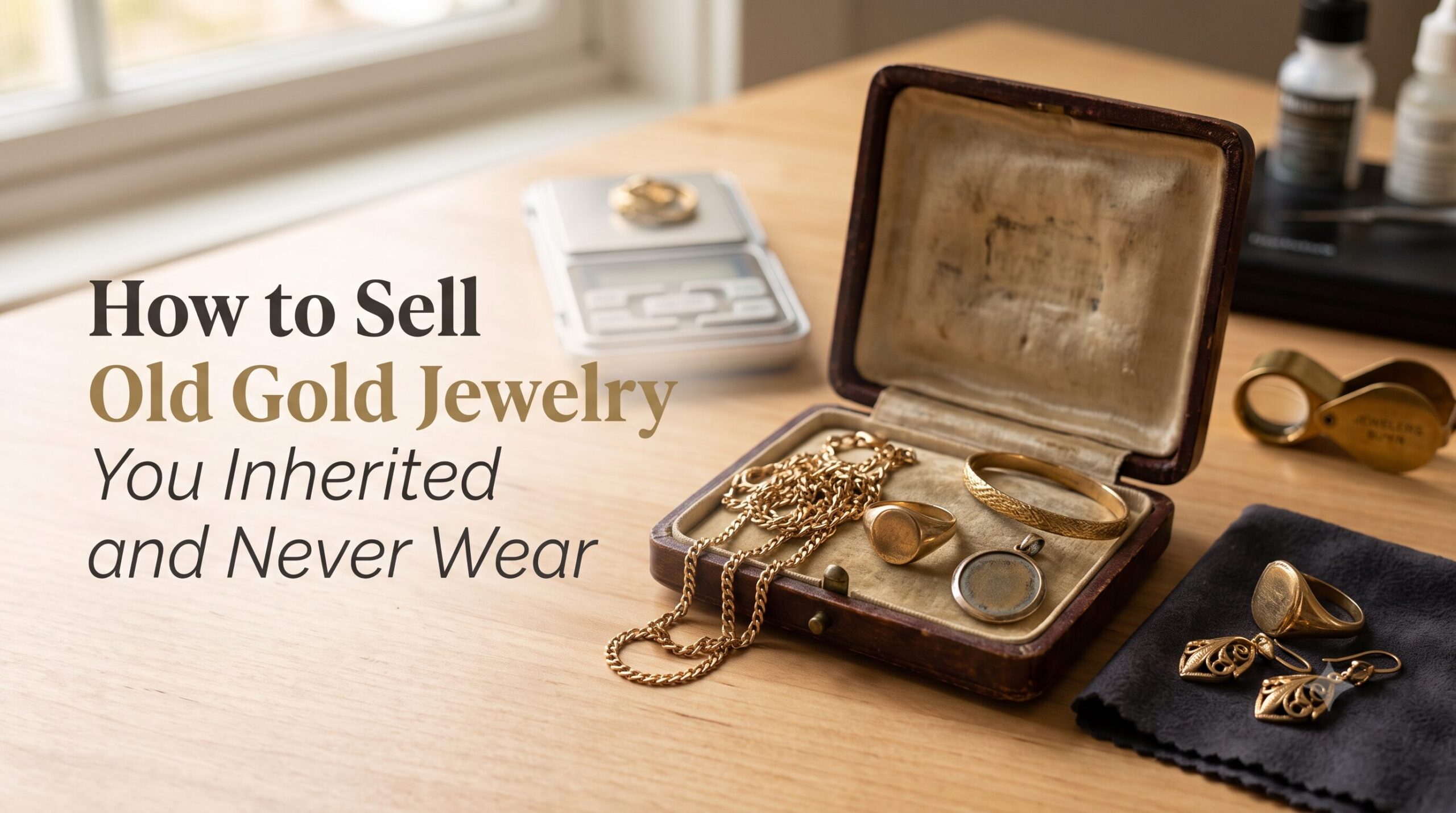
To sell old gold jewelry from an inherited collection, start by separating solid gold from plated pieces and costume jewelry, then have the solid gold tested and weighed rather than guessed at. A proper evaluation establishes karat scientifically, cleans each piece before weighing, and prices against the live market rate. Nothing needs to be sold to find out what it’s worth.
Most inherited jewelry arrives in a box that nobody opens for a year.
There’s a reason for that, and it isn’t indecision. Opening the box means making decisions about someone who has died, and the jewelry stands in for the person. So the box goes in a drawer, and the drawer stays shut.
When it does get opened, the questions are usually the same. Is any of this actually gold? Is any of it worth something? What do I do with the pieces nobody in the family wants, and how do I find out without feeling like I’m putting a price on my grandmother?
What follows is how to sort a collection before you take it anywhere, what a real evaluation involves, and why finding out what something is worth carries no obligation to sell it.
Table of Contents
- Why Inherited Jewelry Sits in a Drawer for Years
- Sorting the Box Before You Go Anywhere
- How to Tell Solid Gold From Plated
- What an Estate Jewelry Buyer Actually Evaluates
- Keep, Sell, or Decide Later
- When Several People Have a Claim
- Sell Old Jewelry in Harwich Without Deciding Anything First
- Frequently Asked Questions
Why Inherited Jewelry Sits in a Drawer for Years
Nobody wants to be the person who sold their mother’s rings.
That’s the honest obstacle, and it’s worth naming before any of the practical advice. The jewelry isn’t really jewelry at this point. It’s the last physical thing that belonged to someone, and selling it feels like a decision about them rather than about metal.
Here’s the part that helps most people: knowing what something is worth and selling it are two different acts. You can do the first without the second. Plenty of people come in, hear the numbers, put everything back in the box, and leave. Some come back years later. Some never do. Both are fine.
What you cannot do is make a good decision without information. A collection you’ve never had looked at is a collection you’re guessing about, and guesses tend to run in both directions. People assume the ornate Victorian brooch is the valuable one and the plain chain is nothing, when it’s frequently the reverse.
Sorting the Box Before You Go Anywhere
You don’t have to do this, but it makes the visit faster and tells you more.
Separate into four rough piles:
- Marked gold. Anything stamped 10K, 14K, 18K, 22K, 585, 750, 916
- Probably gold but unmarked. Older pieces often lost their stamps to wear
- Look for sterling, 925, or a lion passant on British pieces
- Everything else. Costume, plated, unknown
Then bring all four piles anyway.
That’s not a contradiction. Sorting helps you understand your own collection, but the fourth pile is where surprises live. Stamps wear off. Some pieces were never marked. And costume jewelry from certain makers carries collector value that has nothing to do with metal content at all.
The pile people most often leave at home is the broken one. A snapped chain is worth the same per gram as a whole one. So is a single earring, a bent ring, or a clasp with nothing attached.
How to Tell Solid Gold From Plated
A few things you can check yourself, with the caveat that none of them are conclusive.
Look for wear at the edges.
Plating wears through at high-contact points first. Check the inside of a ring band, the back of a pendant, the edge of a clasp. A different color showing through means the plating.
Check for a stamp, then don’t trust it completely.
Marks are useful but not final. They wear down, they’re occasionally wrong, and some older pieces were never marked at all.
Weight gives you a hint.
Gold is dense. A piece that looks substantial but feels light is often hollow or plated. This is a feel rather than a test, and it takes handling a lot of jewelry to develop.
Discoloration on skin
Sometimes indicates plating over base metal, though this varies by person and isn’t reliable on its own.
None of this replaces testing. We use multi-level scientific testing to determine actual gold content rather than relying on a stamp and hoping. It costs you nothing, and it’s the only way to know.
What an Estate Jewelry Buyer Actually Evaluates
Four things happen, all of them on the counter where you can watch.
- Testing establishes what each piece actually is. Not what it’s stamped as. Not what the family always said it was.
- Ultrasonic cleaning comes before weighing. Decades in a box leave residue, polish, and grime, none of which is gold. Cleaning first means you’re paid for metal rather than dirt.
- Weighing to three decimal points per gram. On a collection of small pieces, the third decimal place adds up across the whole box.
- Pricing against the live market rate. Gold moves daily. You can check the live spot price before you come in, and we’d encourage it.
Then each piece gets discussed separately, because the answer isn’t always “melt.” Some pieces are worth more intact than as metal, and we’ll say so.
Keep, Sell, or Decide Later
Most inherited collections split three ways, and the split usually becomes obvious once the numbers exist.
| What it usually is | What to do | |
| Worth more than metal | Signed pieces, period designs, significant stones, some collectible makers | Get it valued as a piece, not as weight |
| Worth metal value | Broken chains, worn bands, single earrings, unfashionable settings | This is the pile most people sell |
| Worth keeping | Anything someone in the family actually wants to wear | Nobody should talk you out of this |
| Worth nothing much | Costume, plated, heavily damaged base metal | Honest answer, delivered plainly |
The fourth row matters. A buyer who finds value in every single item in your box is not being straight with you. Some inherited jewelry is costume jewelry that someone loved, and that’s all it is. We’ll tell you that rather than rolling it into a vague lump-sum offer.
When Several People Have a Claim
This comes up more than you’d expect, and it’s worth planning for.
If a collection is being divided among siblings or beneficiaries, get everything evaluated before anyone takes anything. An itemized assessment gives everyone the same information, making division a conversation about who wants what rather than an argument over who got more.
Come together if you can. Two people hearing the same numbers at the same counter prevents a lot of difficulty later. If that isn’t practical, ask for the breakdown in writing so the same figures can be shared with everyone.
And if the estate is still in probate, check with the executor or the estate’s attorney before selling anything. We’re not lawyers and won’t pretend to be, but we’d rather raise it than have you find out afterward.
Sell Old Jewelry in Harwich Without Deciding Anything First
We’ve been buying gold on Cape Cod for over 40 years, and we’re a BBB Accredited Business. Inherited collections are a large part of what comes across the counter, and the thing most people want isn’t the highest possible number. It’s an honest one, explained, with nobody pushing.
Every evaluation is free. No appointment is needed. Our 100% satisfaction guarantee covers the transaction, and the decision stays yours.
For more on the process, see our sell old jewelry and estate jewelry pages, or read about the shop on our About Us page.
Bring the box as it is, tangles included. Come to Unit 1-C, 537 Main Street in Harwich Port, or call +1 508-252-8888 if you’d rather talk it through first. We also serve Yarmouth, Barnstable, Hyannis, Brewster, Orleans, and towns across Cape Cod and greater Massachusetts.
Frequently Asked Questions
Q.1 Do I have to sell everything I bring in?
No, and most people don’t. You can have the whole collection evaluated, sell three pieces, and take the rest home. Each item is assessed separately so you can decide piece by piece.
Q.2 What if I don’t know whether something is real gold?
Bring it. Testing is free and takes a minute. Roughly a third of what comes in from inherited collections turns out to be plated or costume, and knowing which is which is useful on its own.
Q.3 Should I clean inherited jewelry before bringing it in?
No. We use ultrasonic cleaning as part of the evaluation, and home cleaning can damage older settings or loosen stones.
Q.4 Can you value a collection for dividing among family?
Yes. We can assess each piece individually so everyone involved sees the same figures. Bring everything in one visit, and ask for the breakdown in writing.
Q.5 What about pieces that aren’t gold or silver?
We’ll look at them. Some costume jewelry carries collector value, and we also buy diamonds, watches, coins, and old currency. If something has no real value, we’ll say so plainly.
 +1 508-252-8888