Best Prices for Coins: How to Get the Highest Offer for Your Coin Collection

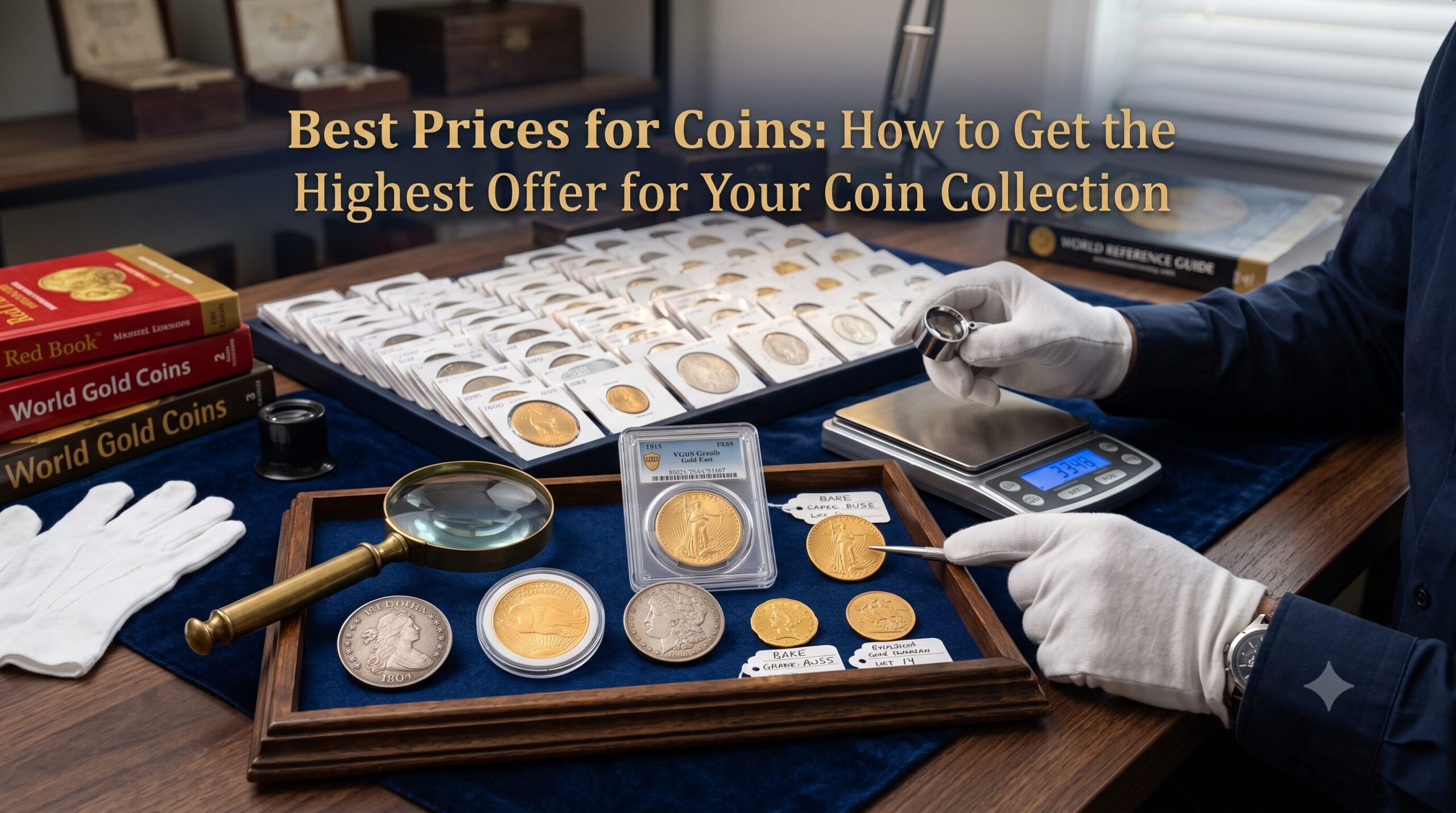
Getting the best prices for coins comes down to two things: an appraiser who knows the difference between metal value and collector value, and a face-to-face evaluation instead of a mailed-in guess. We test purity, weigh precisely, and factor in rarity and condition before making an offer, then pay same-day cash at our Harwich Port shop.

Table of Contents

What Actually Determines a Coin’s Value?

A coin’s offer is built from two separate numbers: what its metal is worth melted down, and what collectors will pay for it as a coin. Common circulated silver or gold coins usually sell close to metal value. Rare dates, low mintage years, and well-preserved condition can push a coin’s price far above that.

This trips up a lot of first-time sellers. Someone assumes a bag of old silver dollars is just “silver weight,” brings it in, and finds out a few dates in the mix are worth several times melt value because of rarity or collector demand. It cuts the other way too. Some “old-looking” coins are common enough that metal weight is genuinely the whole story. You need someone who can tell the difference at a glance and explain why.

Which Coins Do We Buy?

We buy gold, silver, vintage, and bullion coins in nearly any quantity, from a single find to an entire inherited collection.

  • Bullion coins: American Eagles, Canadian Maple Leafs, and Krugerrands
  • Historic gold: pre-1933 U.S. gold coins
  • Silver coins: silver dollars and other circulated or uncirculated silver
  • Collector sets: proof sets and commemoratives
  • Full collections: inherited or accumulated coin collections, evaluated coin by coin

You don’t need to sort or research anything before you come in. Bring the whole box, the coffee can, the album, whatever you’ve got. We’ll go through it with you.

How Does Our Coin Appraisal Process Work?

Our process is the same three steps whether you’re selling one coin or a full collection: bring it in, get a free evaluation, and walk out with cash. For coins specifically, we look at each piece individually rather than weighing everything together as scrap.

  1. Bring in your coins. No appointment needed, no minimum quantity.
  2. Free, itemized evaluation. We assess each coin’s weight, purity, condition, rarity, and current market value.
  3. Walk out with cash. Accept the offer and get paid the same day, no waiting on a check.

Gold coin content is weighed to three decimal places per gram and priced against current market rates, using multilevel scientific testing and ultrasonic cleaning to get an accurate read before anything is weighed.

Why Does Local Appraisal Beat Mailing Coins In?

Mail-in coin buyers price your collection after it’s already in their hands, which means you’re trusting their number sight unseen with no chance to ask questions in the moment. A local appraisal lets you watch each coin get evaluated and push back if something doesn’t add up.

That matters even more for coins than for plain gold scrap, because rarity and condition swing the price so much. If a mail-in buyer misjudges a coin’s condition or overlooks a scarce date, you have no way to know until the check arrives, and by then the coins are already gone.

Local Coin Buyer vs. Mail-In Service vs. Pawn Shop

FactorEagle Coins (Local)Mail-In BuyerPawn Shop
Coin-by-coin appraisalYes, in personRare, often bulk-pricedUsually not specialized
Rarity and numismatic knowledge40+ years of experienceVaries, often automatedTypically general merchandise focus
Item control during appraisalStays in your handsShipped away firstIn-store
PaymentSame-day cashCheck, often delayedSame-day, cash or loan

Selling Silver in Massachusetts

Along with coins, we buy silver in every form: sterling silverware, heirloom pieces, bars, chains, rings, and silver coins. Silver flatware sets in particular often get overlooked because people assume “silver-plate” and “sterling” look the same. They don’t price the same, and we’ll tell you plainly which one you have.

If you’re selling silver in Massachusetts, whether it’s a set of family flatware or a stack of silver dollars, the same evaluation process applies: weighed, tested, and priced against current market rates on the spot.

What About Watch Appraisals?

If your coin collection came out of the same drawer as an old watch, bring that along too. We appraise gold and silver watches, vintage pieces, and luxury brands including Rolex and TAG Heuer, using the same in-person, no-pressure process. We evaluate watches separately from coins but price them during the same visit.

A Trusted Coin Buyer in Massachusetts

We’ve been a coin buyer in Massachusetts and across Cape Cod for over 40 years, and we’re a BBB Accredited Business. That experience is what lets us tell a common date from a scarce one at a glance, and it’s why sellers from Harwich, Brewster, Orleans, and Hyannis, along with towns like Newton and Framingham, choose to make the trip rather than mail in a collection. If you’re looking for the best prices for coins, an in-person evaluation gives you the chance to understand the value of each piece before deciding whether to sell.

You can see our full range of coin buying on our coin buying page, and learn more about our shop on our about us page.

Get the Best Prices for Coins at Our Harwich Port Shop

The best prices for coins come from an appraiser who separates metal value from collector value and explains the difference to you directly. Bring your collection to Eagle Coins Gold and Silver Buying in Harwich Port for a free evaluation and same-day cash, no appointment required.

Frequently Asked Questions

Q.1 How do you know if a coin is worth more than its metal value?
A.
We check each coin’s date, mint mark, condition, and rarity against current collector demand, not just its weight. Some coins sell close to melt value, while rare dates or well-preserved pieces can be worth significantly more. We explain the difference during your evaluation.

Q.2 Do I need to clean or sort my coins before bringing them in?
A.
No. Don’t clean your coins, since cleaning can actually reduce a collectible coin’s value. Just bring them as they are, whether that’s a sorted album or a mixed box, and we’ll evaluate everything during your visit.

Q.3 Do you buy full inherited coin collections? Yes. We regularly evaluate full inherited collections, going through each coin individually rather than pricing everything as bulk metal. Bring the entire collection in one visit, and we’ll provide a free, itemized appraisal.

Q.4 Can I sell silver and watches at the same time as my coins?
A.
Absolutely. We buy silver flatware, heirlooms, and coins, along with gold and silver watches, in the same visit. There’s no need to separate items into different appointments; we’ll evaluate everything you bring in together.
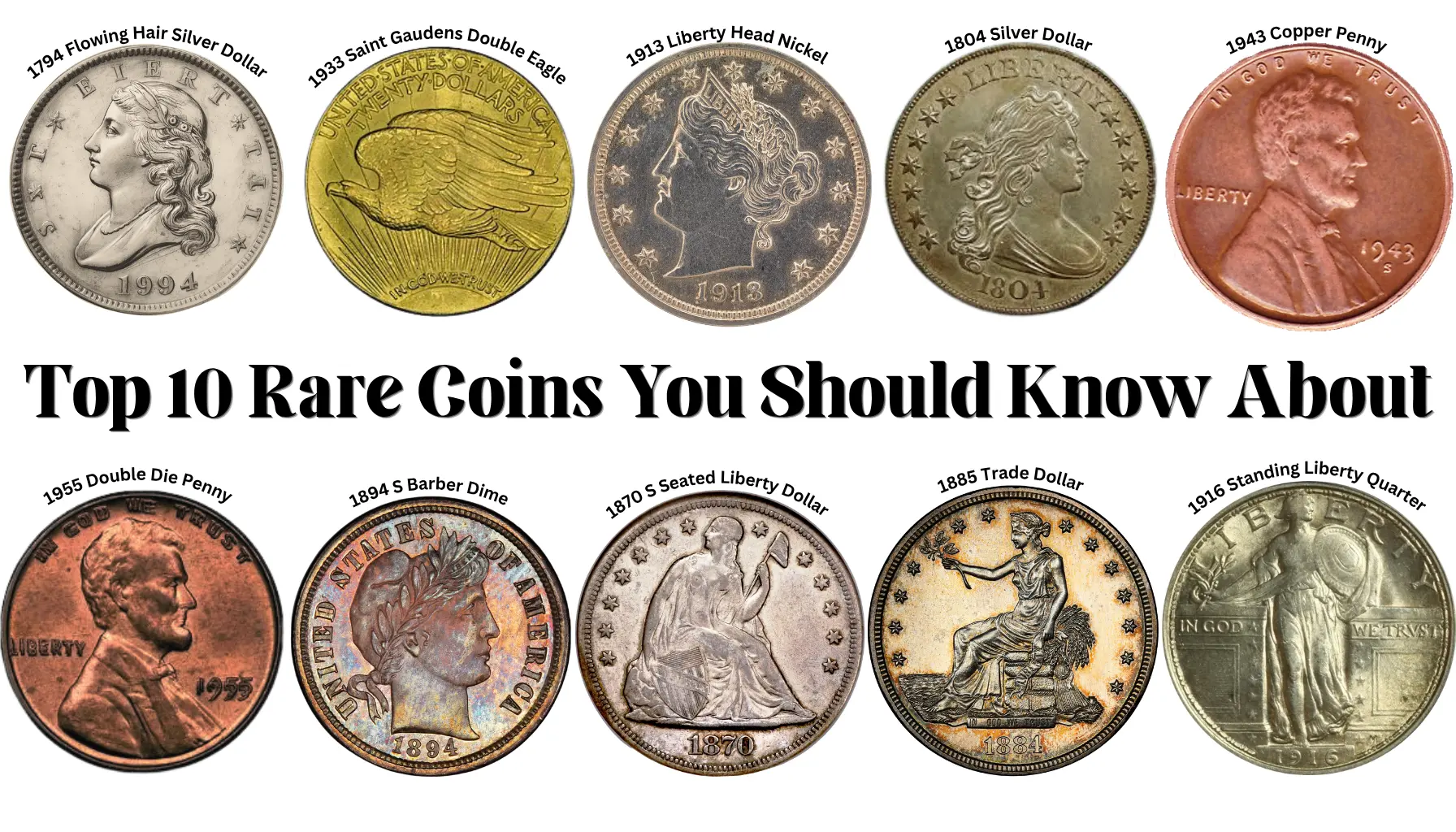
Top 10 Rare Coins You Should Know About

If you’ve ever opened an old drawer, found a jar of coins, or inherited a small collection, you’ve probably had that thought for a second. What if one of these is actually worth something serious? Not just a few dollars. Something real.

That’s exactly why people keep searching for the top 10 rare US coins and the top 10 rare coins wanted by collectors. Because every now and then, someone does find one.

Let’s walk through some of the most talked about rare coins. Not in a stiff textbook way. Just what they are, why they matter, and what makes them so valuable.

And if you ever do come across something unusual, places like Eagle Coins Gold and Silver Buying can help you figure out what you’re actually holding.


1. 1794 Flowing Hair Silver Dollar

This one is kind of legendary.

It’s believed to be one of the very first silver dollars the United States ever made. Think about that for a second. Early days of the country, brand new mint, everything still being figured out.

Because of that, collectors don’t just see a coin. They see history.


2. 1933 Saint Gaudens Double Eagle

This coin has a strange story. It was never really supposed to be in public hands.

Most of them were melted down during the Great Depression. A few survived. That alone makes it rare. Add in the design and the mystery around it, and suddenly you have one of the most desired coins ever.

Definitely one of the top 10 rare coins wanted by collectors.


3. 1913 Liberty Head Nickel

Only a handful exist. Not a few thousand. Literally just a few.

That kind of rarity changes everything. Even people who don’t collect coins have heard of this one.

It shows up in conversations the same way rare paintings or vintage cars do.


4. 1804 Silver Dollar

This coin is sometimes called the king of American coins. Funny thing though, most of them were not actually minted in 1804.

They were produced later for special sets. Still, the name stuck.

Collectors love it. The story behind it helps too.


5. 1943 Copper Penny

This is one of those coins people actually find.

During World War II, pennies were made from steel. But a few copper ones slipped through by mistake. That small error turned into a big deal.

There are stories of people finding one in loose change. Not common, but it happens.


6. 1955 Double Die Penny

If you look closely at this coin, the text looks doubled. Not blurry. Actually doubled.

That’s a minting error, and collectors love errors.

It’s one of those coins where even beginners can spot something is off. Which makes it exciting to look for.


7. 1894 S Barber Dime

Very few of these were ever made. Even fewer still exist.

There’s even a story about a banker giving a few of them to his daughter, who spent one on ice cream. Imagine that.

That one detail alone makes people remember this coin.


8. 1870 S Seated Liberty Dollar

This coin has a bit of mystery around it. No one is completely sure how many were made or why.

That uncertainty actually adds to the appeal.

Collectors don’t just want rare coins. They want stories. This one has both.


9. 1885 Trade Dollar

Trade dollars were used for international trade, mostly with Asia. But the 1885 version is extremely rare.

Very limited numbers. Hard to find. High demand.

That combination is what pushes coins into the top 10 rare US coins category.


10. 1916 Standing Liberty Quarter

This was the first year of a new design, and the production numbers were low.

First year coins tend to attract attention anyway. Add rarity on top of that and you have something collectors actively search for.


So What Actually Makes a Coin Valuable

It’s not just age. People assume that a lot.

A coin can be old and still not worth much. What matters more is:

  • How many were made
  • How many still exist
  • Condition
  • Demand from collectors
  • Any unusual features

Sometimes it’s one factor. Sometimes it’s a mix of all of them.


A Quick Reality Check

Most coins people have are not rare. That’s just the truth.

But here’s the thing. You don’t need a million dollar coin for it to be worth checking. Even moderately rare coins can have real value.

If you’ve got a mix of old coins sitting around, it’s worth taking a closer look.


What You Should Do If You Think You Have One

First, don’t clean it. That’s a common mistake.

Second, don’t guess the value based on Google images. Coins can look similar and be completely different in value.

The best step is getting it looked at properly. A place like Eagle Coins Gold and Silver Buying can evaluate things like authenticity, condition, and market demand.

That part matters more than most people realize.


Small Tips That Actually Help

  • Keep coins in original condition
  • Store them safely
  • Separate anything that looks unusual
  • Pay attention to dates and mint marks

It sounds basic, but these small things can make a difference.


Conclusion

The world of rare coins is interesting because it mixes history, chance, and value all in one place. From the 1794 silver dollar to the 1943 copper penny, the top 10 rare coins wanted by collectors all have something unique going for them.

And while most collections won’t include something ultra rare, you never really know until you check.

If you’re curious, or even a little unsure, getting a proper evaluation from Eagle Coins Gold and Silver Buying is a smart move.

Sometimes it turns out to be nothing special.

Sometimes, not so much.

What Is the Halifax Coin? History and Origins Explained

Coins are more than just money; they are historical artifacts that narrate the history of trade, economies, and societies. Among certain other terms that are subject to curiosity is the Halifax coin, a concept that can be traced to early colonial currency systems and numismatic history. Knowing the origins of the Halifax coins can offer valuable insight into the history of money, whether you’re a collector or just a curious person. 

At Eagle Coins Gold and Silver Buying, both the collectors and the sellers get to know the coins not only as valuable items, but also the stories of these coins. Having a deeper knowledge of coins like Halifax can make you appreciate their significance and the potential worth that they have, whether it’s a historical piece or a modern bullion. 


What Is the Halifax Coin?

The expression ‘Halifax coin’ is not applied to any particular design of coin, but is generally associated with the Halifax rating, a historic price system used in colonial North America to determine the value of coins.

The Halifax rating was designed in Halifax around the middle of the 18th century and was used to standardize the worth of foreign coins, especially the Spanish dollar, in the British colonial economy. 

The Spanish dollar was rated five shillings under this system, which was slightly more than the actual quantity of silver in it. This encouraged coins to remain in circulation instead of being melted down for their bullion value. 


The Historical Context Behind the Halifax Coin

Colonial Currency Challenges

In the 18th century, there was a shortage of British coins in British North America. Because of this, foreign coins, particularly Spanish silver dollars, became highly popular for carrying out day-to-day activities.

However, the inconsistent values used to create confusion. Different areas applied different values to the same coin, which created inefficiency in trade.

To address this problem, the Halifax system was put forward in order to establish a uniform method of valuation. This is the reason why the term ‘Halifax coin’ is usually linked to the regulation of currency, as opposed to a particular minted coin.


Influence of Trade and Economy

The Halifax rating was an important factor that stabilized the trade. It attributed a universal value to widely circulated coins, thereby making transactions more predictable and efficient. 

This system especially came in handy in port cities such as Halifax, which were the hubs of trade and commerce in the area. 


Connection to the “Halifax Coiners”

The other historical aspect that can be linked to the ‘Halifax coin’ is the coiners of Halifax.

During the 1760s, a group of counterfeiters headed by David Hartley was involved in the illegal counterfeiting of gold coins and the printing of counterfeit currency. 

These activities highlight the broader historical issues of currency integrity preservation. Although the Halifax rating has nothing to do with the coiners, the story of the coiners introduces another element of interest behind the term ‘Halifax coin’.


Types of Coins Associated with Halifax

Over time, collectors have loosely used the term Halifax coin to describe various coin types in association with Halifax or its history.

  1. Spanish Dollars (Pieces of Eight)

These were some of the most widely circulated coins in colonial North America, and they formed the basis of the Halifax rating system.

  1. Colonial Tokens and Medals

In some cases, coins located within the regions of Halifax are actually tokens or commemorative medals as opposed to actual currency.

Indeed, as the collector frequently observes, some of the Halifax coins can be seen to be merely souvenir or trade tokens, instead of government-issued money. 

  1. Early Canadian Coinage

Coins used in the early history of Canada can also be informally known as Halifax coins because of the association people had with the region.


Why the Halifax Coin Matters to Collectors

The significance of the monetary history of the ‘Halifax coin’ to collectors is that it was an influential event in the history of monetary coins.

  • Historical Significance: The Halifax rating system indicates the way the early economies were adjusting to the lack of currency and the needs of the trade.
  • Collector Value: Coins relating to this time, especially Spanish dollars or early colonial coins, can be worth a great deal or nothing, according to their condition and rarity.
  • Educational Insight: Studying these coins helps collectors to understand the evolution of modern currency systems better.


Role of Professional Coin Buyers

For the owners of historical coins or people who believe they may have a Halifax coin, it is necessary to have a professional evaluation.

Eagle Coins Gold and silver Buying provides the services that assist people in:

  • Identify rare and historical coins
  • Determine the current value in the market
  • Sell gold and silver coins with security 
  • Look at the opportunities of collectibles and bullions

Their expertise ensures that whether it is the beginners or experienced collectors, you can make informed decisions about collections.


How to Identify a Halifax-Related Coin

If you believe that you may have a coin with Halifax historical connections, it is important to consider the following:

  • Origin: find any markings indicating Spanish or early colonial minting
  • Material: A lot of historical coins are made of silver or gold
  • Design: Symbols, dates, and inscriptions can provide clues
  • Condition: Coins in good condition usually have a higher value 


Due to the fact that the term ‘Halifax coin’ is broad, the coins may need to be professionally evaluated to determine authenticity and value.


FAQs

  1. What is a Halifax coin?

A Halifax coin refers in general to coins related to the Halifax rating system, which standardized the value of foreign coins such as the Spanish dollar in colonial North America.


  1. Is the Halifax coin an actual minted coin?

No, the term does not generally mean a particular coin; it just refers to coins with a value under the Halifax rating system during the 18th century.


  1. What is the significance of the Halifax coin in history?

It played an important role in stabilizing trade by producing a consistent value of foreign coins largely used in colonial economies.


  1. Are coins related to Halifax useful in the present day?

Yes, the coins of that era, Spanish silver dollars in particular, or other early colonial coins, may be, or may not be, valuable, according to their rarity and condition.


  1. How can I find out if I own a Halifax coin?

You may look around and find historical markings and materials, however it is better to get the coin appraised by a reputable service such as Eagle Coins Gold and Silver Buying to confirm the visualization and value of the coin.

Should I Sell My Late Parent’s Gold Coins or Keep Them?

It is a very emotional experience to inherit your parents’ gold coins. They tend to have both monetary and emotional importance, connected to family history and memory. Having been put in such a predicament, a question most people grapple with is what to do with inherited gold coins. There is no clear-cut answer to this question, as it is a matter of emotional attachment, financial necessity, and long-term planning.

Being aware of your choices and the consequences of choosing one over the other may lead you to an informed decision.

The Heart of Inherited Gold Coins

The predecessor gold coins can be much more than money. They can be used to represent milestones, traditions, or individual accomplishments of your deceased parent. To certain people, holding on to such coins is a method of keeping family heritage and having a physical association with family members.

When there is a great deal of sentimental attachment attached to the coins, a sale will be immediately regretted. The first step in thinking over what to do with inherited gold coins is usually to take the time to think.

Knowing the Financial Value

Emotional value is vital, but it is also necessary to comprehend the financial component. Depending on their weight, purity, rarity, and condition, gold coins may be of great value. Certain coins can even be numismatic, i.e., they are of value to a collector beyond their gold value.

Professional appraisal should be considered before making a decision on what should be done with any gold coins that have been inherited. This will assist you in deciding how to best sell, retain, or even auction the coins to the collectors.

Reasons You Should Sell

When wondering what to do with inherited gold coins, selling them may appear as the right choice because there are several practical reasons.

  1. Immediate Financial Needs

When you need money to pay off debts, cover medical bills, or handle some other significant life transition, the sale of gold coins can offer immediate cash. Gold is a universally accepted asset, meaning that it is fairly easy to turn into cash.

  1. Good Market Conditions

The prices of gold vary depending on the economic conditions of the world. When the prices are high, selling would be a good payoff. You can also determine what to do with inherited gold coins by monitoring the market to determine the right time.

  1. Lack of Personal Attachment

Not all people have a strong emotional attachment to inherited objects. Provided that the coins do not have a lot of sentimental meaning to you, it may be a good idea to sell them.

Reasons to Keep the Coins

Conversely, keeping inherited gold coins can be beneficial in a number of ways as well.

  1. Long-Term Investment

Gold is reputed to hold value with time. Holding the coins may be used to hedge against inflation and economic risk. A large number of individuals prefer to own gold as an investment option.

  1. Family Heirloom

It is possible that inherited coins may be turned into treasured heirlooms to be donated to the next generation. By retaining them in the family, their sentimental and historical value is retained.

  1. Potential Appreciation

Some coins, particularly those that are rare or certain collectible coins, can appreciate over time. When your inherited coins are numismatic, it may make better sense to hold onto them and get higher returns in the future.

Hybrid Solution: Sell a Little, Keep a Little

You need not take one extreme if you are not sure what to do with inherited gold coins. Middle ground can be oftentimes the best solution.

You Might Consider:

  • Holding back some of the coins as a memento.
  • To sell part of it to cover financial requirements.
  • Selling standard bullion and retaining the rare or collectible pieces.

This is the best way to pay tribute to your parent and also make sound financial choices.

Critical Things to Keep in Mind

Consider the following before making up your final decision of what to do with inherited gold coins:

Market Timing

The prices of gold can vary tremendously. Selling at a high would be a great way to earn, and selling in a slump might not be the best way to do so.

Storage and Security

In case you decide to retain the coins, they should be stored in a safe place. They can be home safes or bank deposit boxes.

Tax Implications

In other instances, the sale of inherited gold coins can be taxed. A financial advisor may help you to realize any obligations.

Trusted Buyers

Should you sell, it is important to select a buyer that is reputable. Ask around and compare prices to make sure you get a reasonable price.

Making the Right Decision

At the end of the day, the question of what to do with inherited silver and gold coins doesn’t have a one-fits-all answer. The best decision will be determined by your individual situation, financial aspirations, and the emotional attachment you have to the coins.

Move at your own pace, get all the information required, and do not make hasty decisions. Regardless of whether you sell, retain, or merge both strategies, the most important thing is ensuring that you make a decision that is within your values and long-term strategies.

Final Thoughts

The gold coins that you have inherited have both an emotional and a financial value. When deciding what to do with them, you might feel emotional or overwhelmed, but it doesn’t necessarily have to be this way. You can find the right path by evaluating your options and understanding the sentimental and monetary aspects of your inheritance. 

While considering what to do with inherited gold coins, make sure that you know that the best choice is only the one that strikes a balance between practicality and personal meaning. Thoughtful planning will help you in honoring your parents’ memory and also making a decision that is financially sound. 

FAQs

  1. What should I do first after inheriting gold coins?

Get the coins professionally appraised by an experienced assessor. This will help you understand their actual value before you go on to decide what to do with inherited gold coins.

  1. Is it better to sell inherited gold coins immediately?

This isn’t necessary. Whether it is best to sell or not depends on the market conditions, your financial needs, and your emotional attachment to the coins. 

  1. Are inherited gold coins taxable when sold?

Yes, in some cases they do. When you sell gold coins, you are subject to capital gains tax in some cases, so it is better to consult an expert before selling. 

  1. How do I know if my coins are rare or valuable?

It can be assessed by a professional numismatist or a coin dealer whether or not your coins have a collectible value beyond their gold content. 

  1. Can I keep some coins and sell the rest?

Absolutely. A lot of people choose this balanced approach when they have to decide what to do with their inherited gold coins. This allows you to keep some meaningful pieces with yourself and also reap financial rewards by selling others. 

What Coins Are Worth Money? A Beginner’s Guide

To most individuals, when an old coin is found in a drawer or in the pocket, the thought of it makes one wonder: ‘Is this worth anything?’ While most of the modern coins are only worth their face value, whether due to rarity, age, metal content, or unique features, can be significantly more. Understanding what coins are worth money helps collectors, casual savers, and treasure hunters who know how to recognize the value hidden in coins without paying too much or missing opportunities. 

Whether you’re exploring a collection of coins, cashing in inherited coins, or simply checking your spare change, knowing which coins have collectible or melt value can be an outright reward. In this guide, you’ll get to know some common coins that are often worth more than their face value, and explain the key factors behind their value. 


How Coins Gain Value: The Basics

Before we look at some specific coins, it is important to understand why some coins are worth money while others aren’t. Value often comes from one or more of the following: 

  1. Rarity: The coins minted in limited quantities or specific years can be worth more simply because of the scarcity. 
  2. Condition: The state of a coin, often graded from poor to mint state, has a significant impact on its value. Even rare coins in poor condition could have only a modest value above face value. 
  3. Metal Content: Some older coins were minted in silver or gold, giving them an intrinsic value of metal, which in most cases exceeds face value alone. 
  4. Historical Significance: Coins with significant historical significance or interesting designs often attract collectors, increasing their market worth. 


Common U.S. Coins That Can Be Worth Money

Here are some coins that are already known in the United States that may have more value than their face value.

  • Wheat Pennies (1909-1958):

The pennies with wheat ears on their back are among the most recognizable collectible coins. The vast majority of them can be valued at slightly more than 1 cent; however, early issues, especially those from 1909-1911 and those bearing a “VDB” mint mark, can be worth several dollars or beyond in fine condition. 

  • Mercury Dimes (1916-1945):

These silver dimes feature the iconic Winged Liberty Head and contain actual silver. Their value generally is over the face value because of the silver content and collector demand. 

  • Silver Roosevelt Dimes, Quarters, and Half Dollars (Pre-1965):

The coins that were minted in the United States prior to 1965 were often made of 90% silver. As a result, such coins have melt value, the worth of the silver itself, usually greater than the original denominations of the coins. 

  • Franklin and Kennedy Half Dollars:

Franklin half-dollars (1948-1963) and early Kennedy half-dollars (1964) contain high silver content, which makes them worth more than 50 cents based on metal value alone. 

  • Buffalo Nickels (1913-1938):

These coins are commonly referred to as Indian Head nickels, and they are popular among collectors. Some dates, like 1913-S Type 2 and 1937-D three-legged varieties, can be especially valuable. 


Rare and Valuable Coins You Might Find

Beyond the well-known series, some individual coins are also worth checking closely: 

  • 1909-S VDB Lincoln Penny:

This early Lincoln penny is one of the most demanded varieties. In high grades, it can be worth hundreds or even thousands of dollars. 

  • 1916-D Mercury Dime:

This coin is another classic rarity. It is not heavily minted and also has collecting demand, which can make its value go much higher than face value. 

  • 1932-D & 1932-S Washington Quarters:

Both issues from the first year of the Washington quarter series are scarce and valuable in good condition. 

  • 1955 Doubled Die Lincoln Cent:

This penny is a striking error coin where the date and the letters are evidently duplicated. Well-preserved examples can fetch very high prices. 


Error Coins: Unexpected Surprises in Pocket Change

Coins with production errors sometimes attract strong collector interest. These include:

  • Off-Centre Strikes: The lack of parts of the design due to misalignment
  • Double Strikes: Coins struck more than once
  • Wrong Planchet Errors: Coins struck on wrong metal blanks

Although not every coin with an error is valuable, major or dramatic errors can be worth a significant amount more than the face value. 


How Metal Content Affects Value

When people ask ‘What coins are worth money?’, metal composition is often part of the answer. Until 1965, many U.S. coins contained a large amount of silver, and even earlier, gold coins contained pure precious metals: 

  • Gold coins (pre-1933 U.S.) often sell at a premium depending on the gold content and rarity. 
  • Silver coins (pre-1965) still hold value because of silver prices, which fluctuate with the global market. 

Both bullion value and collectible demand both influence pricing, thus coins made of precious metals tend to hold consistent interest over time. 


Condition Matters: Grading and Preservation

The value of two coins of equal type and date can vary radically depending on the condition. The coin assessments involve:

  • Mint State (MS): Almost flawless condition
  • Extremely Fine (EF): There is light wear on high points
  • Good (G): Major details visible but worn

Value is frequently determined by means of standardized grading scales used by collectors and dealers. The better-condition coins are harder to find and usually fetch better prices in the market. 


Where to Learn More About Valuable Coins

If you’re not sure whether a coin you’ve found might be worth money, it may be helpful to seek the advice of professionals or consult reputable pricing manuals. There are many resources available, but professional evaluation remains one of the most reliable ways to determine the value of a coin. 

Whether you are selling an inherited collection or simply want to know what coins are worth money, there are knowledgeable buyers, such as Eagle Coins Gold and Silver Buying, who can help in evaluating coins based on current market conditions, metal value, rarity, and condition. 

FAQs

  1. What are the best coins to collect for a beginner?

The beginner collectors often start with easily available coins like wheat pennies, modern commemorative coins, or pre-1965 silver coins. These are affordable, widely documented, and help build basic collecting knowledge.


  1. What coins should I look for that are worth money?

You should look for older coins, coins with low mintages, silver or gold content, and noticeable errors. Checking dates, mint marks, and condition can help you identify coins with higher value.


  1. How to identify a rare penny?

A rare penny usually has an early mint year, a low-mintage mint mark, or a known error such as doubling or misprints. Comparing it with verified coin guides can help you confirm its rarity.


  1. How should I start collecting coins?

You should start collecting coins by learning the basics, researching common coin types, key dates, and mint marks. Begin with affordable coins, store them properly, and gradually focus on a theme that interests you.


  1. What is the best coin to start with?

Wheat pennies or pre-1965 silver coins are great starting points because they are easy to find, affordable, and provide a solid introduction to coin history and value.

Where Can I Sell Old Coins for the Best Price?

Something extraordinary happened to the coin collecting world in 2025 that nobody saw coming. While precious metals grabbed headlines with gold hitting $3,500 and silver spiking to $37, an entirely different phenomenon was quietly reshaping how coins get bought and sold.

The traditional hierarchy of coin values got turned completely upside down.

Social media changed everything. TikTok videos showing “penny flips” went viral. YouTube channels dedicated to “coin roll hunting” exploded past 500,000 subscribers. Suddenly, coins that veteran collectors dismissed as “modern junk” were selling for hundreds of dollars to Gen-Z buyers who’d never stepped foot in a traditional coin shop.

Last month proved this point when Mrs. Chen from Dennis brought us her late husband’s “miscellaneous coin collection.” Traditional dealers had told her it was worth “maybe $300 for the silver content.” But inside that collection was a 1982-D small date Lincoln cent in mint condition.

Five years ago? Worth maybe 10 cents. Today? Sold to a 22-year-old collector from California for $275 through our online network.

The entire collection – which three traditional buyers had valued between $250-300 – actually brought Mrs. Chen $4,100 because we understood what she owned in today’s market, not yesterday’s.

This dramatic shift reveals why asking where can I sell old coins in 2025 requires completely rethinking everything you thought you knew about coin values and buyers.

The Social Media Generation is Rewriting Coin Values

Where can I sell old coins successfully now depends on understanding that coin collecting has split into two completely different markets: traditional numismatics and social media-driven collecting.

The TikTok Effect: Modern Coins Going Viral

State quarters everyone ignored for 25 years are suddenly worth $5-50 each due to social media attention. The 1999 Delaware quarter with die cracks? Worthless in 2020. Now selling for $85-120 to collectors who saw it featured in viral YouTube videos.

Generation Gap in Buying Patterns

Traditional collectors (age 50+) still focus on historical coins: Morgan dollars, Mercury dimes, Indian Head cents. They meet at local coin shops, negotiate in person, and value historical significance.

Social media collectors (age 18-35) hunt modern errors, unique varieties, and coins featured in online content. They buy through apps, pay via Venmo, and care more about social media “clout” than historical importance.

This creates parallel markets with completely different price structures.

The International Online Revolution

Unlike gold and silver, which have established global markets, coins have traditionally been local markets. That changed dramatically in 2025 when international platforms made American coins accessible to worldwide collectors.

Heritage Auctions now sees 70% of their coin sales go to international buyers who never physically see the coins. A customer recently consigned a Walking Liberty half dollar collection through us – coins that local dealers offered $800 for – which sold to collectors in Japan, Germany, and Australia for $2,400 total.

PCGS and NGC grading services have created international standards that let collectors anywhere in the world bid confidently on American coins. This global access dramatically increases competition for quality pieces.

The “Condition Revolution” Nobody Expected

Where can I sell old coins profitably now revolves around understanding that condition has become exponentially more important than ever before.

Sophisticated collectors are buying professionally graded coins, “cracking them out” of their holders, and resubmitting them hoping for higher grades. A coin graded MS-64 might be worth $200, but the same coin graded MS-65 could bring $500.

High-resolution photography now determines sale prices more than in-person examination. Professional photographers in the coin industry are reporting 40-60% increases in final sale prices for properly photographed pieces.

The Death of the “Red Book” Pricing

For decades, coin collectors relied on the “Red Book” for pricing guidance. Social media has made these printed guides almost irrelevant.

Apps like Coin Facts and Coin Facts Pro show real-time sold prices, not theoretical book values. A coin listed at $50 in the Red Book might actually be selling for $15 or $200 on current markets.

Smart sellers now research completed eBay sales, recent auction results, and social media marketplace transactions to understand actual market values.

Where Smart Sellers Actually Go in 2025?

Where can I sell old coins for maximum value means understanding the new buyer categories:

Online Auction Platforms

  • Heritage Auctions for high-value pieces ($500+)
  • eBay for broad market reach and competitive bidding
  • Specialized apps for modern coins and varieties

Social Media Marketplaces

  • Facebook coin groups with verification systems
  • Instagram dealers with established followings
  • Discord servers for specific coin series

Local Networks with Global Reach

  • Coin shops that understand online markets
  • Dealers connected to international buyers
  • Shows with remote bidding capabilities

The “Documentation Revolution”

Where can I sell old coins profitably now requires understanding that documentation has become crucial in ways it never was before.

Coins with documented ownership history are commanding premiums. A Morgan dollar collection with original 1960s purchase receipts from a Boston dealer recently sold for 25% more than identical coins without documentation.

With social media driving interest in error coins and varieties, professional authentication has become essential. The same 1955 doubled die penny could be worth $5 if fake or $1,800 if authentic.

The Massachusetts Advantage in the New Market

Cape Cod’s location creates advantages that most sellers don’t realize exist:

  • Historical Significance Premium: New England’s revolutionary history creates demand for Colonial and early American pieces that other regions can’t match.
  • Wealthy Summer Population: Seasonal residents include serious collectors willing to pay cash premiums for immediate ownership rather than waiting for auctions.
  • Boston Market Access: Close proximity to major auction houses and international dealers expands selling opportunities beyond local markets.

Beyond Traditional Selling: The New Opportunities

Where can I sell old coins extends into markets that didn’t exist five years ago:

  • Content Creators: YouTubers and TikTok creators buy coins for video content, often paying premiums for “interesting” pieces regardless of traditional value.
  • Corporate Collections: Businesses creating lobby displays pay above-market rates for attractive, historically interesting pieces.
  • Educational Institutions: Schools and museums building educational displays often pay premiums for coins with teaching value over pure collecting value.

The Timing Revolution

The traditional coin show season (fall/winter) no longer dictates best selling times. Social media has created year-round demand with different peaks:

  • January: New Year collecting resolutions drive buying
  • April: Tax refund spending increases coin purchases
  • July-August: Summer show preparation creates demand
  • November: Holiday gift buying for collectors

Professional Authentication Standards

The Professional Numismatists Guild (PNG) has established new standards for coin authentication that reflect modern market demands. Educational resources from the American Numismatic Association (ANA) have become essential for understanding current market dynamics.

Ready to Navigate the New Coin Market?

Don’t make Mrs. Chen’s near-mistake of accepting traditional dealer offers that ignore today’s market realities. At Eagle Coins Gold and Silver Buying, we understand both traditional numismatics and the social media-driven markets that other buyers miss entirely.

Wilma Mankiller Quarter: A Powerful First in U.S. Coin History


Your cashier at the coffee shop hands you change, and something catches your eye – a quarter that looks completely different from the usual Washington design. Instead of the familiar presidential profile, you’re looking at a Native American woman you don’t recognize. Before you dismiss it as just another commemorative piece, consider this: you might be holding the first quarter in U.S. history to feature a Native American woman on circulating currency.

The Wilma Mankiller quarter represents a watershed moment in American coinage, breaking barriers that have stood for over two centuries. Unlike expensive collector coins that most people never see, these quarters entered everyday circulation, meaning they’re hiding in plain sight in cash registers, tip jars, and banking systems across America.

Most people receiving these coins have no idea they’re handling a piece of groundbreaking history. The difference between recognizing what you have and treating it as ordinary change can mean the difference between preserving something significant and letting history slip through your fingers.

At Eagle Coins Gold and Silver Buying, we help people understand the value of coins they discover, including modern pieces that families often overlook. If you’ve found what looks like an unusual quarter featuring a Native American woman, here’s what you should know about its significance and potential value.

Wilma Mankiller: The Woman Behind the Coin

Understanding why this woman deserves a place on American currency helps explain the coin’s lasting appeal. Born in rural Oklahoma in 1945, Mankiller’s family was forced to relocate to California during a drought when she was just eleven. Her childhood experiences shaped her understanding of hardship and community needs.

Key Achievements:

  • First female Principal Chief of Cherokee Nation (1985-1995)
  • Transformed tribal healthcare and education systems
  • Secured millions in federal grants for community development
  • Received Presidential Medal of Freedom in 1998

Her leadership during the 1980s and 1990s modernized Cherokee governance while preserving cultural traditions. Mankiller’s philosophy focused on community-driven solutions, transforming Cherokee Nation from a struggling organization into a thriving, self-sufficient community.

The 2022 Wilma Mankiller Quarter Program

The 2022 Wilma Mankiller quarter launched the American Women Quarters Program, a four-year series running through 2025. This program represents the most diverse commemorative quarter series in U.S. history.

Program Details:

  • Five women honored annually (2022-2025)
  • Released into regular circulation nationwide
  • Produced at three different mint facilities
  • Part of broader effort to diversify American coinage

2022 Honorees: The Wilma Mankiller quarter was released alongside quarters honoring Maya Angelou, Dr. Sally Ride, Nina Otero-Warren, and Anna May Wong. Each woman represents different aspects of American achievement and diversity.

Circulation Strategy: Unlike many commemorative coins that cost extra money, these quarters entered regular circulation through banking systems. This means you can find them in everyday change, bank rolls, or cash registers without paying collector premiums.

Wilma Mankiller Quarter Release Date and Availability

Understanding the Wilma Mankiller quarter release date helps explain current availability:

Release Timeline:

  • Spring 2022: Initial production and first circulation appearances
  • Summer 2022: Widespread distribution across most states
  • Fall 2022: Peak availability in most regions

Geographic Distribution – New quarters typically appear first near mint facilities, then spread nationally through Federal Reserve distribution. Some regions received these coins months before others.

Current Availability – Most areas now have regular access to these quarters through normal banking channels. However, finding uncirculated examples becomes increasingly difficult as circulation wear affects available specimens.

Production Numbers: Wilma Mankiller Quarter How Many Made

The question “Wilma Mankiller quarter how many made” reveals interesting production patterns:

Mint LocationApproximate MintageType
Philadelphia (P)310+ millionCirculation
Denver (D)296+ millionCirculation
San Francisco (S)303,000Collector versions

Circulation Production – Combined Philadelphia and Denver production exceeded 600 million quarters, making them readily available in circulation. These massive numbers ensure most people can find examples without difficulty.

Collector Versions – San Francisco produced special proof and uncirculated versions in much smaller quantities. These limited-production pieces typically command higher premiums than regular circulation strikes.

Rarity Factors – While total production was enormous, finding high-grade uncirculated examples becomes more challenging over time. Early collectors who obtained bank rolls often secured the best specimens before circulation wear occurred.

Identifying Valuable Varieties

Not all Wilma Mankiller quarters have the same value. Several factors determine whether your quarter deserves special attention:

Mint Marks to Look For:

  • P or D mint marks: Common circulation strikes, typically face value unless uncirculated
  • S mint mark: Collector versions, often worth $10-50+ depending on grade
  • No mint mark: Error coins that could be valuable

Condition Assessment:

  • Circulated: Shows wear, typically worth 25 cents
  • Uncirculated: No wear, might be worth $1-5
  • High grade uncirculated: Exceptional condition, potentially $10-25
  • Proof versions: Special collector coins, $15-50+

Error Varieties to Watch For: Recent discoveries include several valuable error types:

Error TypeDescriptionPotential Value
Die BreaksRaised lines from cracked dies$50-1,500
Off-Center StrikesDesign shifted from center$25-500
Wrong PlanchetStruck on different coin blank$100-1,000+

What Makes These Quarters Collectible?

Several factors drive collector interest beyond the historical significance:

  • First of Its Kind: Being the first Native American woman on circulating U.S. currency creates permanent historical appeal that transcends typical commemorative coin markets.
  • Accessibility: Unlike expensive government commemoratives, these quarters can be found in pocket change, making them accessible to collectors of all economic levels.
  • Educational Value: The coins introduce Mankiller’s story to millions of Americans who might never have learned about her contributions otherwise.
  • Series Potential: Complete sets of American Women quarters (2022-2025) may develop enhanced value as the program concludes.

Common Discovery Scenarios

Based on our experience, people typically encounter these quarters in several modern situations:

The Suspicious Cashier: “The teenage cashier at the drive-through kept staring at this quarter before giving it to me as change. Now I know why.”

Young employees who handle hundreds of coins daily often spot unusual specimens first and sometimes set them aside, not sure what they’ve found.

Small Business Owners: “I run a laundromat and started noticing different quarter designs when I collected coins from the machines.”

Business owners who handle large volumes of quarters – from vending machines, car washes, or parking meters – often discover multiple varieties before the general public.

Bank Tellers’ Observations: “My friend who works at the bank mentioned seeing these ‘weird’ quarters and saved me a few when they came through deposits.”

Banking professionals frequently encounter unusual coins through daily transactions and sometimes recognize potentially valuable pieces.

Social Media Discoveries: “Someone posted about these quarters on Facebook, so I started checking my tips more carefully at work.”

Information spreads quickly through social networks, prompting people to examine coins they previously ignored.

Preservation and Storage Recommendations

If you’ve found Wilma Mankiller quarters worth keeping:

Immediate Protection:

  • Handle coins by edges only
  • Place in protective holders immediately
  • Avoid cleaning with any substances
  • Store away from extreme temperatures

Value Preservation: Original condition dramatically affects collector value. Even minor handling damage can reduce worth significantly for modern commemoratives.

Professional Evaluation Benefits

While many Wilma Mankiller quarters trade near face value, certain examples merit professional assessment:

When to Seek Evaluation:

  • Suspected error varieties
  • Exceptionally well-preserved specimens
  • Complete sets in original packaging
  • Coins with unusual characteristics

Authentication Services: Professional grading can verify authenticity and condition, particularly important for valuable error varieties or high-grade examples.

Market Knowledge: Current market conditions and recent sales data inform accurate valuations that individual research might miss.

Estate and Inheritance Considerations

These quarters sometimes appear in inherited collections where some collectors systematically acquired them when released. Estate coin collections often contain various modern quarters mixed with older pieces, requiring careful examination to identify valuable specimens.

Original packaging, purchase receipts, or collection records can add value and help establish authenticity for insurance or sale purposes.

Making Informed Decisions

Understanding what you own helps you make smart choices about Wilma Mankiller quarters:

  • Spending vs. Keeping: Most circulated examples are safe to spend, but uncirculated specimens or suspected errors deserve closer examination.
  • Collection Building: Systematic collecting of American Women quarters creates sets with potential enhanced value over individual pieces.
  • Historical Preservation: These coins represent important American history that some families choose to preserve regardless of monetary value.

Getting Professional Help

If you’ve discovered Wilma Mankiller quarters and want to understand their value, professional evaluation removes guesswork:

At Eagle Coins Gold and Silver Buying, we offer free, no-obligation evaluations for all types of coins, including modern commemoratives. Our appraisers bring over 40 years of experience in appraising and buying valuable items. We emphasize a no-pressure selling process and take time to explain what we’re seeing. We provide information about coins regardless of whether customers choose to sell.

Many people are surprised to learn which modern coins have collector value and which remain at face value. Professional assessment helps you make informed decisions about preservation, insurance, or potential sale.

The Bigger Picture

The Wilma Mankiller quarter represents more than just another commemorative coin. It’s part of America’s evolving effort to tell more complete stories through currency, honoring leaders whose contributions were previously overlooked.

Whether you found a single quarter in pocket change or discovered several in inherited collections, understanding their significance helps you appreciate both their historical importance and potential collector value.

Ready to learn whether your Wilma Mankiller quarter collection includes pieces worth preserving? Visit Eagle Coins Gold and Silver Buying for a free evaluation. We’ll help you understand what you have and explain the factors that affect modern commemorative coin values in terms that make perfect sense.


Why the 1947 Centenario Is So Popular and Sometimes Misleading?

Quick answer: The 1947 Centenario (Mexican 50 Peso gold coin) is popular for its 1.2 troy oz gold content at .900 purity and iconic design. It’s “misleading” because most coins dated 1947 weren’t actually minted that year; they were official restrikes produced between 1949 and 1972. That doesn’t make them fake, but it does mean most examples trade near their gold content rather than as rare collectibles.

FactDetail
Gold content1.2057 troy oz (37.5g) of pure gold per coin, .900 fine (21.6K)
Why “1947” is misleadingMost “1947”-dated coins were actually restruck between 1949–1972, not minted in 1947 itself
Restrikes vs. originalsRestrikes are genuine Mexican Mint gold but trade near melt value, not as rare collectibles
Genuinely rare datesOriginal 1921 and 1931 issues, and low-mintage years, can carry a real collector premium
Counterfeit riskOne of the most frequently counterfeited gold coins due to its value and recognizability, professional testing is essential

You are walking through an estate sale and you notice a vendor selling what appear to be gold coins from a locked display case. The prices seem almost too reasonable for gold pieces of that size. One coin in particular pulls you in: a large, ornate piece dated 1947, with an eagle stamped on the front. The seller assures it is authentic Mexican gold, but the whole transaction feels rushed, like they want you to decide before you think too hard.

This happens more than most people realize. The Centenario is genuinely one of the most beautiful gold coins ever minted, but it is also one of the most copied. The combination of high value and instant recognition has created a perfect storm for forgeries that can fool buyers who think they know what they are doing.

Knowing the difference between a real Centenario and a convincing fake could save you thousands of dollars and considerable heartache. The Mexican gold coin market offers real opportunities, but it also has traps that are easy to walk into if you are not careful.

At Eagle Coins Gold and Silver Buying, we help people across Cape Cod understand the value of coins they discover, including foreign gold pieces that families often overlook or misidentify. Our experience with Mexican gold coins has taught us that knowing what to look for is the best protection against an expensive mistake.

A Brief History Of Mexican Centenario

The Centenario coin was first created in 1921 to mark the 100th anniversary of Mexican independence from Spain. The design is iconic: the Mexican coat of arms, an eagle perched on a cactus devouring a snake, and the Angel of Independence on the reverse.

Key Historical Points:

  • First minted in 1921 for the independence centennial
  • Contains 1.2057 ounces of pure gold
  • Weighs 41.666 grams total
  • Face value of 50 pesos
  • Production continued across multiple years

The coin became popular for two reasons: the gold content and the stunning design. But production was never steady. Some years saw heavy minting, others almost none. That irregular pattern has created lasting confusion about which dates are common and which are genuinely scarce.

The 1947 Date: Production Mystery

This is where it gets tricky. Search online for 1947 Centenario prices and you will find plenty of listings. But the reality of 1947 production is messier than those listings suggest.

Official records show that 1947-dated coins were actually produced later through restrike programs. The Mexican Mint produced Centenarios using 1947 dies for many years after 1947, meaning a coin bearing a 1947 date might have been struck in 1948, 1955, 1960, or even later.

That distinction matters for value. Two coins that look identical, both reading 1947, can be worth different amounts depending on when they were actually struck. Telling the difference usually requires someone who knows what to look for under magnification.

Understanding the 1821 50 Pesos Gold Coin Connection

The Centenario carries “50 pesos” as its denomination and references 1821, the year of Mexican independence. That creates a common mix-up. People searching for an “1821 50 pesos gold coin” often land on Centenario listings, but there is no separate 1821 coin in this design.

The 1821 date on a Centenario is commemorative. It marks independence, not the coin’s own year of issue. Modern Centenarios are 50-peso pieces. No actual 1821-dated 50-peso gold coins exist with this design. That confusion leads to misidentification and bad pricing all the time.

How to Identify a Real Centenario Coin

Authentication requires checking multiple characteristics:

Physical specifications a genuine coin must meet:

  • Weight: exactly 41.666 grams
  • Diameter: 37 millimeters
  • Thickness: 2.8 millimeters
  • Gold content: 90% gold, which equals 1.2057 ounces of pure gold

Design elements to examine:

  • Eagle feathers should be sharp and clearly defined
  • The Angel of Independence should show flowing robe detail
  • Lettering edges need to be crisp and well-defined, not soft or rounded

Basic tests anyone can do:

  • Magnet test: real gold is not magnetic
  • Weight check: use a precise digital scale
  • Diameter check: calipers work best

The problem is that good fakes can pass all of these. A magnet will not catch a gold-plated tungsten counterfeit with the right weight. That is why professional authentication matters when real money is on the line.

Think you might have a real Centenario? Do not rely on a magnet and a hunch. Bring it to our Harwich Port shop for a free authentication and appraisal. We check weight, dimensions, and gold content right in front of you, no obligation. Get a free coin appraisal→ 

The Fake Centenario Coin Problem Is Bigger Than Most People Think

The popularity of genuine Centenarios has made fakes a thriving business. They range from obvious junk sold to tourists to sophisticated copies that can pass casual inspection.

Common characteristics of a fake:

  • Wrong weight, usually lighter than 41.666 grams
  • Soft or muddy detail in the eagle feathers or angel robes
  • Incorrect metal composition
  • Dimensions that are slightly off
  • Lettering that looks rounded or poorly defined

Sophisticated counterfeit techniques:

  • Gold plating over dense base metals that match the right weight
  • High-quality surface detail reproduction
  • Artificial aging and toning to make the coin look old
  • Correct dimensions are achieved through careful machining

Where these fakes show up:

  • Tourist markets in Mexico
  • Online marketplaces with minimal seller verification
  • Coin shows where authentication is not guaranteed
  • Estate sales where provenance is unclear

A real Centenario might be worth $2,500 to $3,500 or more. A fake is worth nothing, no matter how convincing it looks. That gap makes professional authentication worth every minute it takes.

Market Values and Pricing Factors

Several elements affect Centenario coin values on any given day:

  • Gold content value: The base value comes from 1.2057 ounces of actual gold. Whatever gold is trading for sets a baseline that the coin cannot fall below.
  • Condition and rarity: Uncirculated examples command the highest premiums, while some years had lower production than others. Original strikes from the actual year on the coin carry more collector value than restrikes made later with the same date.
  • Market demand: Mexican gold coins maintain steady international demand from both collectors and investors, providing market stability and liquidity for authentic pieces.

Recent Market Trends & Discoveries

The Centenario market has seen some notable shifts lately.

Authentication Study Results:

A recent review found that roughly 35% of Centenarios offered at coin shows needed professional authentication to confirm they were genuine. That number surprised even experienced dealers.

Record-Breaking Sales:

High-grade authentic examples have broken records at major sales, with some specimens fetching over $4,000. Strong demand makes counterfeiting more profitable, which unfortunately means more fakes enter the market.

Better Detection Technology:

New non-destructive testing methods can now catch sophisticated counterfeits that used to slip past traditional checks. X-ray fluorescence spectroscopy and precision weight analysis have changed the game for authentication.

When Professional Authentication Makes Sense

Given how common counterfeits are, getting a professional authentication becomes particularly important for Centenario coins.

A professional evaluation can verify:

  • Exact weight and dimensions against mint specifications
  • Actual gold content, not just surface appearance
  • Surface detail quality under magnification
  • Whether the coin shows signs of being a restrike

You should strongly consider professional authentication if:

  • You bought the coin in a tourist area
  • The online seller had limited feedback or no return policy
  • The coin came to you without paperwork or provenance
  • The price was noticeably below market value
  • Someone pressured you to buy quickly

Professional documentation also helps with insurance, estate planning, and future resale. The cost of authentication usually pays for itself by supporting a higher sale price or preventing a bad purchase.

Real Centenario Storage & Preservation

If you have an authentic piece, handle it properly to protect its value.

  • Pick it up by the edges only, never touch the faces
  • Store it in a holder made specifically for gold coins
  • Keep it away from chemicals, including household cleaners
  • Maintain stable temperature and humidity
  • Use archival-quality materials, not random plastic bags

Red Flags That Should Make You Walk Away

Several warning signs suggest a Centenario deal is not what it seems:

  • Prices well below current gold value
  • A seller who will not let you authenticate before buying
  • Bulk lots of supposedly rare dates
  • Pressure to decide immediately
  • Claims of government surplus or official sources in tourist areas
  • Online sellers with almost no feedback history
  • Estate sales with no documentation
  • Any deal that feels too good to be true

Frequently Asked Questions

Is the 1947 Centenario gold coin valuable?

Yes, every genuine Centenario contains 1.2 troy oz of gold, so it carries real value regardless of the exact mint date. Most 1947-dated examples are restrikes and trade close to their gold content; only genuinely original-year or low-mintage pieces carry a meaningful collector premium above that.

Why is the 1947 Centenario sometimes misleading?

Because the vast majority of coins dated 1947 weren’t struck in 1947 at all, they were official restrikes produced from 1949 through 1972 using the same date. They’re genuine Mexican Mint gold, just not the rare original-year issue the date might suggest.

How do I know if my Centenario coin is genuine?

Given how frequently this coin is counterfeited, professional testing of weight, dimensions, and metal composition, verified by an experienced dealer, is the only reliable way to confirm authenticity. Be especially cautious when buying in casual or pressured sales settings.

Getting Real Answers About Your Coin

If you have come across what might be a Centenario, professional evaluation can tell you whether you have something valuable or an expensive lesson. At Eagle Coins Gold and Silver Buying, we offer free, no-obligation evaluations for all types of coins, including foreign gold pieces.

Our appraisers bring over 40 years of experience. We do not pressure you to sell. We take the time to explain what we are seeing, whether you are in Harwich Port or anywhere else on Cape Cod.

Many people are surprised to learn that coins they assumed were valuable are actually reproductions. Others discover that pieces they wrote off as questionable are authentic and worth real money. Professional assessment removes the guesswork and gives you accurate information to base decisions on.

Ready to find out whether your Centenario is the real thing? Visit Eagle Coins Gold and Silver Buying in Harwich Port for a free evaluation, or get in touch with questions first. We will help you understand what you have and explain what affects Mexican gold coin values in plain terms that actually make sense.

250th Anniversary George Washington Coin: History & Collector Value


Back in 1982, the U.S. government asked Americans to pay $10 for a special commemorative coin honoring George Washington’s 250th birthday. Many people thought it seemed expensive for a coin, but they bought it anyway out of patriotism or curiosity. Fast forward four decades, and those same people – or their families – are discovering that $10 purchase might now be worth $50, $100, or even more.

The government essentially offered Americans an investment opportunity disguised as a patriotic keepsake. The 250th anniversary George Washington dollar coin wasn’t just a tribute to the founding father – it became one of the most successful commemorative coin programs in modern history. Yet thousands of these coins sit forgotten in drawers, closets, and safety deposit boxes while their owners have no idea about their current value.

This wasn’t some get-rich-quick scheme or speculative bubble. The value appreciation happened gradually over decades as collectors realized the historical significance and limited availability of these pieces. Today, families routinely discover these coins during estate settlements or while cleaning out older relatives’ belongings, often surprised to learn their modest $10 investment became something much more valuable.

At Eagle Coins Gold and Silver Buying, we help people understand the value of inherited coin collections, including commemorative pieces that families often overlook. If you have – or think you might have – one of these Washington commemoratives, understanding what happened to their value over the past 40 years could be quite enlightening.

The $10 Decision That Paid Off

When the U.S. Mint announced the 250th anniversary George Washington coin in 1982, the marketing wasn’t subtle. Television commercials, newspaper ads, and direct mail campaigns urged Americans to “own a piece of history” by purchasing these special commemoratives.

The Original Pitch:

  • $10 per coin (premium over 50-cent face value)
  • “Heirloom to pass down through generations”
  • Limited production run
  • Official government issue

Many buyers felt conflicted about the price. Was $10 too much for a half-dollar coin in fancy packaging? Some families bought multiple coins as gifts or investments, while others purchased just one out of curiosity.

What buyers didn’t realize: They were participating in the revival of American commemorative coinage after a 30-year hiatus. These pieces became pioneers in a market that would grow dramatically over subsequent decades.

The government’s pricing strategy actually proved conservative. While $10 seemed expensive in 1982, today these coins routinely sell for multiples of their original price.

Why Values Increased Over Time?

Several factors contributed to the steady appreciation of the 250th anniversary George Washington coin:

Collector Base Expansion

The coin collecting hobby exploded during the 1980s and 1990s. As baby boomers reached peak earning years, many developed interests in historical collectibles, especially coins honoring American presidents.

Limited Availability

Unlike mass-produced circulation coins, commemoratives were made in finite quantities. As years passed and some coins were damaged or lost, high-quality examples became increasingly scarce.

Historical Significance Recognition

Collectors recognized these coins as marking important transitions in American numismatic history. Being the first commemorative coins in decades gave them special status among collectors.

Silver Content Value

Many commemoratives contain 90% silver, providing intrinsic precious metal value. As silver prices fluctuated over decades, the metal content created a value floor that supported coin prices.

Smart Packaging Strategy

The government’s decision to sell these coins in attractive packaging with certificates proved brilliant. Complete sets with original packaging command significant premiums over loose coins.

Understanding What You Might Own

Not everyone who bought these coins in 1982 remembers the purchase, and many have been passed down through inheritance. Here’s how to recognize if you might own one of these increasingly valuable pieces:

Look ForWhat It Means
Government PackagingPlastic cases or cardboard holders with certificates = likely commemorative
Size & WeightHeavier and larger than regular coins = special issue
Mount Vernon DesignFeatures Washington’s estate, not just his profile
Certificate PapersOriginal documentation = authentic commemorative

Key Differences:

  • Regular Washington Quarter: Mass-produced, 25¢ value, lightweight
  • 250th Anniversary Coin: Limited production, $10+ original price, substantial weight
  • Presidential Dollar: Modern (2007+), mass-produced, $1 face value

Red Flag: If someone tells you “all Washington coins are valuable,” they’re wrong. The year, packaging, and production method make enormous differences.

The Presidential Dollar Confusion?

Some people confuse the 250th anniversary commemoratives with more recent Presidential dollar coins. The George Washington 1 dollar coin 1789 to 1797 value from the Presidential series (started in 2007) represents a completely different coin program with different market dynamics.

Presidential dollars were mass-produced for circulation, even though most ended up in collections because Americans didn’t embrace them for everyday use. These modern coins typically trade near face value unless they have errors or special characteristics.

The 1982 commemoratives, however, were always intended as collectibles and were never meant for spending. This fundamental difference in purpose and production creates completely different value trajectories. The 25-year age difference also means the commemoratives have had much longer to appreciate in collector markets.

When people ask “George Washington is on what coin,” the answer involves multiple different coins with vastly different values. Understanding these distinctions helps avoid confusion when evaluating potential treasures found in old collections.

Common Scenarios We Encounter

Our experience with Washington commemoratives reveals several typical situations:

The Forgotten Gift

“My aunt gave me this coin for graduation in 1982. I put it in a drawer and forgot about it.”

Many people received these as gifts and stored them away for decades. Gift recipients often have no memory of the original $10 value, making current worth particularly surprising.

Estate Discoveries

“We found a box of coins while cleaning out Dad’s house. He never mentioned buying these.”

Adult children frequently discover these during estate settlements. Original buyers often didn’t discuss their purchases with family members.

Safety Deposit Box Surprises

“I opened my mother’s bank box and found coins I didn’t know existed.”

Some buyers stored commemoratives in bank boxes and forgot about them. Decades later, families discover unexpected treasures.

Missing Documentation

“I have the coin but threw away the box and papers years ago.”

This scenario costs people money. Original packaging often represents 25-50% of total value.

Maximizing Your Coin’s Value

If you discover you own 250th anniversary George Washington coin specimens, these factors affect their current market value:

DO THIS:

  • Keep original packaging → Adds 25-50% to value
  • Store in stable conditions → Prevents damage
  • Handle minimally → Avoid fingerprints and scratches
  • Preserve all documentation → Certificates add significant worth

AVOID THIS:

  • Never clean coins → Cleaning destroys value
  • Don’t separate coins from packaging → Reduces collector appeal
  • Avoid extreme temperatures → Can cause permanent damage
  • Don’t handle without gloves → Oils from skin cause problems

Quick Value Check:

  • Coin + original packaging + certificate = Maximum value
  • Coin + packaging (no certificate) = Good value
  • Coin only (no packaging) = Reduced value
  • Cleaned or damaged coin = Significantly reduced value

Professional Evaluation Benefits

Determining exact values for commemorative coins requires specialized knowledge that most people don’t possess:

Market Knowledge Coin values fluctuate based on collector interest, precious metal prices, and supply/demand factors. Professionals maintain current market awareness that affects accurate valuations.

Condition Assessment Small condition differences create large value differences with commemoratives. Professional grading provides accurate assessments that support proper valuations.

Authentication Expertise While commemorative counterfeits are less common than with rare historical coins, they exist. Professional evaluation verifies authenticity and prevents costly mistakes.

Complete Documentation Professional assessment provides detailed information about your coins that supports insurance, estate planning, or sales decisions.

Taking Action on Your Discovery

Whether you remember buying these coins in 1982 or discovered them among inherited items, understanding their current value helps you make informed decisions about insurance, storage, or potential sales.

Many people are surprised to learn that their modest 1982 purchase became a significant asset over four decades. Others discover that coins they thought were valuable actually represent common varieties with limited premiums. Professional evaluation removes guesswork and provides accurate information for making smart decisions.

Don’t assume that all old coins automatically increased in value, but don’t assume they remained worthless either. The commemorative coin market created genuine success stories for people who made relatively small investments decades ago.

At Eagle Coins Gold and Silver Buying, we offer free, no-obligation evaluations for all types of coins, including commemorative issues. Our appraisers bring over 40 years of experience in appraising and buying valuable items. We emphasize a no-pressure selling process and take time to explain what we’re seeing. We provide information about coins regardless of whether customers choose to sell.

Ready to learn whether your George Washington dollar coin collection includes pieces that turned your 1982 $10 into something much more valuable? Visit Eagle Coins Gold and Silver Buying for a free evaluation. We’ll help you understand what happened to your investment over the past 40 years and explain everything in terms that make perfect sense.

Eisenhower Dollar Guide: What Every Collector Should Know


Neil Armstrong stepped onto the moon’s surface, marking humanity’s greatest achievement. Two years later, America honored both this historic moment and President Dwight D. Eisenhower by creating a new dollar coin that would carry the legacy of the space race into everyday commerce. The Eisenhower dollar wasn’t just currency, it was a pocket-sized monument to American ingenuity and leadership.

Today, most people see these large coins as relics from the 1970s, outdated reminders of an era when dollar coins actually circulated. But hidden within this seemingly common series are valuable Eisenhower dollars that command premiums far exceeding their face value. The challenge lies in distinguishing between a dollar coin worth exactly one dollar and one worth hundreds of times more.

At Eagle Coins Gold and Silver Buying, we help people understand the value of inherited coin collections, including modern pieces that families often overlook. Here’s what you should know about Eisenhower dollars before deciding whether your collection deserves professional evaluation.

Understanding the Eisenhower Dollar Series

The Eisenhower dollar was America’s last regular-issue dollar coin struck for general circulation. Produced to honor President Dwight D. Eisenhower and commemorate the Apollo 11 moon landing, these coins served dual purposes as both memorial pieces and functional currency.

The series began with the 1971 dollar coin Eisenhower, marking the return of dollar coins to American commerce after a 35-year absence. What makes studying Eisenhower dollars particularly interesting is the variety within the series – different compositions, mint marks, and special finishes that dramatically affect their values today.

Key Varieties and Compositions

Understanding Eisenhower dollar varieties is crucial for determining value:

Circulation Strikes (Clad Composition) – Most Eisenhower dollars were struck for general circulation using a copper-nickel clad composition. These coins contain no silver and were intended for everyday use.

Special Silver Issues – The most valuable Eisenhower dollars are special silver versions produced for collectors. The Eisenhower uncirculated 1971 silver dollar, for example, was struck in 40% silver composition and sold directly to collectors through the U.S. Mint. These represent some of the most sought-after Eisenhower dollar varieties in the market today.

Proof Versions – Proof Eisenhower dollars were produced annually for collectors, featuring mirror-like surfaces and sharp details. Silver proof versions command higher premiums than clad proof examples.

What Makes Valuable Eisenhower Dollars?

Several factors contribute to creating valuable Eisenhower dollars:

  • Silver content – Silver versions automatically command premiums over clad examples due to precious metal value
  • Condition – Circulation strikes in exceptional uncirculated condition can be worth significant premiums
  • Special packaging – Original mint packaging, especially for silver versions, adds considerable value
  • Key dates – Certain years and mint mark combinations are scarcer than others
  • Error varieties – Minting mistakes can create valuable collectible varieties

The most common misconception about the Eisenhower dollar involves silver content. Many people assume all examples contain silver, but this is incorrect. Only special collector versions contain silver, while circulation strikes use base metal compositions.

Dating and Mint Marks Matter

Eisenhower dollars were produced at three different mints:

  • Philadelphia (No Mint Mark) Philadelphia produced both circulation strikes and special collector versions. The absence of a mint mark indicates Philadelphia production.
  • Denver (D Mint Mark) Denver mint Eisenhower dollars were produced only for circulation.
  • San Francisco (S Mint Mark) San Francisco specialized in collector versions, including both silver and clad proof coins. Most valuable Eisenhower dollars carry S mint marks, particularly silver versions in original packaging.

Condition: The Critical Factor

Condition dramatically affects Eisenhower dollar values. Because these coins are relatively recent, small differences in preservation can mean large differences in value.

Most Eisenhower dollars show wear from circulation and trade near face value. However, coins that never circulated can be worth significantly more. Eisenhower dollars in exceptional uncirculated condition can command substantial premiums.

Special Varieties to Watch For

Bicentennial Varieties (1976) The 1976 bicentennial Eisenhower dollars feature special reverse designs commemorating America’s 200th anniversary. The dwight dollar from this period includes both regular strikes and special collector versions. Some bicentennial dwight dollar varieties in silver can be particularly valuable to collectors.

Error Coins Minting errors in Eisenhower dollars can create valuable collectibles. Double strikes, off-center coins, and planchet errors occasionally appear in the series.

Silver vs. Clad: Critical Differences

The most important distinction in Eisenhower dollars involves silver versus clad composition:

TypeCompositionTypical ValueIdentifying Features
Circulation CladCopper-nickelFace value – $5Dull appearance, common
Silver Uncirculated40% silver$15 – $100+Bright luster, special packaging
Silver Proof40% silver$20 – $150+Mirror surfaces, premium packaging

Values vary significantly based on condition, date, and packaging

Silver Eisenhower dollars were sold directly to collectors and typically remain in superior condition. These pieces command premiums for both their silver content and their superior preservation. Understanding the difference between silver and clad Eisenhower dollar compositions is crucial for determining value.

Authentication and Professional Evaluation

Here’s a scenario that happens more often than you’d think: someone brings a shoebox full of old coins to a coin shop, expecting to get a few dollars for “junk silver.” Hidden among the common pieces are valuable Eisenhower dollars that could be worth fifty times more than the seller realizes. The difference between walking away with $20 versus $1,000 often comes down to proper identification.

The challenge with Eisenhower dollar collecting is that valuable pieces don’t always announce themselves. A silver Eisenhower uncirculated 1971 silver dollar might sit unnoticed next to ordinary circulation strikes, looking nearly identical to the untrained eye. Even experienced collectors sometimes overlook key varieties or fail to recognize the significance of original packaging.

At Eagle Coins Gold and Silver Buying, we offer free, no-obligation evaluations for all types of coins, including Eisenhower dollars. Our appraisers bring over 40 years of experience in appraising and buying valuable items. We emphasize a no-pressure selling process and take time to explain what we’re seeing. We provide information about coins regardless of whether customers choose to sell.

Making Informed Decisions

Understanding Eisenhower dollars requires recognizing that not every large dollar coin from the 1970s has significant value, but certain varieties and conditions can be quite valuable. Professional evaluation helps distinguish valuable pieces from common examples and ensures you understand what you own.

Ready to learn whether your Eisenhower dollars include valuable Eisenhower dollars or other significant pieces? Visit Eagle Coins Gold and Silver Buying for a free evaluation. We’ll help you understand which of your Eisenhower dollar coins have collector value and explain the factors that affect pricing in plain English.