

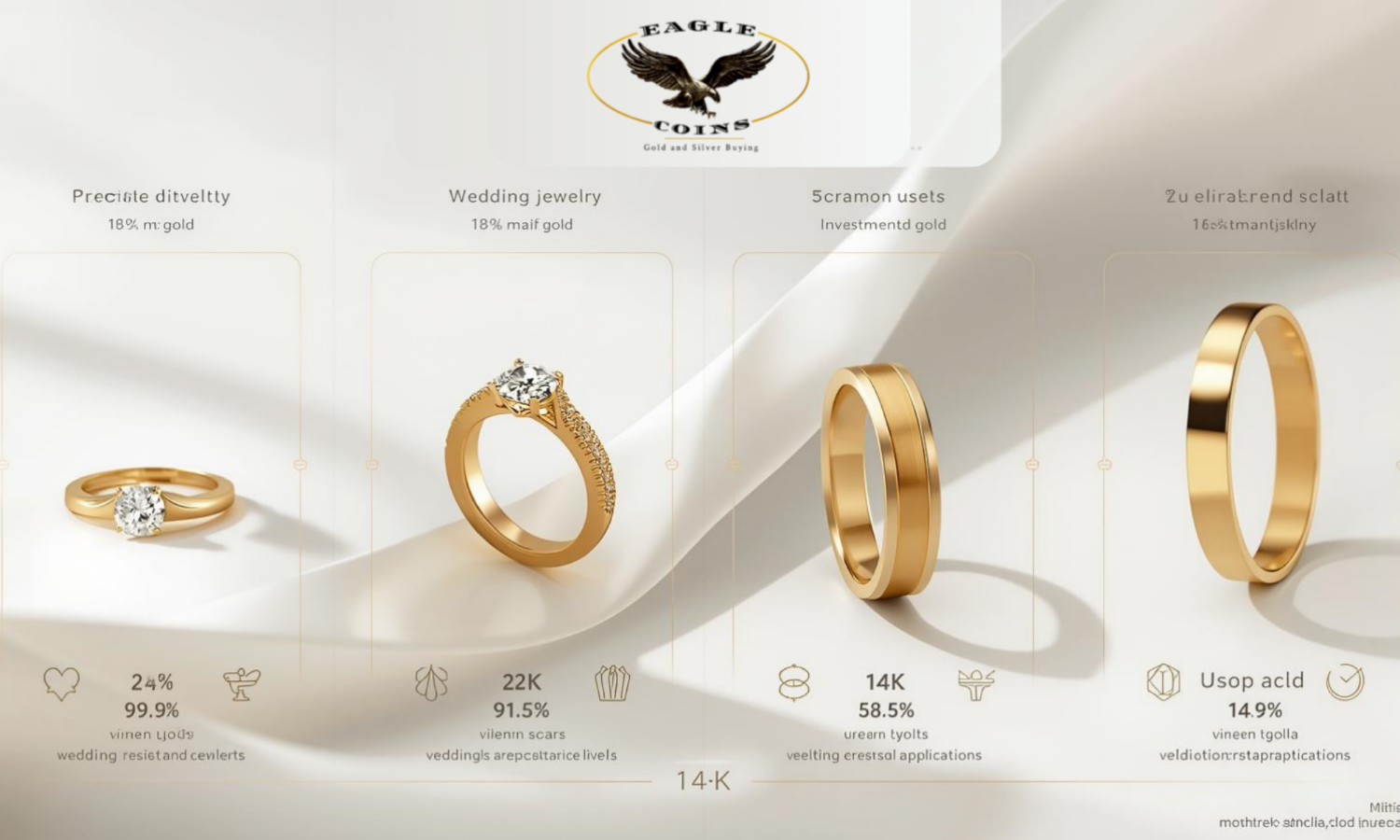
Quick answer: 24k gold is 99.9% pure with no alloy metals, while lower-karat gold mixes in copper, silver, or other metals for added strength. The tradeoff: 24k gold is the softest and most valuable by weight, while 18k and 14k gold are far more durable for everyday jewelry. Lower karat isn’t worse — it’s built for a different job.
24K vs. 22K vs. 18K Gold: Purity and Durability Compared
| Karat | Purity % | Durability | Common Uses | Typical Resale Value |
|---|---|---|---|---|
| 24K | 99.9%+ | Soft, scratches and bends easily | Investment bars, coins, bullion | Highest value per gram; tracks spot price closely |
| 22K | ~91.6% | Soft to moderate | Occasional-wear jewelry, coins, some investment pieces | High value; slightly below 24K per gram |
| 18K | 75% | Durable | Fine jewelry, engagement rings, daily wear | Solid resale; below 22K/24K but above 14K |
| 14K | 58.3% | Very durable | Everyday jewelry, rings, chains | Moderate resale; most common in US retail jewelry |
| 10K | 41.7% | Most durable | Budget jewelry, rings for heavy daily wear | Lowest resale of common karats; US legal minimum |
Your gold jewelry isn’t merely an ornament crafted to be worn. Going above being an adornment, it is a timeless symbol of value, heritage, and security. More than that, the true value of gold jewelry is not in its glittering appearance, but in the amount of pure gold that it holds. So, it becomes more of an investment.
However, have you ever wondered what is hidden beneath? Is 24 karat gold pure gold? How come we have varying shades of gold when raw gold in itself is yellow? Gold’s karatage and color reveal a lot about it, more than the enduring allure and its intrinsic qualities, to its cultural and economic significance. Each color and every karat come with a particular specification that lies behind the value of your gold, and that is what we will be talking about in this blog. So if you are thinking of selling your gold, do read this blog before you sell.
Understanding Gold Purity: Karat and Fineness
The purity of gold is expressed in karats, which is a 24-part scale. This scale measures the parts of gold in a total of 24 parts. In a more precise scale called fineness, the amount of gold is measured in parts per thousand.
Now, if the karat system measures gold in 24 parts, is 24 karat gold pure gold? Yes, it is. 24 karat suggests that all 24 parts consist of gold, meaning it is pure. In the scale of fineness, this corresponds to 999 parts being gold, meaning it is nearly pure. Subsequently, as the karats decrease, so does the purity of the gold. Say, for example, 22k gold, which contains around 91.6% pure gold and 8.4% of other metals, or 22 parts of gold and 2 parts of other metals.
| Karat (K) | Gold Percentage (%) | Gold (Parts per 24) | Typical Alloy Metals | Common Colours Available |
|---|---|---|---|---|
| 24K Gold | 99.9% – 100% | 24/24 | Very minimal traces of other elements | Yellow only |
| 22K Gold | ~91.6% | 22/24 | Silver, Copper, Zinc | Yellow |
| 21K Gold | ~87.5% | 21/24 | Copper, Silver, Zinc | Yellow |
| 18K Gold | 75% | 18/24 | Copper, Silver, Zinc, Nickel, Palladium | Yellow, White, Rose |
| 14K Gold | 58.3% | 14/24 | Copper, Silver, Nickel, Zinc, Palladium | Yellow, White, Rose |
| 10K Gold | 41.7% | 10/24 | Copper, Silver, Nickel, Zinc | Yellow, White, Rose |
| 9K Gold | 37.5% | 9/24 | Copper, Silver, Zinc, Nickel | Yellow, White, Rose |
This ratio varies according to the gold karatage and color. The percentage of other metals also changes as the karat increases or decreases, or the color changes.
How is the Color of Gold Important
The color of gold is achieved by the percentage of other metals added. For example, yellow gold contains silver, copper, and zinc (in the case of 22k gold). However, the amount of silver is more than that of copper and zinc to give it its natural yellow hue. On the other hand, rose gold gets its pink color from a higher percentage of copper. Finally, white gold is crafted by alloying pure gold with palladium and silver and is plated with rhodium. As the percentage of other metals changes, so does the appearance of gold.
The following table will help you understand the concept of color and purity metal percentage better:
| Gold Colour | Gold Base (Example: 18K) | Alloy Metal Mix (Approx.) | Characteristics |
|---|---|---|---|
| Yellow Gold | 75% gold | 12.5% Copper + 12.5% Silver | Closest appearance to natural gold tone |
| White Gold | 75% gold | 25% Palladium / Nickel / Silver | Often rhodium-plated for bright white finish |
| Rose Gold | 75% gold | 22.25% Copper + 2.75% Silver | Warm pink tone due to high copper content |
| Green Gold | 75% gold | 25% Silver | Subtle greenish tint used in specialty jewellery |
Is 24 Karat Gold Pure Gold? Reality Behind the Term
According to the karat system, 24k gold is pure gold. When divided into 24 parts, it contains all 24 parts of gold and so is considered the highest standard of gold. However, in terms of fineness, it contains 999 parts of gold only. So to say, it is almost pure but not 100% pure, which is practically impossible, as even after the mining and processing of gold, some traces of other metals might be left. Which means you can only have 999 parts or as many as 999.9 parts of gold, not a complete 1000.
Considering this, 24k gold is considered pure gold for making bars, coins, and bullion. However, in reality, 24k gold will always have a minute and negligible fraction of other metals and impurities, which are ignored in practice and do not have much effect.
Why Purity Matters — For Investment, Resale, and Jewellery Value
As regards the investment and resale value, 24k is highly acceptable and valuable. This owes to the fact that 24k gold has the highest amount of gold, as per the accepted scale and standard. As the karat number reduces, so does its value, because the value would be calculated on the total percentage of pure gold. So, if you are buying gold for investment or resale purposes, it is better to purchase gold of higher karatage, preferably 24k.
However, if you are purchasing gold for jewelry, 24k wouldn’t be preferable. If it is for daily wear, then even 22k gold jewelry should not be bought. Gold in its purest form is very soft and can easily bend or scratch. In fact, 24k gold is not used for jewelry making. It’s ideal to go for 18k or 14k for jewelry, and choose 22k gold only for occasional wear and investment purposes.
However, be cautious while you are purchasing lower karats of gold, as gold up to a minimum karat is accepted in certain places. In the US, 10k is the minimum legal acceptable gold standard; in France, the UK, Austria, Portugal, and Ireland, it is 9k, and in Denmark and Greece, it is 8k. So, if you go to sell gold of lower karatage in these countries, you wouldn’t be able to sell it.
Which Rolex Models Hold Value Best on Resale?
Steel sports models, the Submariner, GMT-Master II, and Daytona, are well known for holding or exceeding retail value, driven by limited allocation and high demand. Among the more accessible entry-level models covered above, the Datejust and Oyster Perpetual also hold value reasonably well over time, since they’re not tied to the trend-driven price swings that affect rarer sports models.
Which gold karat is best for jewelry vs. investment?
| Goal | Best Karat | Why |
|---|---|---|
| Everyday jewelry (rings, bracelets) | 14K or 18K | Alloy metals add durability for daily wear |
| Fine or special-occasion jewelry | 18K | Balances purity, color options, and strength |
| Investment (coins, bars) | 24K (or 22K for coins like Krugerrand) | Value tracks gold spot price directly, with no alloy dilution |
| Wedding bands (decades of daily wear) | 14K | Most resistant to scratching and bending over time |
How This Affects Buyers & Sellers: Final Thoughts
Is 24 karat pure gold? Yes, it is by the accepted standards; however, the value it has depends on its intended use. As a seller, 24k gold has immense value for you; you can earn the maximum possible amount by selling it, based on the given day’s market value for gold and the total quantity of gold you have. However, as a buyer, unless you are not buying it for investment purposes, 24k gold doesn’t hold much value for you. If your intended use is for making jewelry, then it won’t be of much use. It is better to go for 22k, 20k, 18k, or 14k. The lower value of karatage holds the charm of gold and durability, regardless of its color.
If you have 24k gold bullions, old jewelry, coins, or any kind of damaged and broken gold, we will offer you the highest prices for them, based on fair evaluation and market prices. Visit our store and get a free evaluation.
Frequently Asked Questions
Which is best, 24k gold or 22k gold?
For investment purposes, 24k gold is the best; however, for jewelry, 22k is an optimal option. As 24k gold is very soft, it cannot be made into jewelry, but owing to its high gold content, it is suitable for investment.
What is the disadvantage of 24k gold?
24k gold is very soft and gets easily dented or scratched, which makes it poor for making jewelry.
What is malleability in terms of gold?
The characteristic of gold that allows it to be drawn into wires is called malleability.
Is 24k gold equal to 916?
24k gold is the purest form of gold available; it amounts to 999 gold. 916 gold is 22k gold, which has 91.6% pure gold, and the rest is composed of other metals.
How to quickly check if your gold is real or fake at home?
Do a float test or a magnet test. Due to its high density, gold will sink to the bottom of the water. Similarly, gold will also not stick to a magnet.
How can I test gold with vinegar?
Real gold does not change color in contact with vinegar. If you put a few drops of vinegar on your gold and it changes color, this means it is fake.
Will gold be valuable in the next hundred years?
Chances are that it will. This owes to the fact that there is a limited supply of gold. One of the things that affects the price of any commodity is the general rule of demand and supply. Since the supply of gold is less than its demand, gold will still be valuable in the next 100 years.
What reacts badly with gold?
Chlorine can react badly with gold. It breaks the alloy, making your jewelry brittle and breakable.