Diamond Ring Buyer: What to Expect When You Sell

When you sell a diamond ring, a buyer will look at details such as the diamond’s cut, color, clarity, and carat, along with the precious metal in the ring. Current market prices also matter when an offer is made. An in-person evaluation can help you understand the value of your ring before you decide whether to sell.

A diamond ring can stay forgotten in your jewelry box for years. Perhaps you stopped wearing it a long time ago. Or maybe it belonged to someone in your family.

When you start thinking about selling it, many questions come to mind.

How much is the ring worth?

What will a buyer look at?

How can you tell whether the offer you receive makes sense?

You may also wonder what it is actually like to sit down with a diamond ring buyer.

The process may seem complicated, but it’s actually very simple. When you visit Eagle Coins Gold and Silver Buying, we examine the diamond and the precious metal, consider the details that affect its value, and make an offer. You can even ask questions along the way!

Once you learn everything you need to know, you can then decide what you want to do with your old diamond ring.

Table of Contents

What Will a Diamond Ring Buyer Look At?

It’s a common belief that the size of the stone gives a diamond ring its value. But that’s not true at all!

Two rings that look almost the same from across the room can still have different values. That’s because a diamond’s cut, color, clarity, and carat all play a part.

This is why looking at your ring and trying to guess its value can only take you so far.

DetailWhat it means
CutHow the diamond’s proportions and facets affect the way it reflects light
ColorHow much color the diamond shows
ClarityThe natural marks or inclusions inside the diamond. Also, if there are blemishes on its surface
CaratThe weight of the diamond
Precious metalThe type, purity, and weight of the metal used in the ring

If you have a diamond grading report, receipt, or original paperwork, bring it along. It can give us useful information about the ring and help us understand what we are evaluating. If you do not have these documents, you can still bring the ring in for an evaluation. Your ring’s setting and metal are important parts of the overall piece, too.

You may know the carat weight or remember what you paid for it. But those details alone will not tell you what someone may offer for the ring today.

The Price You Paid Is Not the Same as Today’s Value

There is an easy mistake to make when selling jewelry.

You remember what you paid for it.

Perhaps you bought the ring ten years ago. Maybe it was an expensive purchase at the time. But the jewelry market does not work that way.

Many people use that old price as a starting point for what they think the ring should be worth now. What they don’t understand is that current market conditions matter when a buyer makes an offer.

And that’s not all! The quality of your diamond matters. The precious metal matters. Other details of the ring can matter as well.

So, if you want to sell diamonds for cash, it is wise to have the actual piece evaluated rather than relying on an old receipt or a price you found for a similar ring online.

When you bring your ring to us, we can examine the piece itself and explain the factors that go into our offer.

Not Every Diamond Ring Looks Brand New

People sometimes assume that an old or damaged ring is not worth bringing in. But that’s just a misconception!

Damage is inevitable. Either you can let your old rings sit in your jewelry box for years, or you can have them evaluated.

At Eagle Coins Gold and Silver Buying, we buy different types of diamond rings, including:

– Engagement and wedding diamond rings

– Solitaire rings

– Halo and multi-stone rings

– Vintage and modern designs

– Broken or damaged diamond rings

– Outdated diamond rings

We also evaluate rings with issues such as scratches, resizing, missing stones, or damaged settings.

So, if you want to sell your old engagement ring, you do not need to make your old ring look brand new before bringing it to us. In fact, it is better to have us examine its actual condition rather than spend money on repairs before you know whether they make sense.

What Happens When You Bring the Ring In?

Selling your diamond ring to us follows a simple process. Here is what you can expect when you visit our Harwich Port store.

Step 1: Bring in your ring and any paperwork.

Bring the diamond ring as it is. If you have a grading report, receipt, or other documents describing the diamond, bring those along, too. They may help us understand its background, but you do not need to rely on paperwork alone.

Step 2: We examine the diamond and the setting.

We look at the diamond’s cut, color, clarity, and carat, along with the ring’s metal and overall condition. If the ring has multiple stones, damage, or a setting that needs attention, we consider all these details during our assessment.

Step 3: We consider the relevant market factors.

The diamond’s characteristics and the precious metal content help us assess the piece. But the current market conditions play a role in the offer we make.

Step 4: We explain our offer.

Once we have evaluated the ring, we will give you an offer. You can ask us questions about our assessment and the factors that influenced the amount.

Step 5: You decide whether to sell.

If you accept our offer, we can complete the purchase and pay you in cash. And if you decide not to sell, you are free to walk away. There is no obligation to accept an offer simply because you brought your ring in for an evaluation.

For someone selling a diamond ring for the first time, knowing these steps can take some of the uncertainty out of the process.

The Federal Trade Commission also offers consumer guidance on diamond quality, grading terminology, and gemstone treatments. You can read their guide to buying diamonds and other gemstones if you want to become familiar with these details before your visit.

Why Sell Diamonds for Cash in Person?

You have probably seen online buyers asking you to ship your jewelry to them or evaluating it based on the description you provide over a chat box or a phone call.

Though it may sound convenient, it’s always best to visit the buyer in person and feel more comfortable as your ring gets evaluated.

When you sell diamonds for cash in person, we evaluate your jewelry, including the diamond ring, in front of you. You can talk to our buying professionals who are evaluating your ring. You can even ask a question when you have one instead of sending the jewelry away and waiting for someone to contact you.

This face-to-face conversation can be especially helpful when you are selling a family ring or a piece you have owned for many years.

A Free Evaluation Can Give You Some Breathing Room

Many people think that they need to make the right decision immediately when they plan to sell diamond jewelry in Harwich Port. But not all diamond ring buyers ask you to take the offer right away.

Eagle Coins Gold and Silver Buying, for instance, offers you a free evaluation and provides you with all the information you need to know the worth of diamond pieces you own. This can be especially useful when you are deciding whether to sell your old engagement ring.

Perhaps you are not even sure that you want to sell it yet. And that is completely fine.

There is a difference between knowing what something may be worth and deciding to sell it. You can do the first without being committed to the second.

Get Your Diamond Ring Evaluated Today!

If you want to sell your old engagement ring, pendant, necklace, bracelet, or loose diamond in Harwich Port, bring it to Eagle Coins Gold and Silver Buying and let our diamond ring buyers take a look.

We will examine your items, consider the details that affect their value, and make an offer. You can ask questions and decide whether you want to sell, without any obligation to accept.

You may decide to sell or keep your ring.

Either way, you will have a clearer idea of what you own and what your next step could be.

Frequently Asked Questions

Q.1 What will a diamond ring buyer check?
We examine the diamond’s cut, color, clarity, and carat, along with the precious metal and the ring’s condition. Available grading documents can also give us some useful information.

Q.2 Can I sell my old engagement ring if it is damaged?
Absolutely. You can bring in broken, damaged, scratched, resized, and outdated diamond rings. Our offer typically depends on the diamond, metal, condition, and other relevant factors.

Q.3 Where can I sell diamond jewelry in Harwich Port?
You can bring your diamond ring, loose diamonds, and other diamond jewelry to Eagle Coins Gold and Silver Buying in Harwich Port, Massachusetts. When you sell diamonds for cash, we first evaluate your items and then make an offer.

Q.4 Can I sell diamonds for cash the same day?
Yes. If you accept our offer, we can complete the purchase and pay you in cash on the spot.
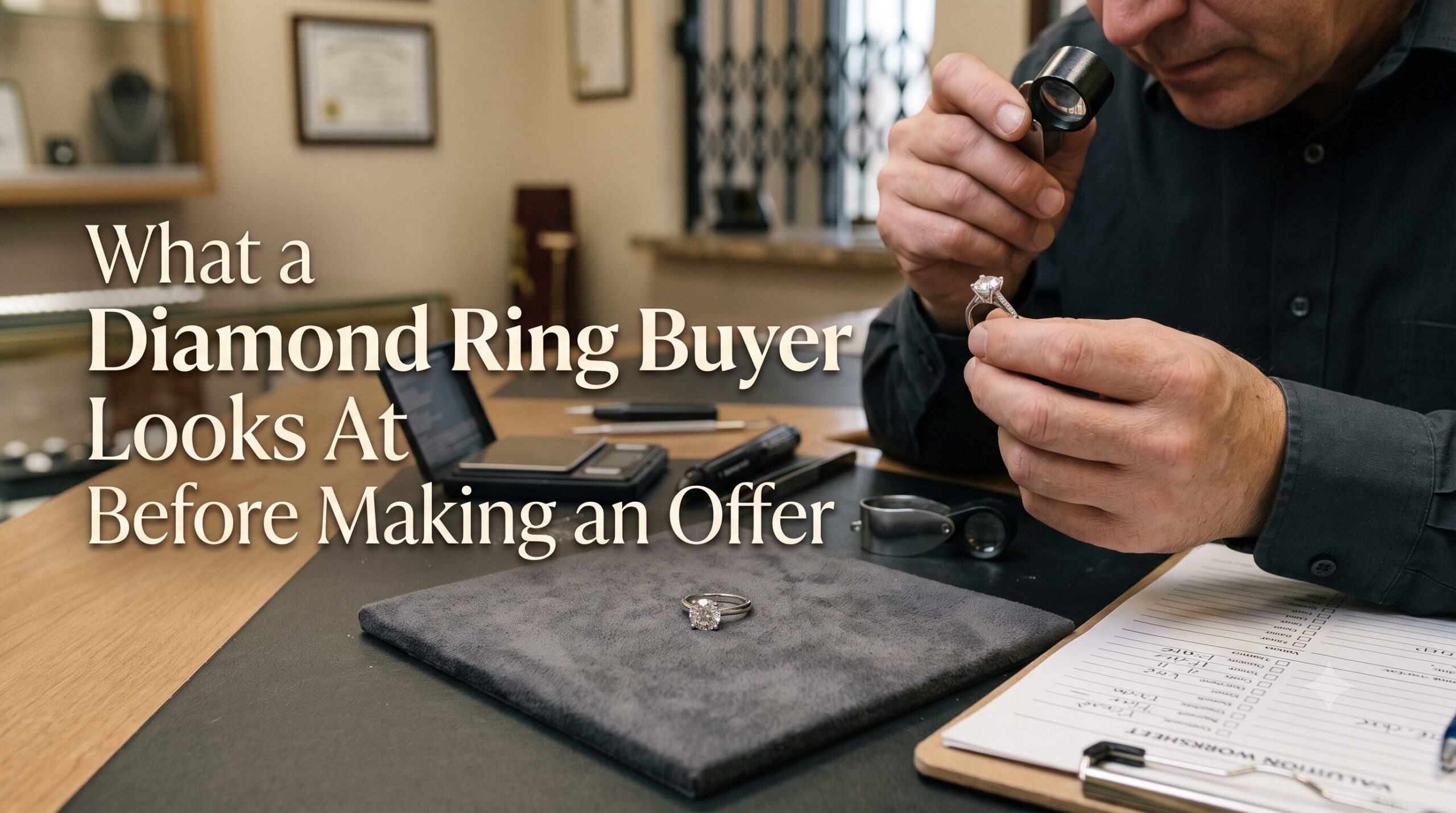
What a Diamond Ring Buyer Looks At Before Making an Offer

A diamond ring buyer assesses the stone and the setting as two separate values. The diamond is graded on cut, color, clarity, and carat weight. The setting is priced based on its metal content, measured in karats and weight. Both figures combine into one offer. The ring’s original retail price does not factor into either number.

The most uncomfortable moment in selling a diamond ring usually arrives about ninety seconds in.

It’s when the seller mentions what the ring cost, and realizes from the pause that the number they’re about to hear is going to be lower. Sometimes substantially.

We’d rather explain why that happens here, in advance, than have it land across a counter. It isn’t a lowball, and it isn’t particular to us. It’s how the diamond resale market works, and understanding it before you walk into any store makes the whole experience easier.

What follows is what actually gets assessed, how the stone and the setting are valued separately, and the questions worth asking whoever you sell to.

Table of Contents

Why the Resale Number Differs From What You Paid

Retail jewelry prices include costs that don’t carry over to resale.

Design work. Brand. Store overhead, staff, insurance, and the months the piece sat in a case. Marketing. Retail margin. When you bought the ring, you paid for all of it. When you sell it, none of it comes back, because the next buyer isn’t buying a retail experience. They’re buying a stone and some metal.

This is true of nearly every diamond ring regardless of where it was purchased, and it’s the single biggest source of disappointment in the transaction. It isn’t a reflection of the ring’s quality or the sincerity of the person who gave it to you.

The useful way to think about it: the ring’s purchase price was what it cost to acquire something meaningful at the time. The resale price is what the materials are worth today. Those were never going to be the same number.

The Stone and the Setting Are Two Separate Values

This surprises people, and it’s the thing most worth understanding.

Your ring is being assessed as two items. The diamond is graded on its own characteristics and priced against the diamond market. The setting is weighed and tested like any other piece of gold or platinum, and priced on metal content against the live metal rate.

The two figures get added together into one offer. They’re reached independently.

That’s why a modest stone in a heavy 18k setting and a better stone in a thin 14k setting can land closer together than their appearance suggests. It’s also why we’ll walk you through both numbers rather than handing you a single figure with no explanation behind it.

How a Diamond Gets Graded

Four characteristics, usually called the 4Cs.

Cut describes how well the stone was shaped and faceted, and it governs how light moves through it. A well-cut diamond returns light to the eye. A poorly cut one leaks it, and looks dull regardless of its other qualities.

Color is graded on how little color is present. The scale runs from colorless downward through increasingly visible warmth.

Clarity describes internal inclusions and surface blemishes. Some are invisible without magnification. Others are visible to the eye and affect both appearance and value.

Carat is weight, not size, though the two correlate within a given shape.

All four get assessed under proper lighting and magnification. This is why an in-person look matters more than a photograph or a description over the phone.

Why Two Identical Carat Weights Price Differently

Here’s the part most sellers don’t expect.

Two diamonds of exactly the same carat weight can be worth very different amounts. A slightly smaller stone with an excellent cut and clean clarity can outprice a larger one with visible inclusions and a poor cut.

Carat weight is the characteristic people remember from the purchase, because it’s the one that got quoted. It’s also the one that tells you the least on its own.

This cuts both ways. Plenty of people arrive expecting a modest number for a stone they think is small, and the cut and clarity turn out to be excellent. The only way to know is to have it looked at properly.

One Thing We Don’t Buy

We don’t buy lab-grown diamonds.

Worth stating plainly, because it saves a trip. Lab-grown stones are physically similar to mined diamonds and are sold as legitimate products, but their resale market behaves very differently from the natural diamond market, and their values don’t hold up as buyers expect based on the retail price.

If you’re not sure which you have, that’s common and nothing to be embarrassed about. Many rings purchased in the last decade are lab-grown, and the paperwork often isn’t kept. We can tell you which you have at no cost, and if it’s lab-grown, we’ll say so rather than making you an offer that wastes your time.

The gold or platinum setting still has metal value either way.

What to Bring When You Sell Diamond Jewelry in Harwich

Any certification you have. A grading report from the original purchase is genuinely useful. Not required, and plenty of rings don’t have one.

The original box or paperwork, if you kept it. Occasionally relevant, particularly on branded pieces.

The ring as it is. Don’t clean it. Don’t have it repaired. Don’t remove the stone. We clean as part of the evaluation, and an amateur repair can reduce value rather than add to it.

Anything else from the same drawer. Diamond jewelry, other rings, chains, watches. Everything gets evaluated in one visit.

Questions Worth Asking Any Diamond Buyer

Whoever you sell to, these five tell you most of what you need to know:

  • Are you pricing the stone and the setting separately, and can I see both figures?
  • What are you grading the stone on, and can I watch?
  • How do you test the metal in the setting?
  • Do you buy lab-grown stones, and can you tell me which mine is?
  • When exactly do I get paid?

A buyer who answers all five plainly is one worth dealing with. A buyer who gives you one number with no breakdown has told you something useful.

Where to Sell Diamonds for Cash on Cape Cod

We’ve been buying diamonds, gold, and silver in Harwich Port for over 40 years, and we’re a BBB Accredited Business. Engagement rings from marriages that ended are a regular part of what comes through the door, and nobody here needs the story unless you feel like telling it.

Every evaluation is free. No appointment is needed. Our 100% satisfaction guarantee covers the transaction, and there’s no pressure to accept anything. People hear the number and take the ring home often enough that it’s unremarkable.

For more details, see our sell diamond ring page or learn more about us. We handle diamond jewelry and loose stones on the same terms.

Come to Unit 1-C, 537 Main Street in Harwich Port, or call +1 508-252-8888 first if you’d rather. Graded while you watch, both figures explained, cash the same visit.

Also clearing out other jewelry? Read about how to sell old gold jewelry you inherited.

Frequently Asked Questions

Q.1 How much is my diamond ring worth?
It depends on the stone’s cut, color, clarity, and carat weight, plus the metal content of the setting. Those are assessed separately and combined. No honest answer exists without seeing the ring.

Q.2 Do I need a certificate to sell a diamond ring?
No. A grading report is helpful if you have one, but we grade the stone ourselves either way.

Q.3 Can I sell an engagement ring from a relationship that ended?
Yes, and it’s common. No explanation is needed, and none will be asked for.

Q.4 Will you buy the ring if the stone is damaged or missing?
Yes. A setting with a missing stone still has metal value, and a chipped diamond may still have value depending on the damage.

Q.5 Do you buy lab-grown diamonds?
No. We’ll identify which type you have at no charge, and the setting still carries metal value regardless.

Lab Grown Diamonds vs Natural Diamonds: Differences in Resale Value

Quick answer: Natural diamonds typically resell for 20–60% of their original purchase price, while lab-grown diamonds typically resell for only 10–40%. The gap comes down to supply: natural diamonds are finite, while lab-grown diamonds can be produced indefinitely, and production costs keep falling each year, pushing resale values down as well.

Diamonds are often viewed as long term assets. Engagement rings, anniversary gifts, and heirloom jewelry tend to carry emotional weight. But when the time comes to resell, the conversation shifts from sentiment to value. And that is where the difference between lab grown and natural diamonds becomes important.

If you have recently started researching how to sell lab grown diamonds, you have probably noticed that resale pricing can look very different from what was paid at retail. That surprise is common. Let’s break down why.

How Much Can You Get When Reselling a Diamond?

Diamond TypeTypical Resale % of Original PriceWhy
Natural diamond~20–60%Finite supply and established resale market support stronger value retention
Lab-grown diamond~10–40%Rapidly falling production costs and increasing supply can put downward pressure on resale value

First, the Core Difference

Natural diamonds are formed underground over billions of years under intense heat and pressure. Lab grown diamonds are created in controlled environments using advanced technology that mimics those natural conditions.

Chemically and visually, they are nearly identical. Most people cannot tell the difference without specialized equipment. In fact, even jewelers rely on proper testing tools.

So at first glance, you might assume resale value would be similar.

It usually is not.

Supply and Perception Matter

Here is the simple economics behind it. Natural diamonds are finite. They require mining, and supply is restricted by geography and production capacity.

Lab grown diamonds, however, can be produced when demand calls for them. Technology continues improving. Production costs have dropped over the years.

Think about it like limited edition artwork versus high quality prints. Both may look the same on a wall, but scarcity drives long term perception of value.

That perception plays a major role in resale pricing.

Why Natural Diamonds Tend to Hold Value Better

Natural diamonds typically maintain more stable resale value because:

  • They are limited in supply
  • They have long standing market demand
  • Collectors and traditional buyers prefer mined stones

That does not mean you recover full retail value. Most diamonds of any kind resell below retail pricing. Retail includes branding, overhead, and markup.

However, natural stones generally retain more market consistency.

Lab Grown Diamonds and Market Depreciation

Lab grown diamonds have experienced significant price drops at retail over the past few years. As production scales up, wholesale prices decrease.

For resale, that affects value directly.

If you paid premium pricing for a lab grown stone five years ago, today’s secondary market price may reflect current production costs rather than original purchase price.

This is usually the biggest shock for sellers researching how to sell lab grown diamonds.

It is not about quality. It is about market supply.

Certification and Documentation Still Matter

Both natural and lab diamonds benefit from proper documentation. Grading reports indicating carat weight, clarity, cut, and color can influence resale interest.

Larger stones in higher grades tend to perform better regardless of origin. Small accent stones rarely add significant resale value in either category.

Documentation provides credibility during evaluation. Still, market demand ultimately shapes pricing.

Gold Setting Still Counts

Often sellers focus only on the diamond and forget about the gold.

When selling a ring, the metal content has intrinsic value. A 14K or 18K band contributes measurable worth based on weight and current gold pricing.

At Eagle Coins Gold and Silver Buying both components are evaluated separately. The gold content follows real time market pricing, while the diamond is assessed based on size, grading, and demand.

That combined approach gives sellers clarity about where their value truly lies.

A Realistic Example

Imagine two one carat diamonds. Same clarity. Same color grade. One natural. One lab grown.

At retail, the lab stone likely cost significantly less. At resale, the difference remains noticeable. The natural stone may command stronger buyer interest due to traditional market demand.

The lab stone may still hold value, but not at the same proportion.

It is a bit like a luxury car. The resale market does not reflect original showroom pricing. It reflects what buyers are currently willing to pay.

Emotional Versus Financial Value

Diamonds carry emotional history. Engagement rings especially. That emotional value does not always align with resale pricing.

Sellers should separate sentiment from market reality. Knowing the market landscape helps avoid disappointment.

When evaluating resale options, transparency matters more than assumptions.

How to Approach Selling Lab Grown Diamonds

If you are exploring how to sell lab grown diamonds, keep these practical points in mind:

  • Bring any grading documentation
  • Understand current retail pricing trends
  • Be realistic about depreciation
  • Consider the gold value separately

Lab diamonds still have resale markets. The key is setting expectations correctly.

Avoid quick decisions based purely on online estimates. In person evaluation gives better clarity.

Transparency Makes the Difference

Resale pricing should not be a mystery. Testing, weighing, and explaining each component allows sellers to understand the numbers clearly.

At Eagle Coins Gold and Silver Buying the evaluation process breaks down metal value and diamond value step by step. That straightforward explanation often helps sellers feel more comfortable about their decision.

There is no one size fits all answer. Every stone and setting is slightly different.

Conclusion

Lab grown and natural diamonds may look identical, but resale value differs due to supply, market perception, and long term demand. Natural diamonds typically maintain stronger resale stability because of their finite supply and traditional market preference. Lab grown diamonds tend to depreciate more as production increases and prices adjust.

If you are researching how to sell lab grown diamonds, the most important step is obtaining an honest and transparent evaluation. Understanding the real market factors allows you to make a decision based on facts rather than assumptions. And in precious metals and diamonds, clarity is everything.

Frequently Asked Questions

Do lab-grown diamonds have resale value?

Yes, but typically much less than natural diamonds, lab-grown diamonds generally resell for 10–40% of their original purchase price, compared to 20–60% for natural diamonds of similar quality.

Do natural diamonds hold their value better than lab-grown diamonds?

Yes. Natural diamonds benefit from a finite supply and an established resale market, which supports stronger value retention. Lab-grown diamonds can be produced indefinitely, and their production costs continue to fall, which pushes resale values down over time.

What’s the resale value difference between lab-grown and natural diamonds?

On a similar-quality stone, a natural diamond will typically retain roughly double the resale percentage of a comparable lab-grown diamond. The dollar gap can be significant on larger stones, even though the percentage gap looks smaller on paper.

How to Identify a Raw Diamond: Geological Clues, Field Tests, and Professional Verification

Diamonds in their natural state are very different in appearance from what they look like after being polished and set in jewelry. Before the cutting and faceting takes place, raw diamonds look much similar to cloudy quartz and river stones. Learning how to identify a raw diamond means you have to understand its unique physical properties, geological context, and the diagnostic tests to be conducted so that the raw gemstone can be differentiated from other similar minerals.

But how will you learn the factors of differentiating? Read on as we cover everything in this blog, and who knows, by the end, you too might become an expert!

Where-Raw-Diamonds-Are-Found

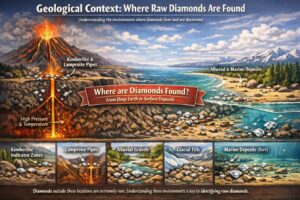
Geological Context: Where Raw Diamonds Are Found

Diamonds are formed deep in the Earth’s mantle, where the pressure and temperature levels are extremely high. When volcanic eruptions occur, they transport these diamonds towards the surface of Earth through volcanic pipes, also known as kimberlite or lamproite structures. With time, as the deposits above erode, the diamonds are released into alluvial or placer environments, such as beaches and riverbeds.

Some of the most common diamond locations include:

  • Kimberlite indicator zones
  • Lamproite pipes
  • Alluvial gravels
  • Glacial tills in diamond-bearing regions
  • Marine deposits (rare but possible)

Diamonds outside these geological locations would be highly uncommon, and so it becomes necessary to understand where you might find diamonds and their formation process. This is the first step to learning how to identify a raw diamond.

Physical-and-Visual-Characteristics-of-Raw-Diamonds

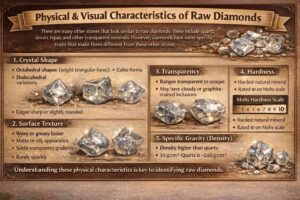
Physical and Visual Characteristics of Raw Diamonds

There are many other stones that look similar to raw diamonds; these include quartz, zircon, topaz, and other transparent minerals. However, diamonds have some specific traits that make them different from these other stones.

1. Crystal Shape

Diamonds naturally form in:

  • Octahedral shapes (eight triangular faces)
  • Cubic forms
  • Dodecahedral variations

The edges of a raw diamond would be sharp or slightly rounded. While stones like quartz form hexagonal prisms with pointed terminations.

2. Surface Texture

Unpolished diamonds often have:

  • Waxy or greasy luster
  • Matte or oily appearance
  • Subtle transparency gradients

They do rarely show the sparkle commonly seen in cut stones.

3. Transparency

The transparency of raw diamonds ranges from transparent to opaque. Some may even have inclusions, which make them appear cloudy or graphite-stained.

4. Hardness

Diamonds are considered one of the hardest natural materials, having a measure of 10 on the Mohs scale. Although hardness is not proof of being a diamond, it rules out the possibility of being one of the softer lookalikes.

5. Specific Gravity (Density)

The density of diamonds is higher than that of quartz. Diamond has a density of ~3.5 g/cm³, whereas quartz has a density of ~2.65 g/cm³. This is one of the most important physical tests for clarifying whether the stone is a diamond or not.

Field Tests to Differentiate Raw Diamonds

For individuals who are curious about knowing how to identify a raw diamond, performing some simple at-home field tests can be a suitable way to know whether the diamond is real or not. Although none of these tests are completely conclusive, getting positive results in a combination of these tests will help in increasing the confidence that the stone is real.

  • Hardness Scratch Test

Diamond is able to scratch glass or quartz with ease. However, there are many other minerals that can scratch glass. Make sure that you do not use this for jewelry-quality stones, as there is a huge risk of damage.

  • Fog (Breath) Test

Diamonds can dissipate heat rapidly, so when breathed on, the condensation will disappear almost instantly, taking at most 1 second. On the other hand, fog would linger on glass or quartz for several seconds.

  • Grease Test

Diamonds have an affinity for grease and oil. When put together in slurry samples, diamonds would stick to the greasy surface, whereas any other transparent mineral would easily wash away.

  • Transparency Test

Diamond offers high refraction, so if you place it over printed text, it will be blurred, making you unable to see or read it. However, that is not the case with quartz or glass, and it may allow readable text up to a limit. Also, keep in mind that this would work better for cleaner stones.

  • UV Fluorescence

Certain diamond pieces will fluoresce blue under UV light. While this may not be universal, it helps in supporting the identification of a little.

Advanced Diagnostic Methods Used by Professionals

Our next step in understanding how to identify a raw diamond is to confirm the results with a gemologist. They used specialized tests to understand whether the stone is a diamond or not. Let’s discuss each of them in brief:

  1. Thermal Conductivity Test: Gemologists and diamond testers measure the thermal conductivity. As diamonds generally dissipate heat rapidly, unlike cubic zirconia or quartz, this is an important test.
  2. Electrical Conductivity: The electrical conductivity of natural diamonds and moissanite is different. This becomes a powerful indicator of differentiation.
  3. Refractive Index (RI): Diamonds have a high RI of ~2.42. Using a refractometer, this can be analyzed. This is why diamonds shine brilliantly after being cut.
  4. Microscopic Inclusion Analysis: The inclusions differ. Where natural diamonds have inclusions such as graphite, garnet crystals, and metallic iron-nickel sulfides, the inclusions in stones like quartz would typically be fluid or gas inclusions.

Using these methods, gemologists and professionals are able to determine whether your specimen is actually a diamond or not.

Common Minerals Mistaken for Raw Diamonds

While learning how to identify a raw diamond, there are certain stones that will appear as impostors. Here are some common characteristics of each of these transparent stones that will help you identify them:

  • Quartz: Clear hexagonal crystals with glassy luster
  • Calcite: Softer, reacts with acid, shows rhombohedral cleavage
  • Topaz: Transparent, harder than quartz, distinct cleavage
  • Zircon: High density but different crystal habit
  • Moissanite: Similar hardness but different conductivity

Misidentification is fairly common in the location of extraction, whether in riverbeds or mining locations. The chances of finding quartz here are also quite high. Knowing how to identify a raw diamond can help you avoid being ripped off.

When to Seek Professional Evaluation

Now, if your stone has passed all the preliminary tests, a professional evaluation becomes necessary. This will ensure that you have proof in case you plan to sell diamond in the future. A gemologist provides you with the following documents for validation:

  • Laboratory reports
  • Grading certificates
  • Authentication for resale

Having professional validation documents is necessary, as they become important for verification in gemstone markets, auctions, and investment contexts.

Conclusion

Understanding how to identify a raw diamond also involves knowing the geological and physical aspects, the basic field tests, and professional diagnostics, and finally, combining them together. Although raw diamonds may look ordinary at a single glance, their properties, like their unique hardness, crystal geometry, luster, and thermal conductivity, set them apart from other similar stones. For serious collectors, prospectors, and jewelry buyers, having a professional confirmation becomes necessary and is the most reliable way of establishing the authenticity and value of the stone.

FAQs

  • How to identify a raw diamond in the field?

    Check geological context, crystal shape (octahedral or cubic), hardness, and greasy luster, then use basic tests like fog or scratch tests.


  • Can a raw diamond scratch glass?

    Yes, diamonds can scratch glass, but so can other hard minerals. Therefore, the scratch test alone is not conclusive.


  • What does a raw diamond look like?

    Natural diamonds may be transparent, cloudy, or opaque with octahedral shapes and greasy or waxy surface textures.


  • Can quartz be mistaken for a diamond?

    Yes, quartz is the most common mineral mistaken for diamond, but it has different crystal shapes, luster, and lower density.


  • Should I get a suspected raw diamond tested professionally?

    Yes, professional gemological verification provides accurate confirmation using thermal, electrical, and optical instruments.

How to Tell If a Diamond Is Real Without a Jeweler?

Quick Answer: A few home tests can give you a good indication: real diamonds fog up and clear almost instantly when you breathe on them, sink quickly in water, and show sharp white sparkle rather than an overly rainbow effect. None of these tests are fully conclusive on their own; a professional evaluation with proper equipment is the only way to be certain.

Comparison: How to Test a Diamond at Home

TestWhat to DoWhat It Tells You
Fog testBreathe on the stone like fogging a mirrorReal diamonds clear almost instantly; fakes stay fogged longer.
Water testDrop the loose stone into a glass of waterReal diamonds sink quickly due to high density; many fakes float or sink slowly.
Sparkle checkLook at the stone under direct lightReal diamonds show sharp white brilliance with some colored flashes; fakes often look overly rainbow-colored or dull.
Edge and facet checkExamine facet edges under magnificationReal diamonds have sharp, clean facet edges; fakes often show rounded or worn edges.
Setting checkLook at what metal it’s mounted inGenuine diamonds are almost always set in real gold or platinum, not base metal or plated settings.


Diamond is valued due to its beauty, durability, and long-term value. Whether you’ve inherited a piece of jewelry, found an old ring at home, or simply want to know how to tell if a diamond is real without immediately visiting a jeweler. Although professional testing provides the most accurate results, there are a number of practical ways to identify key signs of a real diamond with simple at-home methods. 

This guide explains reliable techniques that you might attempt on your own, along with important limitations to keep in mind, so that you can make informed decisions about your jewelry. 

Why It’s Important to Know If a Diamond Is Real

Understanding whether a diamond is real will help you: 

  • Ascertain its potential value
  • Avoid being misled during the sale or purchase of jewelry
  • Determine whether a professional appraisal is worthwhile
  • Protect sentimental and financial investments

Buyers and evaluators like Eagle Coins Gold and Silver Buying tend to emphasize the need to educate first before making any decision involving precious items. 

Start With a Close Visual Inspection

Among the simplest ways of starting to learn about how to tell if a diamond is real is by carefully looking at it under good light.

  • Check the sparkle: The light reflects differently on real diamonds as compared to imitation stones. They give out a sharp, white sparkling effect along with subtle flashes of color. Fake stones are either excessively rainbow-like or dull.
  • Look for inclusions: The majority of natural diamonds have tiny imperfections. With the help of a magnifying glass or a loupe, examine the internal parts of the stone, searching for tiny dots, lines, or cloudiness. A perfectly flawless stone may represent an artificial or imitation gem. 
  • Inspect the edges and facets: Diamond facets are sharp and clean. If there are rounded or worn edges, it may suggest glass or another softer material. 


The Fog Test

This is one of the most popular and harmless tests.

  • Hold the stone close to your mouth
  • Breathe on it to create fog
  • Observe how quickly the fog disappears

If the fog persists, the stone may not be genuine. A real diamond disperses heat instantly, causing the fog to vanish almost instantly.


The Water Test

This basic test involves the use of density to help determine authenticity.

  • Fill a glass with water
  • Drop the loose stone into the glass

The real diamonds are dense and get submerged at the bottom. Stones that float or fall slowly are usually imitations. This test is the most effective for loose stones, not on the jewelry that is mounted.


Examine the Setting and Metal

The type of metal used can offer helpful clues.

  • Look for markings such as 10K, 14K, 18K, or PT (platinum)
  • Authentic diamonds are normally placed in high-quality metals

When the metal appears of low quality or has no markings, it does not necessarily mean that the stone is a fake, but it could be something to ask more questions.


The Text or Newspaper Test

This test is done to test how light passes through the stone.

  • Place the diamond flat-side down on printed text
  • Try to read the letters through it

If you can clearly read the text, the stone is likely not a real diamond. Authentic diamonds refract the light so strongly that the text appears to be blurred or invisible. 


UV Light Observation

Certain diamonds respond to the ultraviolet (UV) light.

  • Shine a UV light on the stone
  • Observe any glow

Many real diamonds give a soft blue fluorescence, though not all do. The intense yellow, green, or no reaction at all does not necessarily mean that the stone is fake, but it may also provide additional evidence. 


Common Diamond Look-Alikes

It is easier to know what you are looking at when you know the alternatives:

  • Cubic Zirconia: It is considerably heavier, quite sparkly, and very clear
  • Moissanite: Strong rainbow flashes and high brilliance
  • Glass or Crystal: Softened edges, bubbles, and dull shine 

Although some of these stones are valuable, they differ significantly from diamonds in terms of durability and resale potential.


Why At-Home Tests Have Limits

Though these means are useful, they are not foolproof. Some more sophisticated simulants and stones are manufactured in the laboratory and can pass simple tests. That is why at-home testing should be considered as a preliminary step rather than a final answer.

Professionals, including those at Eagle Coins Gold and Silver Buying, use specialized tools and experience to verify authenticity in a better manner.


When Professional Verification Is Necessary

You need to get a professional assessment when:

  • Selling or trading jewelry
  • Insuring valuable pieces
  • Checking inherited or antique items
  • You must have certainty rather than estimates

Professional testing includes thermal conductivity equipment, magnification, and professional examination that is way out of the household techniques.


The Value of Knowledge Before Selling or Buying

Knowing how to tell if a diamond is real allows you to ask better questions, understand the red flags and avoid expensive mistakes. Even if you plan to consult a professional, having basic knowledge provides you with confidence and clarity. 

Organizations like Eagle Coins Gold and Silver Buying highlight transparency and education to ensure that people understand their jewelry before making financial decisions. 

FAQs

How do I test if my diamond is real at home?

You can try simple tests like the fog test, water test, or examining the stone under good lighting for sharp edges and natural sparkle. These methods offer clues but are not 100% conclusive.

How do I verify my diamond?

The most reliable way is professional verification using specialized tools such as thermal testers and magnification. A certified evaluation confirms authenticity and quality.

What does a fake diamond look like?

Fake diamonds often appear overly shiny, show excessive rainbow colours, or have rounded edges and visible bubbles. They may also lack natural inclusions.

How to identify a real diamond by eye?

Real diamonds have sharp, well-defined facets and a balanced sparkle with white light and subtle colour flashes. They usually show small imperfections when viewed closely.

Do fake diamonds sparkle more than real diamonds?

Yes, many fake diamonds sparkle more with colourful flashes, while real diamonds produce a cleaner white brilliance with controlled colour dispersion.

How can I tell if a diamond is real without a jeweler?

Try the fog test, water test, and a visual check under good light. Real diamonds clear fog almost instantly, sink quickly in water, and show sharp white brilliance with clean facet edges. These home tests offer useful clues but aren’t fully conclusive on their own.

What’s the fog test for diamonds?

Breathe on the stone the way you’d fog a mirror. A real diamond dissipates heat and clears almost instantly due to its excellent thermal conductivity; simulants like cubic zirconia remain noticeably fogged for longer.

Does a real diamond scratch glass?

Yes, but this test isn’t reliable anymore; some high-quality simulants are now hard enough to scratch glass, too. It was a useful test decades ago; today, professional testing is far more accurate.

Cash for Diamonds – Is Now the Right Time to Sell Your Jewelry?

You probably missed it because it wasn’t front-page news, but the diamond world just had its biggest shake-up since someone first said “diamonds are forever.”

De Beers, the company behind that famous slogan, slashed their rough diamond prices by 15% in August. Not because of some economic crisis or mining disaster. Because they finally admitted what everyone’s been whispering: lab-grown diamonds are eating their lunch.

The same week this happened, Emma Stone showed up at the Venice Film Festival wearing a gorgeous lab-grown diamond necklace. She posted about it on Instagram, telling her 47 million followers she “honestly can’t tell the difference” Between it and mined diamonds. The post got 2.4 million likes.

Then Pandora announced they’re stopping all mined diamond sales by 2026. That’s the world’s biggest jewelry retailer saying mined diamonds are done.

Three massive industry shifts in one week. If you own diamond jewelry, this affects you whether you realize it or not.

So here’s the big question: is now the time to get cash for diamonds, or should you wait this out?

The Psychology Behind What’s Happening

This isn’t really about diamonds. It’s about what diamonds mean to people, and that’s changing fast.

Your grandmother’s generation saw diamonds as symbols of eternal love and social status. They saved for months to buy them, treasured them, passed them down. The bigger and more expensive, the better.

But walk into any coffee shop and listen to twentysomethings talk about engagement rings. They’re asking questions their grandparents never considered: “Where did this diamond come from? Who got hurt mining it? Why am I spending three months’ salary on a rock when I could put that toward a house?”

Younger consumers actually prefer lab-grown diamonds now, and not just because they’re cheaper. They think they’re more authentic because they align with their values.

This creates a weird situation for cash for diamonds sellers. If you’re trying to sell to someone over 50, they might still pay premium prices for natural stones. But if you’re dealing with younger buyers, they might not see the value at all.

Emma Stone’s Instagram post matters because she’s normalizing something that would have been scandalous ten years ago: admitting you can’t tell lab-grown from natural diamonds. When celebrities say this stuff publicly, it changes how everyone thinks about diamond value.

The Numbers Tell the Story

Here’s what’s actually happening to diamond prices, not the marketing spin you get from jewelry stores.

Lab-grown diamond prices have dropped 70-80% since 2020. A lab-grown stone that cost $2,000 in 2020 sells for $400-600 today. They’re becoming commodity items, like flat-screen TVs or smartphones.

Natural diamond prices are holding better, but they’re not immune. The pressure is real, especially for smaller, lower-quality stones that compete directly with lab-grown alternatives.

Russia complicates everything because they produce about 30% of the world’s diamonds. Sanctions mean less supply, which should support prices. But if demand keeps shifting to lab-grown stones, supply shortages don’t matter as much.

The result? Natural diamonds are splitting into two markets: premium stones for traditional luxury buyers, and everything else competing with lab-grown alternatives on price.

Why Location Matters More Than You Think?

Where you try to get cash for diamonds makes a huge difference, and not just because of local competition.

Big coastal cities still have buyers who understand and value natural diamonds. Boston, New York, San Francisco – these places have established wealthy populations who grew up with traditional luxury values. They’ll pay premiums for quality natural stones because they still see them as status symbols and investments.

Smaller markets often show more price sensitivity. Lab-grown adoption happened faster there because people were more focused on getting a beautiful stone for less money than maintaining traditional prestige.

Cape Cod sits in an interesting spot. Our summer population includes plenty of old money families who still prefer natural diamonds. But we also see younger couples choosing lab-grown stones for practical reasons. Understanding which market you’re selling into makes all the difference.

Boston’s jewelry district offers another advantage for high-value pieces. Dealers there have access to traditional luxury consumers and collectors who pay premium prices for quality natural diamonds. For stones worth $5,000 or more, the drive to Boston often pays for itself.

The Technology Factor

Something else has changed: how diamonds get evaluated and sold.

Professional testing equipment can now tell natural from lab-grown diamonds instantly and accurately. No more guesswork, no more conservative estimates from buyers trying to protect themselves. When a buyer knows exactly what they’re looking at, they can offer more aggressive prices.

Blockchain tracking is starting to matter too. Some diamond companies now track stones from mine to retail using permanent digital records. Diamonds with verified ethical sourcing command premiums because buyers can prove they’re conflict-free.

This technology helps legitimate sellers and hurts people trying to pass off synthetic stones as natural. But for honest sellers with quality pieces, it creates opportunities for better pricing.

What This Means for Your Jewelry?

If you’re thinking about getting cash for diamonds right now, the most important question is: what kind of diamonds do you own?

High-quality natural diamonds (1 carat or larger, good cut and clarity, proper certification) are holding value well. There’s still a market of traditional luxury buyers and collectors who want these pieces. GIA certification remains the gold standard, often adding 10-15% to what buyers will pay.

Smaller natural diamonds, especially under half a carat, face more pressure from lab-grown competition. They’re not rare enough to command big premiums, but they’re expensive enough that people consider alternatives.

Lab-grown diamonds should be treated like fashion jewelry, not investments. They depreciate fast and will probably keep dropping in value as production increases and technology improves.

Estate jewelry with historical significance or famous provenance still attracts premium pricing. But generic diamond pieces from chain jewelry stores face the most pressure in today’s market.

Timing Considerations

So is now the right time to sell? Depends on what you own and why you’re selling.

For premium natural diamonds, the market disruption might actually create opportunities. Some sellers are panicking and accepting lower prices, but buyers who understand the traditional luxury market are still paying appropriately for quality pieces.

For fashion jewelry and lower-grade stones, waiting probably doesn’t help. The trend toward lab-grown alternatives seems permanent, not cyclical. If you need the money or don’t have emotional attachment to the pieces, cash for diamonds transactions make sense sooner rather than later.

Cape Cod’s seasonal patterns still matter. Summer wedding season creates demand for diamond jewelry, supporting better pricing from May through September. Fall estate sales temporarily increase supply, often depressing prices until after the holidays.

The Practical Reality

Here’s what we actually see in our shop when people come in with diamond jewelry.

Customers arrive with expectations based on what they paid years ago, not current market conditions. A ring purchased for $3,000 in 2015 might get offers around $800-1,200 today, depending on the stones and setting. That’s not because buyers are trying to rip anyone off – it’s because retail markups were always huge and resale markets are more competitive now.

Certification matters enormously. GIA papers can double what buyers offer because they eliminate uncertainty about quality and authenticity. Uncertified stones get discounted heavily because buyers have to assume the worst about clarity, color, and potential treatments.

Settings add some value, but not as much as people expect. Gold and platinum have their own market values, but elaborate settings often get discounted because they reflect personal taste rather than universal appeal.

The best results come from sellers who understand current market conditions and have realistic expectations about pricing. People who do their homework and get multiple opinions usually capture more value than those who walk into the first jewelry store they find.

Making Your Decision

The diamond market transformation isn’t temporary. Lab-grown technology keeps improving while costs keep falling. Consumer attitudes about ethical sourcing and value are shifting permanently, especially among younger buyers.

This doesn’t mean natural diamonds are worthless. Quality stones with proper certification still appeal to traditional luxury consumers, collectors, and people who value rarity and natural origin.

But it does mean the diamond market is becoming more sophisticated and segmented. Success in getting good cash for diamonds pricing requires understanding which segment your jewelry fits into and finding appropriate buyers.

If you own premium natural diamonds and don’t need immediate cash, you might benefit from waiting for market conditions to stabilize. But if you’re holding lower-grade stones or lab-grown pieces, current market trends suggest sooner is probably better than later.

Ready to Navigate This New Reality?

The diamond world just changed permanently. At Eagle Coins Gold and Silver Buying, we understand both traditional diamond values and how current market shifts affect what your jewelry is actually worth today.

About Eagle Coins Gold and Silver Buying

Eagle Coins Gold and Silver Buying has served Cape Cod for over 40 years, helping customers navigate every major change in precious metals and jewelry markets. We understand that today’s diamond market requires both traditional expertise and current market knowledge.

Legal Disclaimer

Information provided is for educational purposes only and should not be considered financial advice. Eagle Coins operates under all applicable Massachusetts laws governing precious metals dealers.

Your Diamond Selling Checklist: Get Paid More in Boston


Boston has no shortage of places offering cash for diamonds. From high-end jewelers in Back Bay to trusted local buyers in Harwich Port and Cape Cod, there are plenty of options. But if you’ve never sold a diamond before, it can be hard to know what to expect. How much is your diamond worth? Are you getting a fair offer? And how do you make sure you’re working with someone who’s reputable?

We spoke with the team at Eagle Coins Gold and Silver Buying, a Massachusetts-based business with over 40 years of experience in buying diamonds, coins, gold, and silver. They’ve worked with thousands of sellers from Boston and beyond. According to them, these are the things most people don’t know when they walk through the door, but should.

If you’re thinking about turning your jewelry into real value, here’s how to do it the right way.

1. You won’t get retail price, and that’s completely normal

A diamond ring that cost $5,000 at a retail jeweler may only sell for $1,500 or less. That doesn’t mean you’re being cheated. It simply reflects how the resale market works.

Retail prices include brand markups, showroom overhead, warranties, and packaging. Resale prices are based on the actual value of the materials, like the diamond and the setting, and also current demand.

Professionals use tools like the Rapaport Diamond Report to determine wholesale market value. These guides reflect what buyers like Eagle Coins can realistically offer for a diamond in the current economy.

2. Bring your GIA certificate if you have one

The Gemological Institute of America (GIA) is the most respected diamond grading authority. If you have a GIA certificate, bring it with you. It provides accurate details about your diamond’s cut, color, clarity, and carat weight, all of which can help increase the offer.

No certificate? No problem. Most trusted diamond buyers in Boston, including Eagle Coins, offer in-house evaluations and will still give you a fair price based on their assessment.

3. Even flawed or outdated diamonds still have value

Not every diamond needs to be flawless or perfectly cut to have resale potential. You can still get cash for diamonds even if your piece is chipped, broken, or out of style.

Buyers also consider the value of the setting. Gold and platinum can be refined, and even loose stones or single earrings may be worth something.

Eagle Coins frequently purchases pieces others won’t, especially estate jewelry, mismatched sets, and old family items that may no longer suit your taste but still carry value.

4. Boston is a great market for diamonds, but your buyer matters

According to Statista, diamond jewelry sales in the U.S. exceeded $40 billion in 2023. Massachusetts is among the states with the most active resale markets thanks to its mix of urban buyers and antique collectors.

If you’re comparing diamond buyers in Boston, look for:

  • A physical store location
  • Years in business
  • Free, in-person appraisals
  • Transparent offers with no pressure
  • Positive Google and BBB reviews

Eagle Coins, for example, has decades of local trust, an office in Harwich Port, and a simple walk-in process with immediate cash payments.

5. You don’t need to sound like an expert, just bring what you have

Some sellers walk in quoting price charts or online blogs. That’s fine, but what matters more is the actual item you’re selling. Bring whatever paperwork you have, including certificates, receipts, or even the original box.

Don’t stress if you don’t have anything at all. The team at Eagle Coins will evaluate the piece on the spot and explain everything in simple terms.

6. Good questions lead to better experiences

One sign of a trustworthy buyer is how they respond to your questions. Don’t hesitate to ask.

  • How was this offer calculated?
  • What parts of the item added the most value?
  • Would I earn more by separating the diamond from the setting?

The answers will help you understand the process and make a confident decision. And a buyer who is upfront and clear with you is more likely to offer a fair deal.

Eagle Coins encourages sellers to get multiple quotes if needed. They are also known to beat fair local offers and have a strong reputation across Cape Cod and the Boston area.

7. Timing can help, but trust matters more

Diamond prices change based on inflation, supply, and economic demand. Still, the most important decision is who you sell to. A buyer with experience and integrity will give you better value and fewer headaches, regardless of the day.

Eagle Coins updates its pricing regularly based on the market and often pays more than 35 to 40 percent above what many first-time sellers expect.

8. You get cash, not promises

Some buyers make you wait for mailed checks or offer only store credit. At Eagle Coins, sellers receive cash for diamonds right away, with no waiting period.

If you need fast access to funds — whether for an emergency, move, or estate resolution — this matters. It also shows that the buyer has the resources to follow through on their word.

9. The way you treat your buyer makes a difference, too

You don’t have to be overly formal, but a little courtesy goes a long way. Buyers tend to go the extra mile for sellers who are respectful and open to the process.

The team at Eagle Coins takes pride in giving everyone the same professional service, whether you’re selling a solitaire ring or a full estate collection. But just like in any business, a good attitude makes the experience better for everyone.

Thinking about selling your diamond?

Whether you’ve inherited jewelry, decided on a jewelry overhaul, or are simply ready to sell something you no longer wear, the right buyer makes all the difference.

At Eagle Coins Gold and Silver Buying, you’ll find local professionals with real experience and no-pressure offers. We serve sellers throughout Boston, Harwich, Cape Cod, and nearby towns like Brookline, Newton, and Hyannis.

FAQs

1. How much can I expect to get when I sell my diamond in Boston?

Diamond resale prices are typically lower than retail values. A ring bought for $5,000 may resell for $1,500 or less. Offers depend on market demand, diamond quality, and the value of the setting. Trusted buyers like Eagle Coins use industry tools like the Rapaport Diamond Report to ensure fair pricing.

2.Do I need a certificate to sell my diamond?

No, but having a GIA (Gemological Institute of America) certificate can help you get a better offer by confirming your diamond’s quality. Even without paperwork, reputable buyers like Eagle Coins offer in-house evaluations to determine your diamond’s worth.

3.Will buyers accept broken or outdated diamond jewelry?

Yes, many buyers—including Eagle Coins—purchase chipped, outdated, or mismatched pieces. The value of the gold or platinum setting can still contribute to a fair offer, even if the diamond isn’t perfect.

4.What should I look for in a diamond buyer in Boston?

Look for local buyers with physical storefronts, years of experience, free in-person evaluations, and strong customer reviews. Eagle Coins in Harwich Port is known for its transparent offers and immediate cash payments.

5.How fast will I get paid when I sell my diamond?

At Eagle Coins, you receive cash on the spot—no waiting for checks or store credit. This is ideal if you need quick access to funds from inherited jewelry, estate items, or personal pieces you no longer wear.