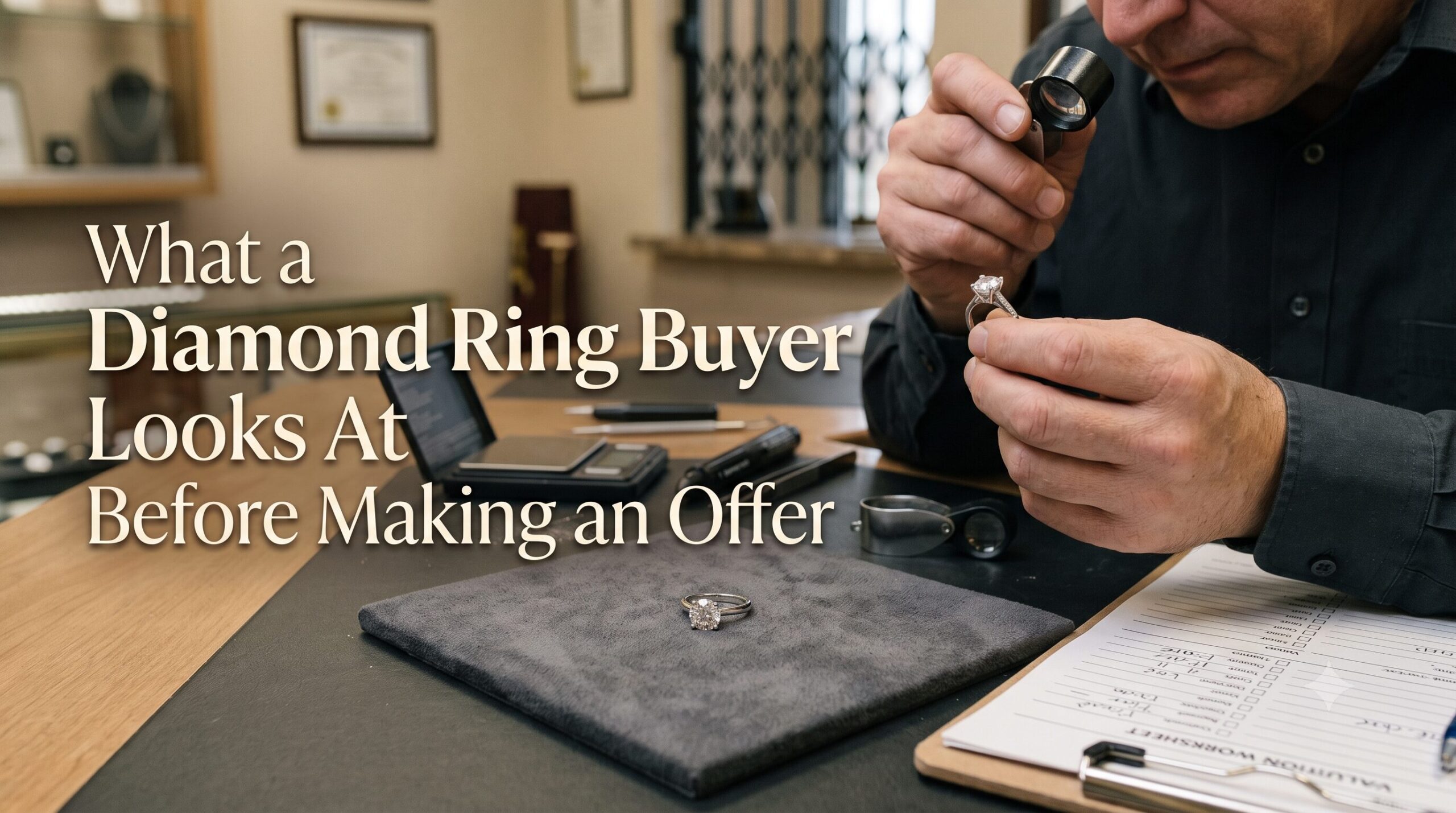
A diamond ring buyer assesses the stone and the setting as two separate values. The diamond is graded on cut, color, clarity, and carat weight. The setting is priced based on its metal content, measured in karats and weight. Both figures combine into one offer. The ring’s original retail price does not factor into either number.
The most uncomfortable moment in selling a diamond ring usually arrives about ninety seconds in.
It’s when the seller mentions what the ring cost, and realizes from the pause that the number they’re about to hear is going to be lower. Sometimes substantially.
We’d rather explain why that happens here, in advance, than have it land across a counter. It isn’t a lowball, and it isn’t particular to us. It’s how the diamond resale market works, and understanding it before you walk into any store makes the whole experience easier.
What follows is what actually gets assessed, how the stone and the setting are valued separately, and the questions worth asking whoever you sell to.
Table of Contents
- Why the Resale Number Differs From What You Paid
- The Stone and the Setting Are Two Separate Values
- How a Diamond Gets Graded
- Why Two Identical Carat Weights Price Differently
- One Thing We Don’t Buy
- What to Bring When You Sell Diamond Jewelry in Harwich
- Questions Worth Asking Any Diamond Buyer
- Where to Sell Diamonds for Cash on Cape Cod
- Frequently Asked Questions
Why the Resale Number Differs From What You Paid
Retail jewelry prices include costs that don’t carry over to resale.
Design work. Brand. Store overhead, staff, insurance, and the months the piece sat in a case. Marketing. Retail margin. When you bought the ring, you paid for all of it. When you sell it, none of it comes back, because the next buyer isn’t buying a retail experience. They’re buying a stone and some metal.
This is true of nearly every diamond ring regardless of where it was purchased, and it’s the single biggest source of disappointment in the transaction. It isn’t a reflection of the ring’s quality or the sincerity of the person who gave it to you.
The useful way to think about it: the ring’s purchase price was what it cost to acquire something meaningful at the time. The resale price is what the materials are worth today. Those were never going to be the same number.
The Stone and the Setting Are Two Separate Values
This surprises people, and it’s the thing most worth understanding.
Your ring is being assessed as two items. The diamond is graded on its own characteristics and priced against the diamond market. The setting is weighed and tested like any other piece of gold or platinum, and priced on metal content against the live metal rate.
The two figures get added together into one offer. They’re reached independently.
That’s why a modest stone in a heavy 18k setting and a better stone in a thin 14k setting can land closer together than their appearance suggests. It’s also why we’ll walk you through both numbers rather than handing you a single figure with no explanation behind it.
How a Diamond Gets Graded
Four characteristics, usually called the 4Cs.
Cut describes how well the stone was shaped and faceted, and it governs how light moves through it. A well-cut diamond returns light to the eye. A poorly cut one leaks it, and looks dull regardless of its other qualities.
Color is graded on how little color is present. The scale runs from colorless downward through increasingly visible warmth.
Clarity describes internal inclusions and surface blemishes. Some are invisible without magnification. Others are visible to the eye and affect both appearance and value.
Carat is weight, not size, though the two correlate within a given shape.
All four get assessed under proper lighting and magnification. This is why an in-person look matters more than a photograph or a description over the phone.
Why Two Identical Carat Weights Price Differently
Here’s the part most sellers don’t expect.
Two diamonds of exactly the same carat weight can be worth very different amounts. A slightly smaller stone with an excellent cut and clean clarity can outprice a larger one with visible inclusions and a poor cut.
Carat weight is the characteristic people remember from the purchase, because it’s the one that got quoted. It’s also the one that tells you the least on its own.
This cuts both ways. Plenty of people arrive expecting a modest number for a stone they think is small, and the cut and clarity turn out to be excellent. The only way to know is to have it looked at properly.
One Thing We Don’t Buy
We don’t buy lab-grown diamonds.
Worth stating plainly, because it saves a trip. Lab-grown stones are physically similar to mined diamonds and are sold as legitimate products, but their resale market behaves very differently from the natural diamond market, and their values don’t hold up as buyers expect based on the retail price.
If you’re not sure which you have, that’s common and nothing to be embarrassed about. Many rings purchased in the last decade are lab-grown, and the paperwork often isn’t kept. We can tell you which you have at no cost, and if it’s lab-grown, we’ll say so rather than making you an offer that wastes your time.
The gold or platinum setting still has metal value either way.
What to Bring When You Sell Diamond Jewelry in Harwich
Any certification you have. A grading report from the original purchase is genuinely useful. Not required, and plenty of rings don’t have one.
The original box or paperwork, if you kept it. Occasionally relevant, particularly on branded pieces.
The ring as it is. Don’t clean it. Don’t have it repaired. Don’t remove the stone. We clean as part of the evaluation, and an amateur repair can reduce value rather than add to it.
Anything else from the same drawer. Diamond jewelry, other rings, chains, watches. Everything gets evaluated in one visit.
Questions Worth Asking Any Diamond Buyer
Whoever you sell to, these five tell you most of what you need to know:
- Are you pricing the stone and the setting separately, and can I see both figures?
- What are you grading the stone on, and can I watch?
- How do you test the metal in the setting?
- Do you buy lab-grown stones, and can you tell me which mine is?
- When exactly do I get paid?
A buyer who answers all five plainly is one worth dealing with. A buyer who gives you one number with no breakdown has told you something useful.
Where to Sell Diamonds for Cash on Cape Cod
We’ve been buying diamonds, gold, and silver in Harwich Port for over 40 years, and we’re a BBB Accredited Business. Engagement rings from marriages that ended are a regular part of what comes through the door, and nobody here needs the story unless you feel like telling it.
Every evaluation is free. No appointment is needed. Our 100% satisfaction guarantee covers the transaction, and there’s no pressure to accept anything. People hear the number and take the ring home often enough that it’s unremarkable.
For more details, see our sell diamond ring page or learn more about us. We handle diamond jewelry and loose stones on the same terms.
Come to Unit 1-C, 537 Main Street in Harwich Port, or call +1 508-252-8888 first if you’d rather. Graded while you watch, both figures explained, cash the same visit.
Also clearing out other jewelry? Read about how to sell old gold jewelry you inherited.
Frequently Asked Questions
Q.1 How much is my diamond ring worth?
It depends on the stone’s cut, color, clarity, and carat weight, plus the metal content of the setting. Those are assessed separately and combined. No honest answer exists without seeing the ring.
Q.2 Do I need a certificate to sell a diamond ring?
No. A grading report is helpful if you have one, but we grade the stone ourselves either way.
Q.3 Can I sell an engagement ring from a relationship that ended?
Yes, and it’s common. No explanation is needed, and none will be asked for.
Q.4 Will you buy the ring if the stone is damaged or missing?
Yes. A setting with a missing stone still has metal value, and a chipped diamond may still have value depending on the damage.
Q.5 Do you buy lab-grown diamonds?
No. We’ll identify which type you have at no charge, and the setting still carries metal value regardless.
 +1 508-252-8888