

Diamonds in their natural state are very different in appearance from what they look like after being polished and set in jewelry. Before the cutting and faceting takes place, raw diamonds look much similar to cloudy quartz and river stones. Learning how to identify a raw diamond means you have to understand its unique physical properties, geological context, and the diagnostic tests to be conducted so that the raw gemstone can be differentiated from other similar minerals.
But how will you learn the factors of differentiating? Read on as we cover everything in this blog, and who knows, by the end, you too might become an expert!
Geological Context: Where Raw Diamonds Are Found
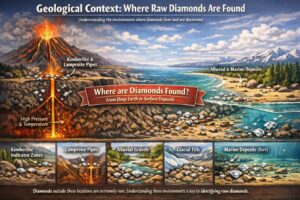
Diamonds are formed deep in the Earth’s mantle, where the pressure and temperature levels are extremely high. When volcanic eruptions occur, they transport these diamonds towards the surface of Earth through volcanic pipes, also known as kimberlite or lamproite structures. With time, as the deposits above erode, the diamonds are released into alluvial or placer environments, such as beaches and riverbeds.
Some of the most common diamond locations include:
- Kimberlite indicator zones
- Lamproite pipes
- Alluvial gravels
- Glacial tills in diamond-bearing regions
- Marine deposits (rare but possible)
Diamonds outside these geological locations would be highly uncommon, and so it becomes necessary to understand where you might find diamonds and their formation process. This is the first step to learning how to identify a raw diamond.
Physical and Visual Characteristics of Raw Diamonds
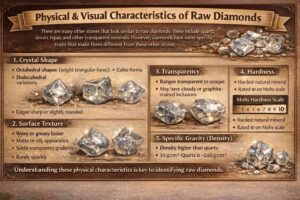
There are many other stones that look similar to raw diamonds; these include quartz, zircon, topaz, and other transparent minerals. However, diamonds have some specific traits that make them different from these other stones.
1. Crystal Shape
Diamonds naturally form in:
- Octahedral shapes (eight triangular faces)
- Cubic forms
- Dodecahedral variations
The edges of a raw diamond would be sharp or slightly rounded. While stones like quartz form hexagonal prisms with pointed terminations.
2. Surface Texture
Unpolished diamonds often have:
- Waxy or greasy luster
- Matte or oily appearance
- Subtle transparency gradients
They do rarely show the sparkle commonly seen in cut stones.
3. Transparency
The transparency of raw diamonds ranges from transparent to opaque. Some may even have inclusions, which make them appear cloudy or graphite-stained.
4. Hardness
Diamonds are considered one of the hardest natural materials, having a measure of 10 on the Mohs scale. Although hardness is not proof of being a diamond, it rules out the possibility of being one of the softer lookalikes.
5. Specific Gravity (Density)
The density of diamonds is higher than that of quartz. Diamond has a density of ~3.5 g/cm³, whereas quartz has a density of ~2.65 g/cm³. This is one of the most important physical tests for clarifying whether the stone is a diamond or not.
Field Tests to Differentiate Raw Diamonds
For individuals who are curious about knowing how to identify a raw diamond, performing some simple at-home field tests can be a suitable way to know whether the diamond is real or not. Although none of these tests are completely conclusive, getting positive results in a combination of these tests will help in increasing the confidence that the stone is real.
Hardness Scratch Test
Diamond is able to scratch glass or quartz with ease. However, there are many other minerals that can scratch glass. Make sure that you do not use this for jewelry-quality stones, as there is a huge risk of damage.
Fog (Breath) Test
Diamonds can dissipate heat rapidly, so when breathed on, the condensation will disappear almost instantly, taking at most 1 second. On the other hand, fog would linger on glass or quartz for several seconds.
Grease Test
Diamonds have an affinity for grease and oil. When put together in slurry samples, diamonds would stick to the greasy surface, whereas any other transparent mineral would easily wash away.
Transparency Test
Diamond offers high refraction, so if you place it over printed text, it will be blurred, making you unable to see or read it. However, that is not the case with quartz or glass, and it may allow readable text up to a limit. Also, keep in mind that this would work better for cleaner stones.
UV Fluorescence
Certain diamond pieces will fluoresce blue under UV light. While this may not be universal, it helps in supporting the identification of a little.
Advanced Diagnostic Methods Used by Professionals
Our next step in understanding how to identify a raw diamond is to confirm the results with a gemologist. They used specialized tests to understand whether the stone is a diamond or not. Let’s discuss each of them in brief:
- Thermal Conductivity Test: Gemologists and diamond testers measure the thermal conductivity. As diamonds generally dissipate heat rapidly, unlike cubic zirconia or quartz, this is an important test.
- Electrical Conductivity: The electrical conductivity of natural diamonds and moissanite is different. This becomes a powerful indicator of differentiation.
- Refractive Index (RI): Diamonds have a high RI of ~2.42. Using a refractometer, this can be analyzed. This is why diamonds shine brilliantly after being cut.
- Microscopic Inclusion Analysis: The inclusions differ. Where natural diamonds have inclusions such as graphite, garnet crystals, and metallic iron-nickel sulfides, the inclusions in stones like quartz would typically be fluid or gas inclusions.
Using these methods, gemologists and professionals are able to determine whether your specimen is actually a diamond or not.
Common Minerals Mistaken for Raw Diamonds
While learning how to identify a raw diamond, there are certain stones that will appear as impostors. Here are some common characteristics of each of these transparent stones that will help you identify them:
- Quartz: Clear hexagonal crystals with glassy luster
- Calcite: Softer, reacts with acid, shows rhombohedral cleavage
- Topaz: Transparent, harder than quartz, distinct cleavage
- Zircon: High density but different crystal habit
- Moissanite: Similar hardness but different conductivity
Misidentification is fairly common in the location of extraction, whether in riverbeds or mining locations. The chances of finding quartz here are also quite high. Knowing how to identify a raw diamond can help you avoid being ripped off.
When to Seek Professional Evaluation
Now, if your stone has passed all the preliminary tests, a professional evaluation becomes necessary. This will ensure that you have proof in case you plan to sell diamond in the future. A gemologist provides you with the following documents for validation:
- Laboratory reports
- Grading certificates
- Authentication for resale
Having professional validation documents is necessary, as they become important for verification in gemstone markets, auctions, and investment contexts.
Conclusion
Understanding how to identify a raw diamond also involves knowing the geological and physical aspects, the basic field tests, and professional diagnostics, and finally, combining them together. Although raw diamonds may look ordinary at a single glance, their properties, like their unique hardness, crystal geometry, luster, and thermal conductivity, set them apart from other similar stones. For serious collectors, prospectors, and jewelry buyers, having a professional confirmation becomes necessary and is the most reliable way of establishing the authenticity and value of the stone.
FAQs
How to identify a raw diamond in the field?
Check geological context, crystal shape (octahedral or cubic), hardness, and greasy luster, then use basic tests like fog or scratch tests.
Can a raw diamond scratch glass?
Yes, diamonds can scratch glass, but so can other hard minerals. Therefore, the scratch test alone is not conclusive.
What does a raw diamond look like?
Natural diamonds may be transparent, cloudy, or opaque with octahedral shapes and greasy or waxy surface textures.
Can quartz be mistaken for a diamond?
Yes, quartz is the most common mineral mistaken for diamond, but it has different crystal shapes, luster, and lower density.
Should I get a suspected raw diamond tested professionally?
Yes, professional gemological verification provides accurate confirmation using thermal, electrical, and optical instruments.

 +1 508-252-8888